Gilchrest’s Sign: Purpose, Technique, Positive Findings, and Clinical Significance
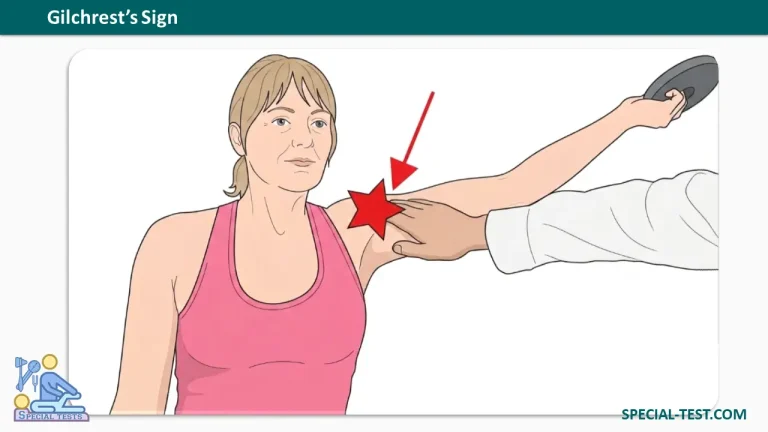
Gilchrest’s sign is a clinical shoulder examination maneuver described for assessing bicipital paratenonitis and biceps tendinosis. The test involves controlled overhead elevation and lowering of the arm while monitoring for pain or snapping in the region of the bicipital groove.
Biceps tendinopathy commonly presents with anterior shoulder pain that may worsen during overhead activities. However, symptoms can overlap with rotator cuff disorders and other causes of shoulder pain, so Gilchrest’s sign should be interpreted alongside the patient’s history and a comprehensive physical examination.
What Is Gilchrest’s Sign Used For?
Gilchrest’s sign is used to assess symptoms potentially associated with:
- Bicipital paratenonitis: Inflammation or irritation involving the tissues surrounding the biceps tendon.
- Biceps tendinosis: Degenerative changes within the tendon, commonly associated with repetitive loading.
- Possible biceps tendon irritation or instability: Particularly when the maneuver produces pain, clicking, or an audible or palpable snap.
The primary anatomical area of interest is the bicipital groove, where the long head of the biceps tendon travels along the anterior humerus.
Clinical note: Evidence validating Gilchrest’s sign specifically is limited in the readily accessible medical literature. A positive result should not be considered diagnostic on its own.
How to Perform Gilchrest’s Sign
Perform the maneuver in a controlled clinical setting, provided the patient can safely move the shoulder through the required range.
- Patient position: Ask the patient to stand upright.
- Equipment: Have the patient hold a weight of approximately 2–3 kg (5–7 lb), as described in traditional accounts of the maneuver.
- Overhead elevation: Ask the patient to raise the weighted arm overhead.
- External rotation: Have the patient externally rotate the arm fully.
- Controlled lowering: Ask the patient to lower the arm to the side in the coronal plane.
- Observe symptoms: Monitor for pain localized to the bicipital groove, discomfort during lowering, or an audible or palpable snap as the arm moves through the range of motion.
Do not force the shoulder into a painful position. The maneuver should be stopped if significant pain occurs.
What Is a Positive Gilchrest’s Sign?
A positive Gilchrest’s sign is traditionally described by one or more of the following findings:
- Pain or discomfort localized to the bicipital groove.
- An audible or palpable snapping sensation during shoulder movement.
- Pain or snapping as the arm passes through approximately 90°–100° of abduction, as reported in descriptions of the test.
These findings may raise suspicion of long-head biceps tendon pathology. Snapping can also occur with tendon instability, while anterior shoulder pain may have several alternative causes.
Clinical Interpretation and Limitations
Gilchrest’s sign should be considered one component of the shoulder examination rather than a standalone diagnostic test.
For a more comprehensive assessment, clinicians may combine the patient’s history with:
- Palpation of the bicipital groove for localized tenderness.
- Speed’s test.
- Yergason’s test.
- The uppercut test.
- Assessment of rotator cuff function and other potential sources of shoulder pain.
Research on proximal biceps tendon examination indicates that combining relevant examination findings may improve clinical assessment, but no single maneuver reliably identifies every case of biceps pathology. Further investigations, such as ultrasound or MRI, may be appropriate when clinically indicated.
Frequently Asked Questions (FAQ)
1. What condition does Gilchrest’s sign assess?
Gilchrest’s sign is traditionally described as a maneuver for assessing bicipital paratenonitis and biceps tendinosis. Pain localized to the bicipital groove may suggest pathology involving the long head of the biceps tendon, but the finding is not diagnostic by itself.
2. Where is pain typically felt during a positive Gilchrest’s sign?
Pain is typically localized to the anterior shoulder over the bicipital groove, where the long head of the biceps tendon passes through the humerus.
3. What does snapping during Gilchrest’s sign indicate?
An audible or palpable snap may suggest biceps tendon irritation or instability. Additional examination is needed to determine the cause and assess for associated shoulder pathology.
4. Is Gilchrest’s sign sufficient to diagnose biceps tendinopathy?
No. The test should be interpreted alongside the patient’s history, localized tenderness, other provocative maneuvers, and assessment of the rotator cuff and shoulder joint. Imaging may be indicated when the clinical findings warrant further investigation.
5. Which other clinical tests are used to assess biceps tendinopathy?
Commonly described maneuvers include Speed’s test, Yergason’s test, and the uppercut test. Clinicians may also assess tenderness over the bicipital groove. Combining examination findings can help guide the diagnostic assessment. [1–3]
6. What is the difference between biceps tendinitis and biceps tendinosis?
Biceps tendinitis refers to an inflammatory process involving the tendon, whereas biceps tendinosis describes degenerative changes in tendon structure. In clinical practice, the broader term biceps tendinopathy is often used when the precise underlying process is uncertain.
7. When should further evaluation be considered?
Further evaluation is appropriate when shoulder pain persists, function is limited, symptoms recur during overhead activity, or snapping suggests possible tendon instability. Acute severe pain, substantial weakness, or symptoms following significant trauma warrant prompt clinical assessment.
Trusted Medical References
- StatPearls: Proximal Biceps Tendinitis and Tendinopathy — NCBI Bookshelf. Overview of clinical presentation and examination of proximal biceps tendon disorders.
- American Academy of Family Physicians — Diagnosis and Treatment of Biceps Tendinitis and Tendinosis. Clinical review of diagnosis and management.
- National Library of Medicine — A Practical, Evidence-Based, Comprehensive Physical Examination for Diagnosing Pathology of the Long Head of the Biceps. Research review of examination maneuvers for long-head biceps tendon pathology.