Gagey Test (Hyperabduction Test): Purpose, Procedure, and Interpretation
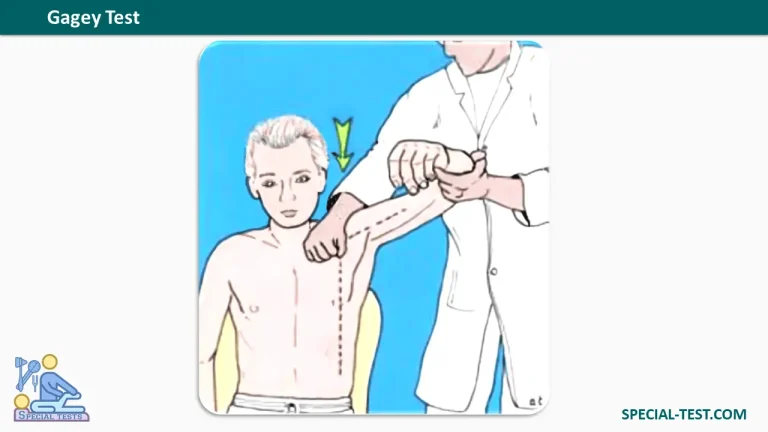
The Gagey Test, also known as the hyperabduction test, is a clinical orthopedic examination used to assess laxity of the inferior glenohumeral ligament (IGHL) and the inferior capsuloligamentous structures of the shoulder. It evaluates excessive passive shoulder abduction and may help identify inferior glenohumeral laxity associated with shoulder instability.
What Is the Gagey Test Used For?
The Gagey Test is used to assess the integrity and laxity of the inferior glenohumeral ligament, an important stabilizer of the shoulder joint. The IGHL complex helps prevent excessive translation of the humeral head, particularly when the arm is abducted.
This test may be useful when evaluating patients with suspected:
- Inferior glenohumeral ligament laxity.
- Multidirectional shoulder instability.
- Excessive passive shoulder abduction.
- Shoulder capsuloligamentous laxity.
Although the test may contribute to the clinical assessment of shoulder instability, it should not be used alone to diagnose a ligament injury or labral tear.
How to Perform the Gagey Test
Follow these steps to perform the Gagey Test:
- Patient position: Ask the patient to sit or stand comfortably, with the examiner positioned behind them.
- Initial arm position: Flex the patient’s elbow to approximately 90 degrees.
- Stabilization: Hold the patient’s elbow with one hand while the other hand stabilizes the scapula and clavicle to limit scapular elevation.
- Passive abduction: Slowly and gently abduct the patient’s arm in the frontal plane.
- Identify the endpoint: Continue abduction until the scapula and clavicle begin to elevate. Observe the angle of glenohumeral abduction at this point.
Compare the findings with the opposite shoulder when appropriate, and consider the patient’s symptoms, shoulder mobility, and overall clinical presentation.
What Is a Positive Gagey Test?
A positive Gagey Test is traditionally described when glenohumeral abduction exceeds 105 degrees before scapular and clavicular elevation begins.
This finding suggests increased inferior glenohumeral laxity and may be associated with shoulder instability.
However, interpretation requires caution. Normal passive scapulohumeral rhythm may allow glenohumeral abduction of up to approximately 120 degrees in some individuals, depending on the measurement method and individual anatomy.
Therefore, the 105-degree threshold should not be interpreted as a definitive diagnostic cutoff. The test result should be considered alongside the patient’s history, symptoms, other physical examination findings, and relevant imaging when indicated.
Clinical Significance of the Gagey Test
The Gagey Test can be a useful component of a comprehensive shoulder examination, particularly when inferior capsuloligamentous laxity is suspected.
A positive result may support the presence of inferior shoulder laxity, but it does not independently confirm an inferior glenohumeral ligament tear or an inferior labral tear. Additional examination findings and, when clinically indicated, imaging may be needed to investigate the underlying cause of shoulder instability.
Key Takeaways
- The Gagey Test is also called the hyperabduction test.
- It assesses excessive passive glenohumeral abduction and potential inferior glenohumeral ligament laxity.
- The traditional positive threshold is greater than 105 degrees of glenohumeral abduction before scapular elevation.
- Normal variation in shoulder mobility means that the threshold should be interpreted cautiously.
- The test should be combined with other clinical findings rather than used as a standalone diagnostic tool.
Frequently Asked Questions (FAQ)
1. What does the Gagey Test assess?
The Gagey Test assesses inferior glenohumeral laxity by measuring passive shoulder abduction while the examiner stabilizes the scapula and clavicle. It helps evaluate the contribution of the inferior glenohumeral ligament complex to shoulder stability.
2. What is another name for the Gagey Test?
The Gagey Test is also known as the hyperabduction test. It is used during orthopedic and musculoskeletal examinations to assess inferior shoulder laxity.
3. What is considered a positive Gagey Test?
A result is traditionally considered positive when glenohumeral abduction exceeds 105 degrees before the scapula and clavicle begin to elevate. This finding suggests increased inferior glenohumeral laxity but is not diagnostic on its own.
4. Which ligament does the Gagey Test evaluate?
The test primarily evaluates laxity associated with the inferior glenohumeral ligament (IGHL) complex, an important static stabilizer of the shoulder joint.
5. Does a positive Gagey Test indicate a shoulder labral tear?
No. A positive result may suggest inferior glenohumeral laxity, which can coexist with shoulder instability and labral pathology. However, the test alone cannot confirm an inferior labral tear or establish the exact cause of instability.
6. Can a healthy person have more than 105 degrees of glenohumeral abduction?
Yes. Normal shoulder mobility varies between individuals, and some people may demonstrate greater passive glenohumeral abduction without clinically significant instability. The measurement should be interpreted in the context of symptoms, examination technique, and other clinical findings.
7. Is the Gagey Test sufficient to diagnose shoulder instability?
No. The Gagey Test should be included as part of a comprehensive shoulder assessment. Patient history, symptoms, other instability tests, and additional investigations when indicated help establish the clinical diagnosis.
References
- Magee DJ. Orthopedic Physical Assessment. 7th ed. Elsevier.
- Gagey OJ, Gagey N. The hyperabduction test. J Bone Joint Surg Br. 2001 Jan;83(1):69–74. doi: 10.1302/0301-620X.83B1.10628. PMID: 11245541.