Cyriax Release Test for Thoracic Outlet Syndrome: Procedure & Positive Findings
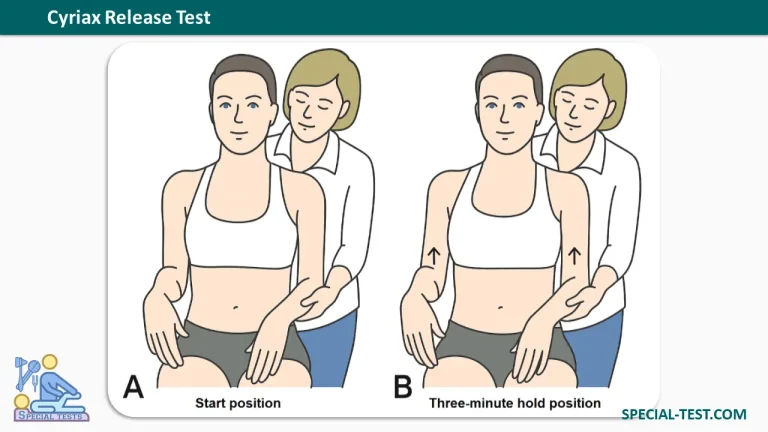
The Cyriax Release Test is a clinical provocative maneuver used to assess symptoms associated with thoracic outlet syndrome (TOS), particularly neurogenic thoracic outlet syndrome (nTOS). The test involves passive elevation of the shoulder girdle for a sustained period to assess whether neurological symptoms are reproduced or whether a characteristic release phenomenon occurs.
Although the test may contribute to a clinical examination, its findings must be interpreted alongside the patient’s history, neurological examination, and other diagnostic findings.
What Is the Cyriax Release Test Used For?
The Cyriax Release Test is used to evaluate symptoms potentially associated with thoracic outlet syndrome, a group of conditions involving compression of the nerves or blood vessels passing from the neck into the upper extremity.
The test is primarily intended to investigate possible neurogenic involvement, including symptoms such as:
- Tingling or pins and needles in the arm or hand.
- Numbness or altered sensation in the upper extremity.
- Pain in the neck, shoulder, or arm.
- A sensation of heaviness in the upper extremity.
A positive response may suggest neural irritation or altered mechanosensitivity, but it does not independently confirm thoracic outlet syndrome or identify the precise site of compression.
How to Perform the Cyriax Release Test
The Cyriax Release Test is performed with the patient seated and the examiner supporting the patient’s upper extremities.
Step-by-Step Procedure
- Patient position: Ask the patient to sit comfortably with the elbows flexed and the forearms, wrists, and hands in a neutral position.
- Examiner position: Stand behind the patient and grasp the patient’s forearms from underneath, providing support to both upper extremities.
- Trunk positioning: Gently lean the patient’s trunk backward by approximately 15 degrees.
- Shoulder girdle elevation: Passively elevate the patient’s shoulder girdle toward its available end range while maintaining support of the arms.
- Sustained position: Maintain the position for approximately 3 minutes, monitoring the patient’s symptoms and neurological responses throughout the maneuver.
- Symptom monitoring: Ask the patient to report any changes in sensation, tingling, numbness, pain, or other unusual symptoms during the test and after the position is released.
Clinical safety note: The maneuver should be performed by an appropriately trained healthcare professional. Stop the test if symptoms become severe or concerning, and avoid forcing the shoulder girdle into end range.
What Is a Positive Cyriax Release Test?
A positive Cyriax Release Test is traditionally associated with either of the following responses:
- Symptom reproduction: The patient develops or experiences an increase in neurological symptoms, such as tingling or numbness, during the sustained position.
- Release phenomenon: Neurological symptoms or signs change or resolve after the shoulder girdle is released from the elevated position.
The release phenomenon is classically described as a response associated with the test. However, symptom changes are not specific enough to establish a diagnosis on their own.
What Does a Positive Result Mean?
A positive result may indicate that the maneuver influences the patient’s upper-extremity symptoms. It should prompt further clinical assessment rather than be interpreted as definitive evidence of thoracic outlet syndrome.
A comprehensive assessment should consider alternative explanations, including cervical radiculopathy, peripheral nerve entrapment, and shoulder disorders.
Diagnostic Accuracy and Clinical Limitations
The diagnostic value of the Cyriax Release Test remains limited by the broader challenges of diagnosing thoracic outlet syndrome using provocative maneuvers.
A 2004 study by Gilbert and colleagues investigated false-positive findings in 119 asymptomatic participants. The reported specificity was highest at the 1-minute assessment and decreased as the duration of the maneuver increased. At 3 minutes, the reported specificity was approximately 90.8%. These findings suggest that test duration may influence the likelihood of a false-positive response.
However, the study examined asymptomatic participants and does not establish the test’s ability to distinguish thoracic outlet syndrome from other causes of upper-extremity symptoms in clinical populations.
A systematic review of clinical diagnostic tests for thoracic outlet syndrome also concluded that provocative maneuvers, including the Cyriax Release Test, cannot reliably establish TOS as the exclusive cause of a patient’s symptoms.
Consequently, the test should be used as one component of a comprehensive clinical assessment, not as a stand-alone diagnostic tool.
Clinical Assessment of Suspected Thoracic Outlet Syndrome
When thoracic outlet syndrome is suspected, clinicians should integrate findings from several sources:
- Patient history: Symptom distribution, duration, aggravating activities, and occupational or sporting demands.
- Physical examination: Cervical spine, shoulder, sensory, motor, and vascular assessment as clinically indicated.
- Provocative maneuvers: Selected tests may help reproduce the patient’s familiar symptoms but must be interpreted cautiously.
- Differential diagnosis: Consider cervical spine disorders, peripheral neuropathies, and other musculoskeletal conditions.
- Additional investigations: Imaging, electrodiagnostic testing, or vascular studies may be appropriate depending on the suspected TOS subtype and clinical presentation.
International expert consensus recommendations emphasize a combination of clinical history and examination findings when evaluating neurogenic thoracic outlet syndrome.
Frequently Asked Questions (FAQ)
1. What is the Cyriax Release Test used for?
The Cyriax Release Test is a provocative clinical maneuver used to assess symptoms that may be associated with thoracic outlet syndrome, particularly neurogenic symptoms affecting the upper extremity.
2. How long should the Cyriax Release Test be held?
The commonly described procedure involves maintaining passive shoulder girdle elevation for approximately 3 minutes. The patient’s symptoms should be monitored throughout the maneuver.
3. What indicates a positive Cyriax Release Test?
A positive response is traditionally described as the reproduction of neurological symptoms or a change in symptoms associated with the release phenomenon. These findings are not diagnostic of thoracic outlet syndrome on their own.
4. Can the Cyriax Release Test confirm thoracic outlet syndrome?
No. The test cannot independently confirm thoracic outlet syndrome. Diagnosis requires a comprehensive clinical assessment and consideration of other conditions that may produce similar symptoms.
5. What is the release phenomenon in the Cyriax Release Test?
The release phenomenon refers to a change or disappearance of neurological symptoms or signs following release of the sustained shoulder girdle elevation. This response should be interpreted in the context of the patient’s overall clinical presentation.
6. Is the Cyriax Release Test reliable?
Its reliability and diagnostic accuracy are not sufficiently established to support its use as a stand-alone test. Research has documented false-positive responses, and broader evidence reviews have highlighted the limitations of provocative maneuvers for diagnosing thoracic outlet syndrome.
7. What other tests are used to assess neurogenic thoracic outlet syndrome?
Clinical assessment may include the elevated arm stress test (EAST), Tinel’s sign over the supraclavicular region, and the upper limb tension test, alongside a detailed history and physical examination. No single provocative maneuver should be used in isolation to establish the diagnosis.
8. What conditions can mimic thoracic outlet syndrome?
Conditions with overlapping symptoms include cervical radiculopathy, carpal tunnel syndrome, other peripheral nerve entrapments, and shoulder disorders. The differential diagnosis depends on the patient’s symptoms and examination findings.
9. Who should perform the Cyriax Release Test?
The test should be performed by a trained healthcare professional familiar with upper-extremity neurological and musculoskeletal assessment. The patient’s symptoms and tolerance should be monitored throughout the procedure.
10. What is the most important clinical takeaway from the Cyriax Release Test?
The Cyriax Release Test may provide supplementary information about symptom provocation, but a positive result does not establish thoracic outlet syndrome. Clinical findings must be interpreted alongside the history, examination, and appropriate investigations.
References and Further Reading
- Gilbert KK, Isom K, Hall R, et al. Rate of False Positive Using the Cyriax Release Test for Thoracic Outlet Syndrome in an Asymptomatic Population. Journal of Manual & Manipulative Therapy. 2004;12(2):73–81. Read the study at Taylor & Francis.
- Dessureault-Dober I, Bronchti G, Bussières A. The Diagnostic Accuracy of Clinical Diagnostic Tests for Thoracic Outlet Syndrome. PubMed.
- Chim H, Hagan RR, and the INTOS Workgroup. Consensus Recommendations for Neurogenic Thoracic Outlet Syndrome from the INTOS Workgroup. Full text on PubMed Central.
- Society for Vascular Surgery. Thoracic Outlet Syndrome. Clinical overview.
- Orthofixar. Cyriax Release Test. Procedure overview.