Coracoid Impingement Test: Purpose, Procedure, and Positive Results
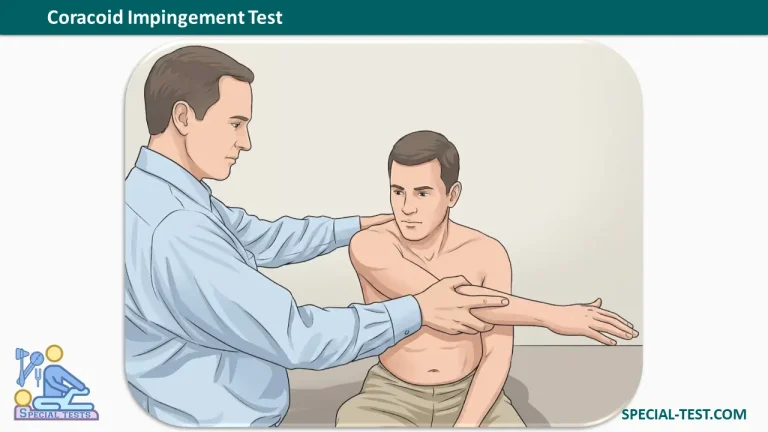
The Coracoid Impingement Test is a clinical shoulder examination maneuver used to assess subcoracoid impingement, a condition in which soft tissues around the shoulder become compressed between the coracoid process of the scapula and the humeral head, particularly near the lesser tuberosity. This test helps clinicians investigate anterior shoulder pain that may occur during specific arm movements.
The test is performed similarly to the Hawkins–Kennedy impingement test, but the position of the arm is adjusted to narrow the subcoracoid space and provoke symptoms associated with coracoid impingement. A positive result occurs when the maneuver reproduces the patient’s familiar shoulder pain.
Clinical findings should be interpreted alongside the patient’s history, physical examination, and, when indicated, imaging studies. The test is not sufficient on its own to establish a definitive diagnosis.
What Is the Coracoid Impingement Test Used For?
The primary purpose of the Coracoid Impingement Test is to evaluate suspected subcoracoid impingement syndrome.
The coracoid process is a hook-shaped bony projection on the anterior aspect of the scapula. It lies close to the humeral head and the lesser tuberosity, which serves as the attachment site for the subscapularis tendon.
When the space between these structures becomes reduced, shoulder movements involving forward flexion, adduction, and internal rotation may compress sensitive tissues and reproduce anterior shoulder pain. Research has described this mechanism as a potential source of chronic shoulder symptoms.
The Coracoid Impingement Test may help assess patients with:
- Anterior shoulder pain, particularly during forward elevation or internal rotation.
- Suspected compression of the subscapularis tendon or adjacent soft tissues.
- Possible narrowing of the subcoracoid space.
- Persistent shoulder symptoms that require differentiation from other causes of impingement.
A review of coracoid impingement syndrome describes the test as a passive maneuver that brings the lesser tuberosity toward the coracoid process to reproduce symptoms. <Cite refs={[“turn760936search11″,”turn760936search2”]}/>
Relevant Shoulder Anatomy
Understanding the anatomy helps explain how the Coracoid Impingement Test works.
The principal structures involved include:
- Coracoid process: A bony projection on the anterior scapula that serves as an attachment site for several muscles and ligaments.
- Lesser tuberosity: A prominence on the proximal humerus where the subscapularis tendon attaches.
- Subscapularis tendon: Part of the rotator cuff that contributes to internal rotation and dynamic shoulder stability.
- Subcoracoid space: The anatomical interval between the coracoid process and the humeral head or lesser tuberosity, depending on the measurement used.
When this space becomes narrow during particular shoulder positions, the rotator cuff and nearby soft tissues may be compressed. Anatomical variation, previous trauma, postoperative changes, and soft-tissue abnormalities may contribute to symptomatic impingement. However, reduced space alone does not necessarily mean that a patient has a symptomatic condition. <Cite refs={[“turn760936search9″,”turn760936search10”]}/>
How to Perform the Coracoid Impingement Test
The Coracoid Impingement Test should be performed by a trained healthcare professional who can control the shoulder position and recognize signs of pain or instability.
Patient Position
The patient is positioned comfortably, usually sitting or lying supine, with the shoulder relaxed. The examiner explains the maneuver and asks the patient to report any pain immediately.
Step-by-Step Procedure
- Position the shoulder: The examiner brings the patient’s arm forward into approximately 90 degrees of shoulder flexion.
- Add horizontal adduction: The arm is moved approximately 10–20 degrees across the body, depending on the examination technique and the patient’s tolerance.
- Apply internal rotation: The examiner gently internally rotates the shoulder, following the maneuver’s modified Hawkins-like positioning.
- Assess the response: The examiner observes whether the maneuver reproduces the patient’s familiar anterior shoulder pain.
- Compare sides when appropriate: The unaffected shoulder may be examined to help assess differences in symptoms and movement, provided the comparison is comfortable and clinically appropriate.
The combination of forward flexion, cross-body adduction, and internal rotation brings the lesser tuberosity closer to the coracoid process. The resulting compression may reproduce symptoms associated with subcoracoid impingement. The maneuver should be passive, with the examiner controlling the movement rather than asking the patient to resist force. <Cite refs={[“turn760936search11″,”turn760936search8”]}/>
Important Safety Considerations
The examiner should move the arm gradually and avoid forceful overpressure. The test should be stopped if the patient experiences severe pain, marked apprehension, or other concerning symptoms.
It should not be performed aggressively in the presence of a suspected acute fracture, recent shoulder surgery without clearance, or an acute injury requiring further assessment.
What Is a Positive Coracoid Impingement Test?
A positive Coracoid Impingement Test occurs when the maneuver reproduces the patient’s familiar anterior shoulder pain.
This response suggests that compression in the subcoracoid region may be contributing to the symptoms. It does not, by itself, prove that the coracoid process is the sole source of pain.
A positive result should be interpreted in the context of other clinical findings, including the location of tenderness, shoulder range of motion, rotator cuff strength, and relevant imaging results.
A negative result means that the maneuver did not reproduce the expected symptoms. However, it does not completely exclude subcoracoid impingement or another shoulder disorder.
Clinical Interpretation and Differential Diagnosis
Anterior shoulder pain can arise from several structures, so clinicians should consider alternative diagnoses when interpreting the test.
Possible conditions include:
- Subscapularis tendinopathy or tear: The subscapularis tendon lies close to the subcoracoid region and may be affected by compression.
- Long-head biceps tendon disorders: Biceps tendon irritation can produce pain at the front of the shoulder.
- Subacromial impingement: This involves different anatomical relationships and may be evaluated with other examination maneuvers.
- Labral pathology: Some labral disorders can cause anterior shoulder pain or pain during combined shoulder movements.
- Glenohumeral joint disorders: Joint abnormalities may produce overlapping symptoms.
The Coracoid Impingement Test should therefore be used as one component of a comprehensive shoulder assessment rather than as a standalone diagnostic test.
Diagnostic Accuracy and Limitations
The diagnostic accuracy of the Coracoid Impingement Test should not be assumed to match that of the Hawkins–Kennedy test simply because the procedures are similar. The two maneuvers emphasize different anatomical relationships, and evidence concerning one test cannot automatically validate the other.
Research using magnetic resonance imaging has demonstrated that different shoulder positions can alter the distance between the coracoid process and surrounding structures. A study of the mechanisms of shoulder impingement found that forward flexion and internal rotation can influence coracoid-related contact, supporting the biomechanical rationale for provocative examination maneuvers. <Cite refs={[“turn760936search8″,”turn760936search9”]}/>
Nevertheless, a positive result is not definitive proof of symptomatic subcoracoid impingement, and a negative result does not rule it out. The available evidence should be interpreted cautiously, particularly when assigning sensitivity, specificity, or other diagnostic performance values to this individual test.
When symptoms persist or the diagnosis remains uncertain, a clinician may consider radiographs, magnetic resonance imaging (MRI), or computed tomography (CT), depending on the suspected pathology and the clinical question.
Frequently Asked Questions (FAQ)
1. What does the Coracoid Impingement Test assess?
It assesses suspected subcoracoid impingement, in which soft tissues near the rotator cuff and lesser tuberosity may be compressed against the coracoid process during certain shoulder movements.
2. How is the Coracoid Impingement Test performed?
The examiner brings the shoulder into approximately 90 degrees of forward flexion, adds 10–20 degrees of horizontal adduction, and gently internally rotates the arm to provoke symptoms.
3. What is a positive Coracoid Impingement Test?
The test is considered positive when it reproduces the patient’s familiar anterior shoulder pain during the maneuver.
4. Does a positive test confirm subcoracoid impingement?
No. A positive result suggests possible subcoracoid involvement, but other shoulder conditions can produce similar pain. Additional examination and, when appropriate, imaging may be needed.
5. Is the Coracoid Impingement Test the same as the Hawkins–Kennedy test?
No. The maneuvers are similar, but the Coracoid Impingement Test uses positioning intended to bring the lesser tuberosity closer to the coracoid process. The Hawkins–Kennedy test primarily evaluates pain associated with subacromial impingement.
6. Which structures may be involved in subcoracoid impingement?
The subscapularis tendon and nearby soft tissues may be involved. The specific structures affected depend on the patient’s anatomy and underlying pathology.
7. Can imaging help diagnose coracoid impingement?
Yes. MRI can help assess soft tissues, including the rotator cuff, while CT can provide detailed information about bony anatomy. Imaging findings must be correlated with the patient’s symptoms and examination.
8. Is the Coracoid Impingement Test reliable on its own?
No single provocative shoulder test should be relied upon in isolation. The findings should be combined with the history, other physical examination tests, and additional investigations when indicated.
References
- Gerber C, Terrier F, Ganz R. The role of the coracoid process in the chronic impingement syndrome. Journal of Bone and Joint Surgery, British Volume. 1985;67(5):703–708. Read on PubMed
- Coracoid impingement syndrome: a literature review. Read the full review on PubMed Central
- Coracoid impingement: current concepts. Read on PubMed
- In vivo analysis of coracoid and subacromial shoulder impingement mechanism during clinical examination. Read on PubMed
- Campbell’s Operative Orthopaedics. A standard orthopedic reference for musculoskeletal conditions and their clinical evaluation.