Compression Rotation Test: Shoulder Labral Tear Assessment, Procedure & Clinical Accuracy
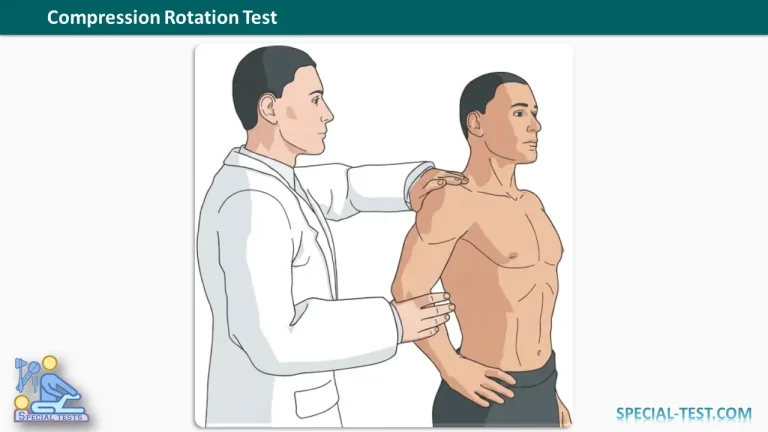
The Compression Rotation Test is an orthopedic physical examination maneuver used to evaluate suspected shoulder labral tears, particularly superior labrum anterior-to-posterior (SLAP) lesions. The test involves applying axial compression through the humerus while passively rotating the shoulder to reproduce pain, clicking, catching, or other mechanical symptoms associated with labral pathology.
The Compression Rotation Test is commonly included in the clinical assessment of patients presenting with shoulder pain, instability, or mechanical symptoms. However, it should be interpreted alongside the patient’s medical history, other shoulder examination findings, and appropriate diagnostic imaging.
What Is the Compression Rotation Test?
The Compression Rotation Test is a provocative shoulder examination designed to assess the integrity of the glenoid labrum, a ring of fibrocartilaginous tissue surrounding the glenoid cavity of the scapula.
The glenoid labrum contributes to shoulder stability by deepening the glenoid socket and providing attachment sites for the joint capsule, glenohumeral ligaments, and long head of the biceps tendon.
A labral tear can occur following traumatic shoulder injuries, repetitive overhead activities, or degenerative changes.
The Compression Rotation Test attempts to reproduce symptoms by compressing the humeral head against the glenoid while rotating the arm. This maneuver may mechanically engage an injured portion of the labrum, resulting in pain or catching.
What Is the Compression Rotation Test Used For?
The primary purpose of the Compression Rotation Test is to identify findings suggestive of glenoid labral pathology, especially SLAP lesions.
A SLAP lesion involves injury to the superior portion of the glenoid labrum, extending from anterior to posterior near the attachment of the long head of the biceps tendon.
Clinical indications for performing the test include:
- Deep shoulder pain associated with overhead movements.
- Pain or discomfort during throwing activities.
- Recurrent shoulder clicking, popping, or catching.
- Suspected labral injury following a fall or traction injury.
- Persistent shoulder pain with suspected intra-articular pathology.
- Mechanical shoulder symptoms that cannot be explained by other examination findings.
Although the Compression Rotation Test is primarily associated with labral injuries, a positive finding is not specific to a particular type or location of labral tear.
How to Perform the Compression Rotation Test
The Compression Rotation Test is performed by a qualified healthcare professional using controlled passive movements of the shoulder.
Patient Position
The patient may be positioned supine (lying on their back) on an examination table or standing upright.
The examiner stands beside the affected shoulder, ensuring that the patient’s arm is relaxed throughout the examination.
Step-by-Step Procedure
- Position the shoulder: Passively abduct the patient’s shoulder between 20° and 90°, depending on comfort and the examination technique.
- Flex the elbow: Maintain the patient’s elbow at approximately 90° of flexion.
- Support the upper limb: Stabilize and control the patient’s arm while maintaining the desired shoulder position.
- Apply axial compression: Introduce a controlled compressive force along the longitudinal axis of the humerus by pushing proximally through the elbow toward the glenohumeral joint.
- Rotate the humerus: While maintaining gentle compression, passively rotate the humerus internally and externally through small and larger rotational arcs.
- Observe the response: Assess whether the maneuver reproduces deep shoulder pain, clicking, catching, snapping, or other mechanical symptoms.
The maneuver is intended to create compression and rotational stress across the glenoid labrum, potentially engaging an injured labral fragment.
Clinical precaution: The test should be performed gently and discontinued if the patient experiences severe pain, significant apprehension, or marked discomfort. It should not be used as a self-diagnostic maneuver.
What Is a Positive Compression Rotation Test?
A positive Compression Rotation Test occurs when axial compression combined with passive humeral rotation reproduces symptoms suggestive of a labral injury.
Positive findings may include:
- Pain: Reproduction of deep pain within the glenohumeral joint.
- Clicking: A palpable or audible click during shoulder rotation.
- Catching: A sensation that something is catching or becoming trapped inside the shoulder joint.
- Snapping or clunking: Mechanical symptoms occurring during the rotational movement.
Painful clicking or catching is generally more clinically meaningful than an isolated, painless joint sound.
A positive test raises suspicion of a labral lesion but does not confirm that a labral tear is present. Other intra-articular shoulder conditions may produce similar symptoms.
What Does a Negative Compression Rotation Test Mean?
A negative result occurs when the examination does not reproduce the patient’s familiar symptoms.
However, a negative Compression Rotation Test does not rule out a SLAP lesion or another shoulder labral injury because the test has limited sensitivity.
Further assessment may be appropriate when the patient’s clinical history and symptoms remain suggestive of labral pathology.
Compression Rotation Test Sensitivity and Specificity
The diagnostic accuracy of the Compression Rotation Test has been investigated in several clinical studies and systematic reviews.
A 2017 systematic review and meta-analysis by Gismervik and colleagues, published in BMC Musculoskeletal Disorders, reported the following pooled diagnostic values for the Compression Rotation Test in evaluating SLAP lesions:
| Diagnostic Parameter | Reported Value |
|---|---|
| Sensitivity | 43% |
| Specificity | 89% |
| Diagnostic odds ratio | 6.36 |
Sensitivity of 43% indicates that the examination may fail to identify a substantial proportion of patients who have SLAP lesions.
Specificity of 89% suggests that a positive finding may provide useful supporting evidence in the appropriate clinical setting.
However, diagnostic estimates differ across studies. A separate 2017 study by Somerville and colleagues found that shoulder special tests, including compression rotation, had limited clinical usefulness for independently identifying SLAP lesions.
Consequently, the Compression Rotation Test should not be used as the sole basis for diagnosing or excluding a shoulder labral tear.
Clinical Significance of the Compression Rotation Test
The Compression Rotation Test is one component of a comprehensive shoulder examination.
Its greatest value comes from combining examination findings with a detailed history, including the mechanism of injury, symptom duration, activity-related pain, and previous episodes of instability.
Other shoulder tests that clinicians may consider include the O’Brien Active Compression Test, Crank Test, Biceps Load II Test, Speed’s Test, and Dynamic Labral Shear Test.
The Compression Rotation Test should not be confused with O’Brien’s Active Compression Test. O’Brien’s test involves resisted shoulder positioning, whereas the Compression Rotation Test uses passive rotation with axial compression.
When a labral tear remains clinically suspected, MRI or magnetic resonance arthrography may be considered to evaluate the labrum and associated shoulder structures. Imaging findings should also be correlated with the patient’s symptoms because not every structural labral abnormality is symptomatic.
Conclusion
The Compression Rotation Test is a clinical examination technique used to assess suspected shoulder labral tears and SLAP lesions.
It is performed by applying axial compression through the humerus while passively rotating the shoulder. Reproduction of deep shoulder pain, clicking, catching, or snapping may indicate underlying labral pathology.
Although the test can provide useful clinical information, its limited sensitivity means that a negative result cannot reliably exclude a SLAP lesion. Accurate diagnosis requires consideration of clinical history, additional physical examination findings, and imaging when appropriate.
Frequently Asked Questions (FAQ)
1. What is the Compression Rotation Test used to diagnose?
The Compression Rotation Test is used to evaluate suspected shoulder labral pathology, particularly superior labrum anterior-to-posterior (SLAP) lesions. It is a screening and provocative examination maneuver rather than a definitive diagnostic test.
2. How do you perform the Compression Rotation Test?
The examiner positions the patient’s shoulder in approximately 20°–90° of abduction with the elbow flexed to 90°. Axial compression is applied through the humerus while the shoulder is passively rotated internally and externally. The examiner observes for pain, clicking, catching, or snapping.
3. What indicates a positive Compression Rotation Test?
A positive result involves reproduction of deep shoulder pain or mechanical symptoms such as clicking, catching, or snapping during compression and rotation. These findings suggest possible labral pathology but are not sufficient to confirm a tear.
4. What are the sensitivity and specificity of the Compression Rotation Test?
A 2017 systematic review and meta-analysis reported a sensitivity of approximately 43% and a specificity of 89% for detecting SLAP lesions. These findings indicate that the test has limited ability to rule out a labral tear when negative.
5. Is the Compression Rotation Test the same as the O’Brien Test?
No. The Compression Rotation Test involves passive humeral rotation with axial joint compression. O’Brien’s Active Compression Test uses resisted shoulder movements in different rotational positions to investigate labral and acromioclavicular joint pathology.
6. Can a negative Compression Rotation Test rule out a SLAP tear?
No. A negative Compression Rotation Test does not reliably exclude a SLAP lesion because the test has relatively low sensitivity. Further examination or imaging may be necessary when clinical suspicion remains high.
7. Which imaging test is used to evaluate a suspected shoulder labral tear?
MRI and MR arthrography can help identify shoulder labral abnormalities. The selection of imaging depends on the patient’s clinical presentation, examination findings, and the treating clinician’s assessment.
8. Can the Compression Rotation Test be performed at home?
The Compression Rotation Test should be performed by a trained healthcare professional. Incorrect positioning or excessive compressive force may aggravate shoulder pain or an existing injury. A professional shoulder examination is recommended when a labral tear is suspected.
References
- Gismervik SØ, Drogset JO, Granviken F, Rø M, Leivseth G. Physical examination tests of the shoulder: a systematic review and meta-analysis of diagnostic test performance. BMC Musculoskeletal Disorders. 2017;18:41. PubMed – PMID: 28122541.
- Somerville LE, Willits K, Johnson AM, et al. Clinical Assessment of Physical Examination Maneuvers for Superior Labral Anterior to Posterior Lesions. The Surgery Journal. 2017;3(4)–e162. PubMed – PMID: 29018839.
- Dean RS, Onsen L, Lima J, Hutchinson MR. Physical Examination Maneuvers for SLAP Lesions: A Systematic Review and Meta-analysis of Individual and Combinations of Maneuvers. American Journal of Sports Medicine. 2023;51(11):3042–3052. PubMed – PMID: 35997579.
- Orthofixar. Shoulder SLAP Lesion: Causes, Classification, Diagnosis, and Treatment. Orthofixar – SLAP Lesion.