Towel Test for Obstetric Brachial Plexus Palsy
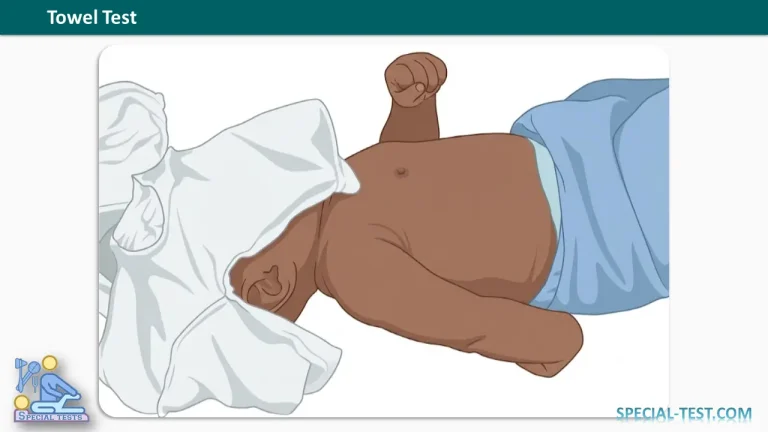
The Towel Test is a clinical examination technique used to assess upper-limb motor function and recovery in infants and children with obstetric brachial plexus palsy (OBPP). The test evaluates whether a child can use the affected arm to remove a towel placed over the face while the unaffected arm is prevented from assisting. It provides a functional assessment of movements involving the shoulder, elbow, and hand, with particular clinical relevance to the recovery of elbow flexion.
The Towel Test was described by Bertelli and Ghizoni as a useful technique for the clinical and electromyographic evaluation of obstetric brachial plexus palsy. It can complement other clinical examinations when monitoring motor recovery following a birth-related brachial plexus injury.
What Is the Towel Test Used For?
The Towel Test is primarily used to evaluate children with obstetric brachial plexus injuries, which occur when the brachial plexus is damaged during childbirth. The brachial plexus is a network of nerves originating from the cervical spinal roots that supplies motor and sensory function to the shoulder, arm, forearm, and hand.
The test is useful for the following purposes:
- Assessing upper-limb motor function: It evaluates the child’s ability to use the affected arm during a purposeful task.
- Monitoring neurological recovery: Repeated assessments can help clinicians identify changes in functional movement over time.
- Evaluating elbow flexion: Successful towel removal requires coordinated upper-limb movement, including elbow flexion, making this an important functional component of the test.
- Assessing shoulder and hand function: The task also requires shoulder movement and sufficient finger movement to grasp, manipulate, or displace the towel.
- Supporting clinical follow-up: The findings can contribute to the overall assessment of children undergoing observation, rehabilitation, or specialist management for obstetric brachial plexus palsy.
The Towel Test is a functional examination rather than an isolated test of one muscle or nerve root. Its findings should therefore be interpreted alongside the child’s history, other physical examination findings, and age-appropriate motor assessments.
How to Perform the Towel Test
The Towel Test is performed with the child lying on their back (supine). The examiner observes whether the affected upper limb can perform the movements needed to remove a towel from the face.
Examination technique:
- Position the child: Place the child comfortably in the supine position.
- Cover the face: Gently place a towel over the child’s face. The examination must be performed with appropriate supervision, ensuring that the airway remains unobstructed and the child is not distressed.
- Restrict the unaffected arm: Prevent the unaffected upper limb from assisting with towel removal, so that the task depends on the affected arm.
- Observe the response: Allow the child an opportunity to remove the towel using the affected upper limb.
- Assess the movements: Observe shoulder movement, elbow flexion and extension, and finger flexion and extension during the attempt.
- Record the result: Document whether the child successfully removes the towel and note any limitations or compensatory movements.
The examiner should interpret the response in the context of the child’s developmental age, alertness, cooperation, and ability to understand or respond to the task. The towel should never be left over an infant’s face unattended.
What Is a Positive Towel Test Result?
A positive or passing Towel Test generally means that the child successfully removes the towel using the affected arm while the unaffected arm is prevented from assisting.
Successful performance suggests that the child has sufficient functional motor ability to coordinate the movements required for the task. These movements include shoulder flexion, elbow flexion and extension, and finger flexion and extension.
In particular, successful towel removal may indicate recovery of elbow flexion, which is an important functional milestone in children with obstetric brachial plexus palsy.
Conversely, a failed test occurs when the child cannot remove the towel using the affected arm under the examination conditions. This may suggest persistent motor impairment, including weakness of elbow flexion, but it does not establish a specific nerve lesion or prove that neurological recovery has failed.
A failed result may also be influenced by factors such as developmental age, limited cooperation, discomfort, or difficulty coordinating the required movements. The finding should therefore be interpreted as part of a comprehensive clinical assessment.
What Movements Does the Towel Test Assess?
The Towel Test evaluates a coordinated functional task involving several upper-limb movements.
- Shoulder flexion: Helps bring the arm toward the towel and face.
- Elbow flexion: Helps position the hand and bring it toward the face; recovery of this movement is particularly relevant in obstetric brachial plexus palsy.
- Elbow extension: May contribute to repositioning the arm during the task.
- Finger flexion: Supports grasping or engaging with the towel.
- Finger extension: Helps adjust hand position and release or manipulate the towel.
Because successful performance depends on several movements working together, the test cannot independently identify the strength of each individual muscle. Specific muscle function should be examined separately when clinically indicated.
Towel Test Accuracy and Reliability
Bertelli and Ghizoni published a study describing the Towel Test as a useful technique for the clinical and electromyographic evaluation of obstetric brachial plexus palsy in the Journal of Hand Surgery (British Volume) in 2004.
The technique provides a practical, task-oriented way to assess upper-limb function in affected children. However, claims about its accuracy should be distinguished from claims about its clinical usefulness. The existence of a published clinical study does not, by itself, establish universally applicable sensitivity, specificity, or interobserver reliability values.
The Towel Test should therefore be regarded as a complementary functional assessment, not a stand-alone diagnostic test. Clinical decisions should incorporate the overall neurological examination, the pattern and severity of the brachial plexus injury, serial assessments, and specialist evaluation when appropriate.
Clinical Importance of the Towel Test in Brachial Plexus Palsy
Obstetric brachial plexus palsy can affect different nerve roots and produce varying degrees of weakness. Some children recover spontaneously, while others experience persistent motor deficits requiring ongoing rehabilitation or specialist intervention.
Functional tasks are useful because they demonstrate how the child uses the affected arm rather than measuring an isolated movement in a controlled position. The Towel Test offers a simple way to observe coordinated upper-limb activity and document changes during follow-up.
Nevertheless, a passing result does not prove complete recovery of the brachial plexus, normal sensation, or normal function of every muscle. Similarly, a failed result should not be used alone to determine prognosis or the need for surgery. The findings must be considered alongside the child’s clinical course and other examination results.
Frequently Asked Questions (FAQ)
1. What is the Towel Test used for?
The Towel Test is used to assess functional upper-limb motor ability in children with obstetric brachial plexus palsy, particularly during follow-up of motor recovery.
2. How is the Towel Test performed?
The child lies supine with a towel gently placed over the face. The unaffected arm is prevented from assisting, and the examiner observes whether the child can remove the towel using the affected arm.
3. What is a positive Towel Test?
A positive or passing result occurs when the child successfully removes the towel using the affected arm. This suggests functional recovery of the movements needed for the task, particularly elbow flexion.
4. Which muscles or movements are assessed by the Towel Test?
The test assesses coordinated shoulder movement, elbow flexion and extension, and finger flexion and extension. It does not isolate individual muscles or nerve roots.
5. Does a failed Towel Test mean permanent brachial plexus damage?
No. A failed test indicates difficulty completing the task under the examination conditions, but it does not establish permanent damage. The result must be interpreted alongside the child’s age, cooperation, neurological examination, and progress over time.
6. Is the Towel Test reliable for assessing obstetric brachial plexus palsy?
The technique has been described in the medical literature as useful for clinical and electromyographic evaluation. However, its usefulness should not be confused with established diagnostic accuracy or reliability values unless these are supported by specific validation data.
7. Can the Towel Test determine whether a child needs surgery?
No. The Towel Test alone cannot determine the need for surgery. Management decisions require a comprehensive assessment by clinicians experienced in pediatric brachial plexus injuries.
8. Is the Towel Test safe for infants?
It must be performed under direct clinical supervision. The examiner should ensure that the towel does not obstruct breathing, should never leave the infant unattended, and should stop the test if the child becomes distressed.
References
- Bertelli JA, Ghizoni MF. The towel test: a useful technique for the clinical and electromyographic evaluation of obstetric brachial plexus palsy. J Hand Surg Br. 2004 Apr;29(2):155–158. doi: 10.1016/j.jhsb.2003.10.018. PMID: 15010163.
- Orthofixar. Towel Test.