Ortolani’s Test: Purpose, Procedure, Positive Result, and Clinical Significance
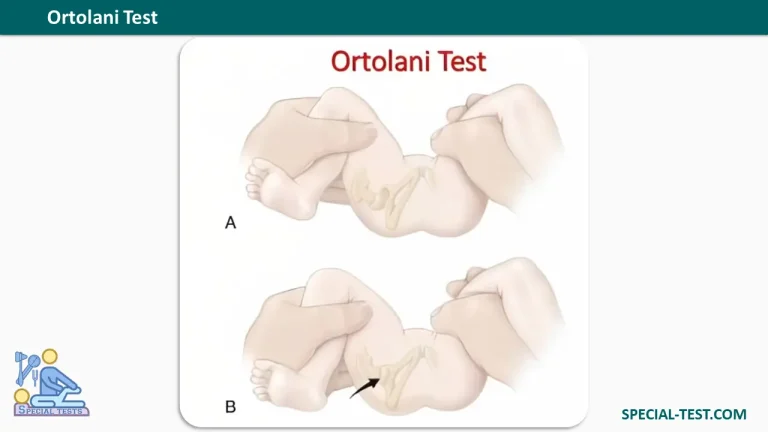
Ortolani’s test is a clinical examination maneuver used to identify developmental dysplasia of the hip (DDH) in newborns and young infants. It is designed to detect a dislocated femoral head that can be gently reduced into the acetabulum during examination. This test is an important component of the newborn hip examination and helps clinicians identify infants who may require further assessment and early treatment.
Developmental dysplasia of the hip describes a spectrum of abnormalities affecting the developing hip joint, ranging from mild acetabular shallowness and instability to subluxation or complete dislocation of the femoral head. Early detection is essential because timely management can improve hip development and reduce the risk of long-term complications, including gait abnormalities, chronic pain, and early-onset osteoarthritis.
What Is Ortolani’s Test Used For?
The primary purpose of Ortolani’s test is to detect a dislocated but reducible hip in infants with suspected developmental dysplasia of the hip.
The test assesses whether the femoral head, which is displaced from the acetabulum, can be gently guided back into its normal position within the hip socket. A positive Ortolani test suggests hip instability and warrants prompt clinical assessment.
Ortolani’s test is particularly useful during the neonatal period and the first few months of life. As an infant grows, soft-tissue contractures and other changes may make a dislocated hip less reducible, reducing the usefulness of the maneuver.
The test is commonly performed alongside Barlow’s test, which evaluates whether a located but unstable hip can be gently displaced out of the acetabulum. Although both maneuvers assess hip instability, they examine different aspects of the condition:
- Ortolani’s test: Attempts to reduce a dislocated femoral head into the acetabulum.
- Barlow’s test: Attempts to demonstrate whether an unstable hip can be dislocated from the acetabulum.
Neither test alone excludes every form of developmental dysplasia of the hip. Clinical examination findings must be interpreted alongside the infant’s age, risk factors, and imaging findings when indicated.
How to Perform Ortolani’s Test
Ortolani’s test should be performed gently by a clinician experienced in examining the infant hip. The infant should be calm and relaxed to minimize muscle tension and improve the reliability of the examination. Performing the test after feeding may help settle the infant, provided it is appropriate for the clinical situation.
Patient Position
- Place the infant in the supine position on a firm, comfortable examination surface.
- Ensure that the infant is relaxed, with the pelvis positioned symmetrically.
- Flex both hips and knees to approximately 90 degrees.
Hand Position
- Hold the infant’s knees and thighs securely but gently.
- Place the thumbs along the medial aspects of the thighs.
- Position the fingers over the greater trochanters of the femurs.
The examiner should maintain control of each thigh while avoiding excessive pressure or forceful movement.
Movement
- Begin with the hips flexed and the thighs in a relatively adducted position.
- Gently abduct the hips in a smooth, controlled movement.
- Apply gentle anteriorly directed pressure through the greater trochanters while abducting the hips, allowing a displaced femoral head to return to the acetabulum if it is reducible.
- Assess whether a distinct palpable sensation occurs as the femoral head enters the hip socket.
The maneuver should be performed without force. Repeated or forceful attempts to elicit a response are inappropriate because they may cause discomfort and are unlikely to improve diagnostic accuracy.
What Is a Positive Ortolani Test?
A positive Ortolani test occurs when the examiner feels the femoral head move back into the acetabulum during gentle hip abduction and reduction.
The characteristic finding is a palpable clunk, which represents the movement of the femoral head across the acetabular rim into the hip socket. An audible sound may occasionally accompany the movement, but the palpable finding is more important than an audible click.
A positive result suggests a dislocated but reducible hip and requires further evaluation for developmental dysplasia of the hip.
Importantly, a soft click without a palpable shift of the femoral head is not considered a positive Ortolani sign. Benign soft-tissue clicks can occur in otherwise normal infants and should not be confused with the characteristic reduction clunk.
Restricted Hip Abduction
Restricted hip abduction is an important abnormal finding, particularly in older infants. It may indicate a fixed or irreducible hip dislocation, although other causes are possible.
A negative Ortolani test does not exclude developmental dysplasia of the hip. A dislocated hip that cannot be reduced may not produce a positive Ortolani sign. Therefore, clinicians should assess hip abduction, limb symmetry, and other relevant examination findings.
Clinical Significance and Management
A positive Ortolani test is a significant finding that warrants prompt referral to a pediatric orthopedic specialist. It may indicate neonatal hip instability or a dislocated, reducible hip, depending on the clinical context.
Management depends on the infant’s age, the degree of instability, examination findings, and imaging results. In young infants with confirmed suitable forms of DDH, treatment commonly involves a Pavlik harness or another appropriate abduction orthosis under specialist supervision.
Not every abnormal hip examination requires immediate splintage without further assessment. The diagnosis and treatment plan should be established by an experienced clinician, with ultrasound commonly used to evaluate hip morphology and stability in young infants.
Early diagnosis and appropriate treatment are important for optimizing hip development and reducing the likelihood of persistent dysplasia or later reconstructive surgery.
Ortolani Test Accuracy
The reported sensitivity of Ortolani’s test is 66%, and the reported specificity is 95% in the referenced clinical examination material.
- Sensitivity: 66% — the proportion of affected infants correctly identified by the test.
- Specificity: 95% — the proportion of unaffected infants correctly identified as not having the condition.
These values should be interpreted cautiously. Diagnostic accuracy varies with the population studied, the infant’s age, examiner experience, the definition of hip dysplasia, and the reference standard used. A single sensitivity and specificity estimate should not be treated as universally applicable to all newborn screening settings.
Because the test may miss some affected infants, a negative result does not rule out DDH. Risk-based assessment, repeat physical examinations, and appropriately indicated ultrasound remain important parts of early detection.
Limitations of Ortolani’s Test
Ortolani’s test has several limitations:
- It is most useful in young infants with a reducible dislocation.
- It may be negative in a fixed or irreducible dislocation.
- Its performance depends on the examiner’s experience and technique.
- It does not reliably detect every case of acetabular dysplasia without instability.
- A normal examination does not eliminate the need for further evaluation when clinical risk factors or other concerning findings are present.
For these reasons, Ortolani’s test should be incorporated into a comprehensive hip examination rather than used as the sole screening method.
References
- Clinical Orthopaedic Examination. Reference text for the clinical examination technique and interpretation of Ortolani’s test.
- Orthofixar. Ortolani Test: Procedure, Positive Result, and Clinical Significance.
- American Academy of Pediatrics. Clinical guidance on the early detection and evaluation of developmental dysplasia of the hip.
- American Academy of Orthopaedic Surgeons. Clinical practice guidance on the detection and nonoperative management of developmental dysplasia of the hip in infants up to six months of age.