Quadriceps Active Test: Purpose, Technique, Results & Accuracy
What Is the Quadriceps Active Test Used For?
The quadriceps active test (QA test) is an orthopedic special test that helps clinicians identify a posterior cruciate ligament (PCL) injury of the knee. It was introduced by Daniel and colleagues in 1988. In their PubMed-indexed study, the patient’s own muscle contraction, rather than an outside force from the examiner, served as the displacing force.
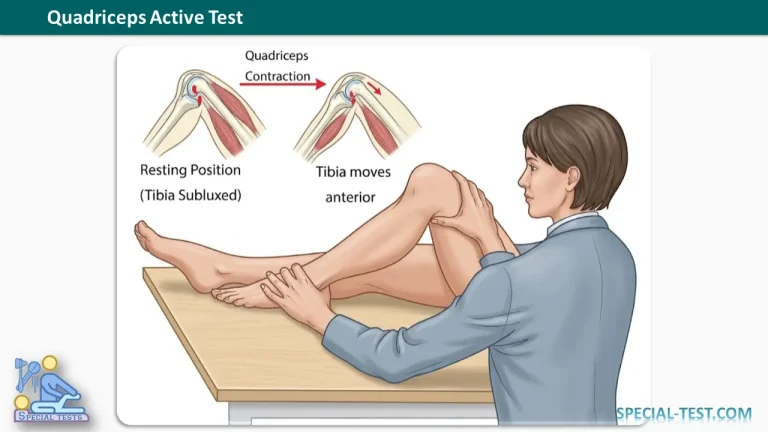
The test relies on a simple mechanical principle. When the quadriceps contracts, its force travels through the patella and the patellar tendon to the tibial tubercle. In a knee with a healthy PCL, this pull causes little tibial movement. In a PCL-deficient knee, the contraction moves the tibia noticeably. This makes the test useful for confirming PCL laxity, especially alongside other tests such as the posterior drawer and posterior sag sign.
How to Perform the Quadriceps Active Test
Per Orthofixar and Dutton’s Orthopaedic Examination, Evaluation, and Intervention, the steps are:
- Position the patient supine on the examination table.
- Flex the knee to 90° in the same position used for the posterior drawer test, with the relaxed limb supported.
- Flex the hip to about 45° and keep the foot in a neutral position.
- Ask for a gentle quadriceps contraction. The patient tries to shift the tibia without actually extending the knee.
- Observe the tibia. Watch for movement at the proximal tibia and compare it with the uninjured knee.
Keep the contraction gentle and isometric. The aim is to load the extensor mechanism, not to move the leg through range.
What Is a Positive Result?
In a PCL rupture, the tibia often rests in a posteriorly sagged position at 90° of flexion because gravity pulls it backward with no PCL to hold it. When the quadriceps contracts, the patellar tendon pulls the tibia forward, and the sag reduces by 2 mm or more. A displacement of that size suggests a PCL tear. Janousek and colleagues describe this reduction of posterior subluxation in their review, “Posterior Cruciate Ligament Injuries of the Knee Joint” (Sports Medicine, 2000).
In Daniel’s original series, quadriceps contraction at 90° of flexion produced anterior tibial translation in 41 of 42 knees with documented PCL disruption. It did not occur in normal knees or in knees with an isolated ACL tear, which makes the finding useful for telling the two injuries apart.
Quadriceps Active Test Accuracy
Reported diagnostic values for the test are:
| Measure | Value |
|---|---|
| Sensitivity | 54% |
| Specificity | 97% |
These figures come from the clinical accuracy study by Rubinstein et al. (Am J Sports Med, 1994).
In practice, the high specificity means a positive result is strongly suggestive of a PCL injury. The modest sensitivity means a negative result does not rule one out. For this reason, clinicians combine the QA test with the posterior drawer test, the posterior sag sign, and imaging such as MRI when the clinical picture calls for it.
Limitations to Keep in Mind
- Gravity and hamstrings can mimic a positive test. A published case report describes a patient with a chronic grade 3 PCL injury whose tibia translated forward even without active quadriceps contraction.
- Pain, guarding, or swelling in an acute injury can limit a good examination.
- Comparison with the opposite knee is essential, since normal laxity varies between people.
Frequently Asked Questions (FAQ)
1. What does the quadriceps active test diagnose?
It helps diagnose injury to the posterior cruciate ligament (PCL) of the knee.
2. How does the quadriceps active test work?
Quadriceps contraction pulls on the tibial tubercle through the patella and patellar tendon. If the PCL is torn, this shifts the tibia more than it would in a normal knee.
3. What knee and hip positions are used?
The patient lies supine with the knee flexed to 90°, the hip flexed to about 45°, and the foot in neutral.
4. What counts as a positive quadriceps active test?
Tibial displacement of 2 mm or more when the quadriceps contracts suggests a ruptured PCL.
5. How accurate is the quadriceps active test?
Sensitivity is about 54% and specificity about 97%, so a positive result is reliable but a negative one cannot exclude a PCL tear.
6. Can the test distinguish a PCL tear from an ACL tear?
Daniel’s original study found the forward tibial shift in PCL-disrupted knees but not in knees with an isolated ACL tear, so it can help separate the two.
7. Is the quadriceps active test painful?
The contraction is gentle, but it may be uncomfortable in an acutely injured, swollen knee.
8. Is one test enough to diagnose a PCL injury?
No. Diagnosis combines the history, several physical tests, and often MRI. A healthcare professional should interpret the findings.
References
- Daniel DM, et al. Use of the quadriceps active test to diagnose posterior cruciate-ligament disruption and measure posterior laxity of the knee. J Bone Joint Surg Am. 1988;70(3):386-91. PubMed
- Rubinstein RA Jr, et al. The accuracy of the clinical examination in the setting of posterior cruciate ligament injuries. Am J Sports Med. 1994. PubMed
- Janousek A, et al. Posterior cruciate ligament injuries of the knee joint. Sports Med. 2000;28(6):429-41. doi:10.2165/00007256-199928060-00005
- A positive quadriceps active test, without the quadriceps being active (case report). PubMed Central
- Quadriceps Active Test, Orthofixar
- Dutton’s Orthopaedic Examination, Evaluation, and Intervention, 3rd ed.