Dial Test for the Knee: How to Perform It and Read the Results
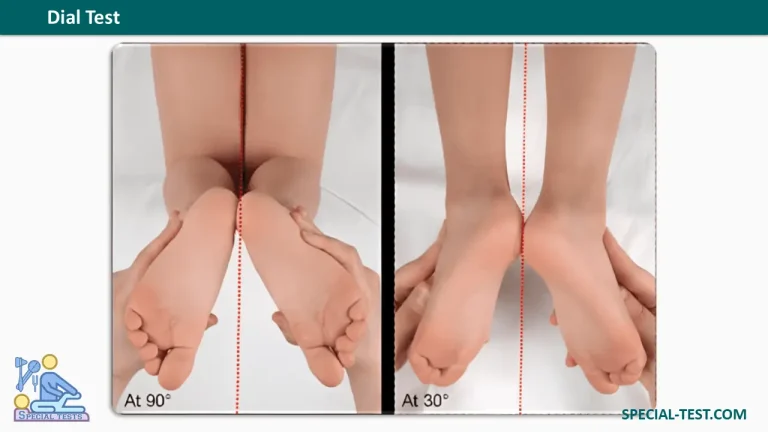
What is the Dial Test used for?
The Dial Test, also called the tibial external rotation test, is a clinical exam for posterolateral knee instability. It helps clinicians do two things:
- Diagnose an injury to the posterolateral corner (PLC) of the knee.
- Distinguish an isolated PLC injury from a combined PLC and posterior cruciate ligament (PCL) injury.
This matters because PLC injuries are rare and commonly missed. They usually follow athletic trauma, motor vehicle accidents, or falls. One published case describes a patient whose only positive finding was the Dial Test at 30° of flexion. Diagnosis was delayed and reconstruction was needed. Spotting the pattern early, and referring on, can change the outcome.
How to perform the Dial Test
The test measures how far the tibia rotates outward (the foot-thigh angle) at 30° and 90° of knee flexion. The result is always compared with the uninjured knee. The test was first described by Noyes and colleagues, with the tibia positioned at both 30° and 90° of flexion and the amount of external rotation compared with the other knee.
Prone position
- With the patient face down, flex both knees to 30°.
- Cup the patient’s heels, with both hands on the feet.
- Apply a maximal external rotation force, then measure the foot-thigh angle and compare it with the other side.
- Flex the knees to 90°, apply the external rotation force again, and measure again.
Supine position
There are two common variations:
- Knees together: Bend both knees to 30° and rotate the lower legs and feet outward. Use the tibial tubercle as your reference point to compare rotation side to side. Repeat at 90°.
- Knee over the edge of the bed: Flex the knee over the side of the bed and stabilize the thigh. Apply an external rotation force through the foot and ankle, then watch the tibial tubercle and compare with the other knee.
What is a positive Dial Test?
The test is positive when the injured knee shows more than 10° of additional external rotation than the uninjured knee. Some sources give a range of 10–15°. The flexion angle at which the difference appears tells you which structures are likely involved:
| Finding | Likely injury |
|---|---|
| >10° difference at 30° only | Isolated posterolateral corner (PLC) injury |
| >10° difference at 90° only | PCL instability |
| >10° difference at 30° and 90° | Combined PLC and PCL injury |
An increase at 30° with symmetric rotation at 90° points to an isolated PLC injury. An increase at both angles suggests a combined PLC and PCL injury.
Limitations of the Dial Test
The Dial Test is useful, but it should never be used alone.
- It can miss milder injuries. A cadaveric study found the test most valuable when three posterolateral structures were injured, or when the PCL and two posterolateral structures were injured. Injuries to only one or two structures may not be detected.
- MCL injuries can mimic it. In a cadaveric study, cutting the medial collateral ligament produced a dial test result similar to a solitary posterolateral corner injury. The authors recommend a valgus stress test whenever a posterolateral injury is suspected.
- Tibial position changes the result. In combined PCL-PLC-deficient knees, applying an anterior force to the tibia increased the observed external rotation. This reduces the posterior sagging caused by PCL injury, similar to what happens when the patient is prone.
Combine the Dial Test with patient history, varus stress testing, the posterior drawer test, the external rotation recurvatum test, and imaging such as radiographs and MRI.
Frequently Asked Questions (FAQ)
What does the Dial Test diagnose?
It diagnoses posterolateral knee instability and helps separate an isolated PLC injury from a combined PLC and PCL injury.
At what angles is the Dial Test performed?
At 30° and 90° of knee flexion, always compared with the opposite knee.
How many degrees of difference make the test positive?
More than 10° of extra external rotation compared with the uninjured knee. Some sources use 10–15°.
What does a positive Dial Test at 30° but not 90° mean?
It suggests an isolated posterolateral corner injury.
What does a positive test at both 30° and 90° mean?
It suggests a combined PLC and PCL injury.
Can the Dial Test be done supine?
Yes. It can be done with the knees together at 30° and 90°, or with the knee flexed over the edge of the bed. Prone is the most commonly taught position.
Is the Dial Test enough to diagnose a PLC injury?
No. It can miss injuries involving only one or two posterolateral structures, and an MCL tear can give a similar result. It should be combined with other physical tests and imaging.
Who should perform the Dial Test?
A trained clinician, such as a physician or physiotherapist. If you suspect a knee ligament injury, see a healthcare professional for a full assessment.
References
- OrthoFixar. Dial Test (Knee Special Tests). orthofixar.com
- Bae JH, et al. Evaluation of the reliability of the dial test for posterolateral rotatory instability: a cadaveric study using an isotonic rotation machine. Arthroscopy. 2008.
- Influence of tibial positioning on the dial test in the PCL-PLC-deficient knee. Br J Sports Med. 2007;41(8):481. PMC2465456
- Cadaveric study on MCL injury and the dial test. PubMed 16762352
- Case report on isolated posterolateral corner injury and the Dial Test at 30°. PMC5178015
- Dutton’s Orthopaedic Examination, Evaluation, and Intervention, 3rd ed.
- Scott C, Murray A. Paediatric intrasubstance posterior cruciate ligament rupture. BMJ Case Reports. 2011. doi:10.1136/bcr.09.2011.4803