Posterior Sag Sign: How to Test for a PCL Tear (Technique & Accuracy)
Posterior Sag Sign: A Clinical Guide to Detecting PCL Injury
The posterior sag sign, also called the gravity drawer test or Godfrey sign, is a physical examination test for the posterior cruciate ligament (PCL) of the knee. It needs no equipment. The clinician only has to position the patient and look at the profile of the knee, which makes it a quick first check when a PCL injury is suspected.
What Is the Posterior Sag Sign Used For?
The test assesses the integrity of the PCL, the ligament that keeps the tibia from sliding backward beneath the femur. A PCL injury often follows a direct blow to the front of the shin, such as a dashboard injury in a car accident or a fall onto a bent knee during sport.
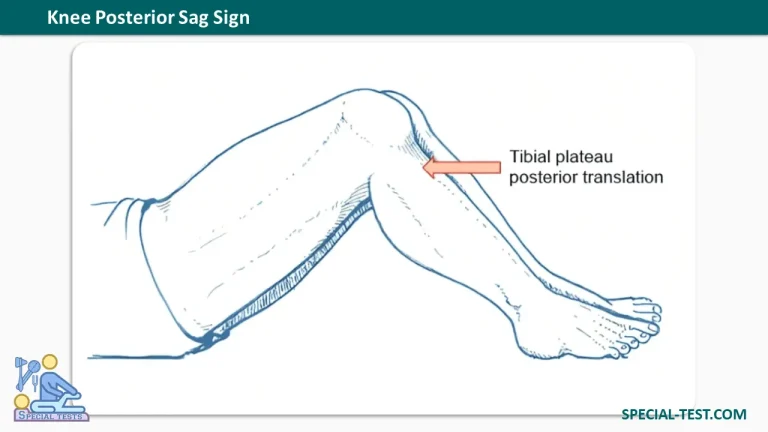
When the PCL is torn, gravity alone can pull the tibia backward when the knee is bent and the leg is relaxed. This sagging is the finding the test looks for. According to Orthofixar, it is the most characteristic sign in a knee with a PCL rupture, appearing as an apparent loss of the tibial tuberosity when the knee is viewed from the side.
How to Perform the Posterior Sag Sign
- Position the patient supine on the examination table.
- Flex the hips to about 45 degrees and the knees to about 90 degrees, with the feet flat on the table.
- Support the legs under the lower calf or heel so the thigh and calf muscles stay relaxed.
- View both knees from the side of the table and compare the contour of the tibial tuberosity and the position of the tibia relative to the femur.
Comparing both sides matters, because normal knees vary and the healthy knee is the best reference for each patient.
What Is a Positive Result?
The sign is positive when the affected tibia sags backward compared with the unaffected knee. The tibial tuberosity looks less prominent on the injured side. Normally, the front edge of the medial tibial plateau sits roughly 1 cm ahead of the femoral condyle at 90 degrees of flexion. A torn PCL lets the tibia drop back and this “step-off” disappears.
Accuracy: Sensitivity and Specificity
Orthofixar reports the posterior sag sign at 79% sensitivity and 100% specificity. These figures come from Rubinstein and colleagues’ 1994 study of the clinical examination in PCL injuries, published in the American Journal of Sports Medicine and indexed on PubMed (PMID 7943523).
- High specificity (100%): a clear positive sign is very unlikely to occur in a knee with an intact PCL.
- Moderate sensitivity (79%): a negative test does not fully exclude a PCL injury, since some injured knees will not sag.
Tips and Limitations
- If the finding is unclear, ask the patient to gently press the heels into your arm. This contracts the hamstrings and can increase the backward translation of the tibia.
- Pain and muscle guarding in an acute injury can hide the sag, so interpret the result in context.
- The sign works best alongside other tests, such as the posterior drawer test and the quadriceps active test, and imaging such as MRI when needed.
- Posterolateral corner injuries can accompany PCL tears. The quadriceps contraction test is used when posterolateral instability is suspected.
Frequently Asked Questions (FAQ)
What is another name for the posterior sag sign?
It is also called the gravity drawer test or the Godfrey sign.
Does the posterior sag sign test the ACL?
No. It evaluates the posterior cruciate ligament. The anterior drawer and Lachman tests are used for the anterior cruciate ligament.
How accurate is the posterior sag sign?
Reported sensitivity is 79% and specificity is 100%, so a positive result is very reliable, while a negative result does not completely rule out a PCL tear.
What knee and hip angles are used?
The hips are flexed to about 45 degrees and the knees to about 90 degrees, with the feet flat on the table.
What does a positive posterior sag sign look like?
Viewed from the side, the injured tibia drops backward and the tibial tuberosity looks flattened compared with the healthy knee.
Can the test be done on its own to diagnose a PCL tear?
It is a useful screening and confirmatory sign, but diagnosis normally combines history, other examination tests such as the posterior drawer test, and imaging.
Should I attempt this test on myself?
This test is designed for trained clinicians. If you have knee pain, instability, or a recent injury, see a doctor or physiotherapist.
References
- Posterior Sag Sign | Orthofixar
- Rubinstein RA Jr, Shelbourne KD, McCarroll JR, VanMeter CD, Rettig AC. The accuracy of the clinical examination in the setting of posterior cruciate ligament injuries. Am J Sports Med. 1994;22(4):550-557. PubMed PMID 7943523
- Kannus P, Bergfeld J, Järvinen M, et al. Injuries to the posterior cruciate ligament of the knee. Sports Med. 1991;12(2):110-131. PubMed PMID 1947532
- Clinical Tests for the Musculoskeletal System, 3rd Edition.