Lachman Test for ACL Injury: Technique, Positive Result and Accuracy
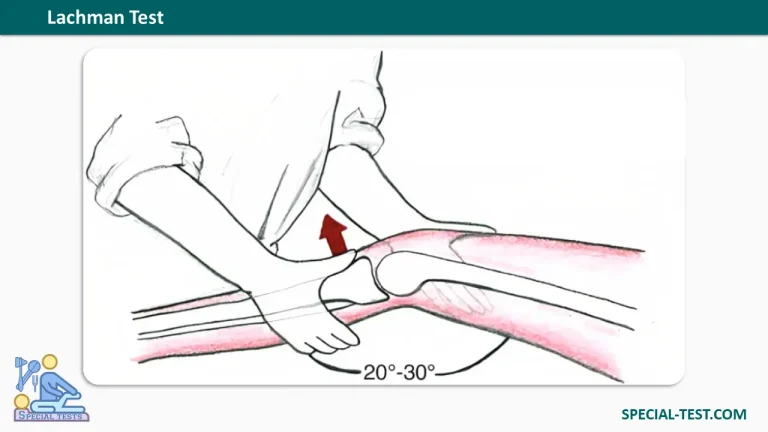
What Is the Lachman Test Used For?
The Lachman test is a hands-on knee examination used to assess the integrity of the anterior cruciate ligament (ACL). The ACL is one of the main stabilizers of the knee. It stops the shinbone (tibia) from sliding too far forward relative to the thighbone (femur). Clinicians use the Lachman test when they suspect an ACL injury after a twisting, pivoting, or landing injury, especially if the knee swelled quickly or felt unstable.
Reviews of the evidence describe the Lachman test as a valid way to diagnose an ACL rupture, and an easier test to perform than the pivot shift. That is why it is one of the first ACL tests taught in sports medicine and physical therapy.
How to Perform the Lachman Test (Step by Step)
The test should be done by a trained clinician. These are the standard steps:
- Patient position: The patient lies on their back (supine) with the injured knee bent to about 20 to 30 degrees. The leg is slightly externally rotated, which relaxes the iliotibial band. OrthoFixar’s overview of the test gives a similar flexion range, 15 to 30 degrees, with slight external rotation.
- Stabilize the femur: The examiner uses one hand to hold the lower thigh (distal femur) steady.
- Grip the tibia: The examiner’s other hand grasps the upper part of the shinbone (proximal tibia).
- Apply a forward force: The examiner pulls the tibia forward while keeping the femur still. The examiner feels how far it moves and what the movement feels like at its end.
- Compare both knees: The healthy knee is always tested too, because normal laxity varies from person to person.
The patient needs to stay relaxed, particularly the hamstrings. Tense muscles can mask laxity and produce a false negative.
What Is a Positive Lachman Test?
The test is positive when two findings are present:
- Excess anterior translation: The tibia moves forward more than on the uninjured side.
- A soft or absent endpoint: The movement stops without a firm, solid feel.
Endpoints are graded on a simple scale:
| Grade | Endpoint | Meaning |
|---|---|---|
| A | Firm, hard endpoint | ACL likely intact |
| B | Soft or absent endpoint | ACL likely torn |
A forward tibial shift with a soft, mushy endpoint indicates a positive test and a high probability of ACL injury. A positive result is a strong clinical sign, but doctors usually confirm it with an MRI and a full knee assessment before planning treatment.
How Accurate Is the Lachman Test?
Studies report different numbers depending on the patient group and the setting. The most-cited PubMed-indexed meta-analysis (Benjaminse et al., 2006) found that the Lachman test had a pooled sensitivity of 85% and a pooled specificity of 94%. In plain terms:
- Sensitivity (about 85%): the test correctly picks up most real ACL tears.
- Specificity (about 94%): a positive result is rarely a false alarm.
Other reviews give somewhat lower or higher figures. A 2022 systematic review and meta-analysis of tests for acute ACL injury pooled the Lachman test at 79% sensitivity and 91% specificity. An office-based meta-analysis found sensitivity of 0.81, which rose to 0.91 when the exam was done under anaesthesia. The patient is relaxed under anaesthesia, so laxity is easier to detect.
One meta-analysis found the Lachman test has the lowest negative likelihood ratio, which makes it very useful for ruling out an ACL tear. The same review found the pivot shift test is the most specific for confirming one. That is why clinicians often combine several tests instead of relying on one.
Limitations to Keep in Mind
- Pain, swelling, and muscle guarding right after an injury can make the test harder to read.
- OrthoFixar notes that meniscus lesions or hamstring spasm can cause false negatives, and that a posterior cruciate ligament (PCL) injury should be ruled out when the test is positive.
- Examiner experience matters. Technique and hand placement affect the result.
If you think you have injured your ACL, see a qualified healthcare professional. Don’t rely on self-testing.
Frequently Asked Questions (FAQ)
What does the Lachman test check?
It checks the anterior cruciate ligament (ACL) by measuring how far the tibia slides forward relative to the femur.
At what angle is the Lachman test performed?
The knee is bent about 20 to 30 degrees. Some sources describe a range of 15 to 30 degrees.
What does a positive Lachman test mean?
It means the tibia moves forward more than on the healthy side and the endpoint feels soft or absent. This strongly suggests an ACL tear.
Is the Lachman test better than the anterior drawer test?
In most reviews, yes. A prospective study of 133 patients found the Lachman test more sensitive than the anterior drawer test.
Can the Lachman test give a false negative?
Yes. Muscle guarding, swelling, pain, or a meniscus problem can mask the laxity, and a partial ACL tear may be missed.
Does a positive Lachman test always need surgery?
No. Treatment depends on the degree of instability, your age, activity level, and other knee injuries. Rehabilitation alone is an option for some people.
Can I do the Lachman test on myself?
It is not reliable to do on yourself, because you can’t relax the leg muscles fully. A clinician should perform it.
Is the Lachman test painful?
It is usually less painful than other tests because the knee is only slightly bent and the muscles are relaxed.
References
- Benjaminse A, Gokeler A, van der Schans CP. Clinical diagnosis of an anterior cruciate ligament rupture: a meta-analysis. J Orthop Sports Phys Ther. 2006. (via PubMed/PMC: https://pmc.ncbi.nlm.nih.gov/articles/PMC9915950)
- van Eck CF, et al. Methods to diagnose acute anterior cruciate ligament rupture: a meta-analysis of physical examinations with and without anaesthesia. Knee Surg Sports Traumatol Arthrosc. 2013. https://dx.doi.org/10.1007/s00167-012-2250-9
- Tanaka S, et al. Diagnostic accuracy of physical examination tests for suspected acute ACL injury: a systematic review and meta-analysis. Int J Sports Phys Ther. 2022. https://doaj.org/article/e4660e27894047bdb714af83016e8f2a
- Jia Y, et al. Clinical examination of ACL rupture: a systematic review and meta-analysis. https://aott.org.tr/en/clinical-examination-of-anterior-cruciate-ligament-rupture-a-systematic-review-and-metaanalysis-133773
- Scholten RJ, et al. Accuracy of physical diagnostic tests for assessing ruptures of the ACL: a meta-analysis. J Fam Pract. 2003. (PMC: https://pmc.ncbi.nlm.nih.gov/articles/PMC1421494)
- OrthoFixar: Lachman Test for ACL Assessment. https://orthofixar.com/special-test/lachman-test/