Patellar Ballottement Test (Patellar Tap Test): How to Perform It and the Results
What Is the Patellar Ballottement Test Used For?
The patellar ballottement test, also called the patellar tap test, “ballottable patella sign” or “dancing patella”, is a bedside exam used to detect fluid in the knee joint, known as knee effusion. It is considered the most suitable special test for moderate to large effusions, while the bulge sign suits small effusions and the sweep test suits minimal ones. Clinicians use it during knee pain and swelling evaluations after trauma, in arthritis, and in suspected ligament or meniscal injury.
How to Perform the Patellar Tap Test (Step by Step)
Have the patient lie with the knee fully extended and relaxed. Then:
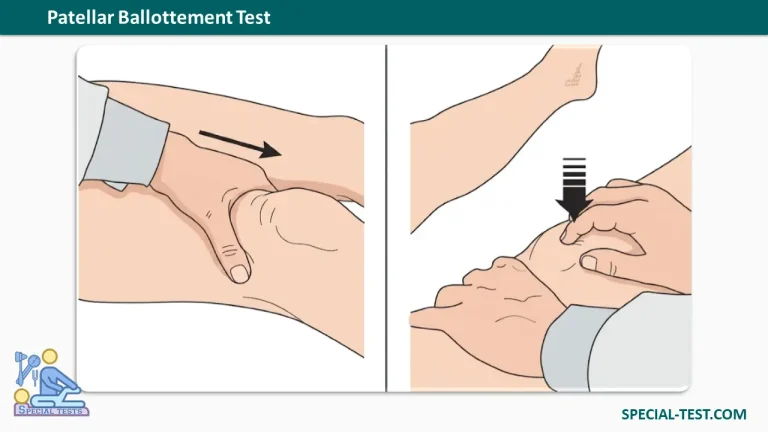
- Position the proximal hand. Grasp the thigh on its front surface about 10 cm above the patella, with the fingers on the inner (medial) side and the thumb on the outer (lateral) side.
- Position the distal hand. With the other hand, grasp the lower leg about 5 cm below the patella, again with the fingers medial and the thumb lateral.
- Squeeze the fluid out of the suprapatellar pouch. The upper hand compresses the front, outer and inner thigh and, while keeping that pressure, slides downward toward the kneecap.
- Compress from below. The lower hand applies similar pressure and slides upward toward the kneecap.
- Tap the patella. Using the index finger of the lower hand, tap the patella down against the femur.
Perform the test on both knees and compare them.
How to Interpret the Results
Normal (negative) result: With little or no free fluid, the patella sits directly against the femoral condyle. The examiner feels no tapping sensation under the fingertips.
Positive result: With excess fluid, the patella floats above the femur. Tapping makes it knock against the femoral condyle, and the examiner feels that click. A positive test points to a significant synovial effusion or hemarthrosis (blood in the joint).
False positives: The test can occasionally be positive when it shouldn’t be. If the uninvolved knee also tests positive, suspect a false-positive finding rather than true effusion.
How Accurate Is the Patellar Tap Test?
Clinical effusion tests vary in reliability. A systematic review in PubMed Central found that reliability and diagnostic accuracy tended to be better in experienced examiners. A diagnostic study by Kastelein and colleagues (2009, Archives of Physical Medicine and Rehabilitation) is widely cited for the test’s performance. Secondary summaries report 83% sensitivity and 49% specificity, which suggests a negative result helps rule out effusion more than a positive result confirms it. Verify these figures against the original paper before quoting them publicly.
Because small effusions are easy to miss, ultrasound is considered superior to physical examination for detecting and localizing knee effusion. If the exam is inconclusive, imaging is the logical next step.
Clinical Tips for Better Results
- Pair the patellar tap with the bulge (stroke) sign, which detects smaller effusions.
- Always compare with the opposite knee.
- Interpret findings alongside history, swelling, warmth, range of motion and ligament testing.
- Remember that swelling outside the joint, such as prepatellar bursitis, will not produce a positive tap.
Frequently Asked Questions (FAQ)
What is the patellar tap test used to detect?
It detects excess fluid (effusion) inside the knee joint, including synovial fluid or blood.
What does a positive patellar ballottement test mean?
It suggests a significant synovial effusion or hemarthrosis. The patella floats on fluid and taps against the femur when pressed.
Does a negative test rule out knee effusion?
Not completely. Small effusions can be missed, so clinicians often add the bulge sign or ultrasound.
What is the difference between the patellar tap test and the bulge sign?
The patellar tap suits moderate to large effusions. The bulge sign suits small ones.
Can the test give a false-positive result?
Yes. If the healthy knee also tests positive, the result is probably false.
Is the patellar tap test painful?
It is usually well tolerated, but a very swollen or injured knee may be tender. The clinician should apply firm but gentle pressure.
Who should perform the test?
A physician, orthopedic specialist or physical therapist. Self-testing is unreliable.
When should I see a doctor for knee swelling?
See a doctor if swelling follows an injury, comes with severe pain, warmth, fever, or inability to bear weight, or if it persists beyond a few days.
References
- Dutton’s Orthopaedic Examination, Evaluation, and Intervention, 3rd ed.
- Kastelein M, et al. Arch Phys Med Rehabil. 2009;90(1):82-86. PubMed.
- Systematic review of clinical tests for knee effusion, PubMed Central (PMC4823277). https://pmc.ncbi.nlm.nih.gov/articles/PMC4823277
- OrthoFixar, “Patellar Tap Test,” https://orthofixar.com