Wilson Test for Knee Osteochondritis Dissecans: How to Perform and Interpret It
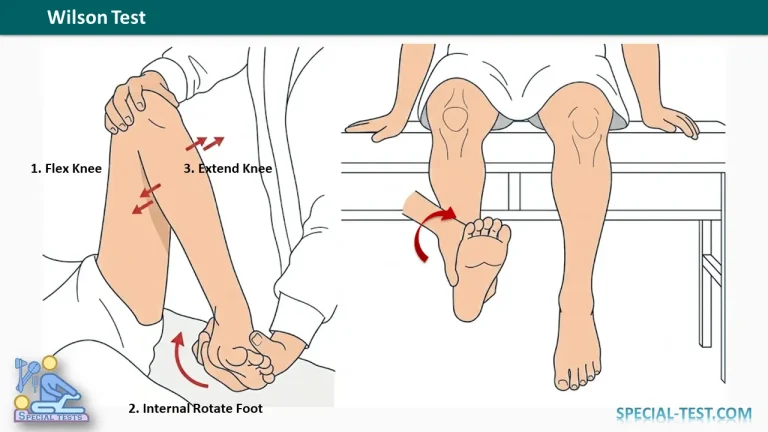
The Wilson Test, also called Wilson’s sign, is a provocative physical examination maneuver used when osteochondritis dissecans (OCD) of the knee is suspected. It was first described by the British orthopedic surgeon A. J. Wilson in a 1967 case series titled “A Diagnostic Sign in Osteochondritis Dissecans of the Knee” [1,2]. More than five decades later, it is still taught and used at the bedside, although its diagnostic value is limited [2,3].
What Is the Wilson Test Used For?
The Wilson Test is used to screen for an osteochondritis dissecans lesion of the knee, most classically on the lateral aspect of the medial femoral condyle, close to the intercondylar notch [2,4]. OCD is a focal condition of the subchondral bone that can secondarily damage the overlying articular cartilage. It is most often seen in adolescents and young adult athletes [4]. The test is meant to reproduce pain by pressing the tibial spine against the lesion during knee extension [2,5].
How to Perform the Wilson Test
The test can be performed in a supine or a sitting position. The principle is the same: extend the knee while the tibia is internally rotated, then see whether external rotation relieves the pain.
Supine Position
- With the patient supine, grasp the knee above the patella with one hand and palpate the area around the medial joint space.
- Passively flex the hip and knee to 90 degrees.
- Ask the patient to gradually and actively extend the knee while the tibia is held in internal rotation. Ask the patient to tell you when pain appears. In OCD, this position brings the tibial spine and ACL region against the lesion on the medial femoral condyle [5].
- From the painful position, ask the patient to externally rotate the tibia.
Sitting Position
- Have the patient sit on the edge of the table with the legs dangling.
- Flex the knee to 90 degrees.
- Grasp the foot and bring the tibia into internal rotation.
- Ask the patient to extend the leg until pain is felt.
- Then externally rotate the tibia and note any relief.
What Is a Positive Wilson Test?
The test is positive when pain appears during knee extension with the tibia internally rotated and is relieved by external rotation of the tibia [3,5]. In patients with OCD, the pain typically appears at roughly 20 to 30 degrees of knee flexion, from pressure on the joint and from the palpating fingers [5,6]. The painful area corresponds to the classic OCD site on the medial femoral condyle near the intercondylar fossa. Positive findings have been documented in published case reports of juvenile and adolescent patients with OCD of the knee [7,8].
How Accurate Is the Wilson Test?
Accuracy is the main limitation of this test. The literature describes the Wilson sign as having low sensitivity, so a negative test does not exclude OCD [3,5]. A 2003 retrospective review of 32 patients, cited in a historical review of eponyms in pediatric sports medicine, found that 75% of patients with radiographic OCD had a negative test [3]. For this reason, the Wilson sign is of minimal diagnostic value on its own. When it is positive, however, it can be useful as a clinical marker for monitoring a patient during treatment [5].
Clinical Pearls
- Use the Wilson Test together with history (vague, activity-related knee pain, effusion, mechanical symptoms) and imaging. It should never be the only basis for diagnosis [4].
- Standard radiographs and MRI remain the key tools for confirming OCD and judging fragment stability. Stability strongly influences management [4,9].
- Compare both knees, as OCD lesions are sometimes bilateral [7].
- Document the knee flexion angle at which pain appears and whether external rotation relieves it, so you can track changes over time.
Research Limitations
Evidence on the Wilson Test is limited. Most published information comes from the original 1967 series, case reports, and narrative reviews, and few modern studies report its sensitivity and specificity. Clinicians should interpret the test within the whole clinical picture.
Frequently Asked Questions (FAQ)
What is the Wilson Test?
The Wilson Test is a provocative knee examination used when osteochondritis dissecans is suspected. It is positive when pain during extension with internal tibial rotation is relieved by external rotation [3].
Which part of the knee does the Wilson Test evaluate?
It targets the classic OCD location: the lateral aspect of the medial femoral condyle, near the intercondylar notch [2,4].
At what angle does the pain occur in a positive Wilson Test?
Pain typically appears between about 20 and 30 degrees of knee flexion during extension [5,6].
Can the Wilson Test be performed sitting?
Yes. The patient sits with the knee flexed to 90 degrees, the examiner internally rotates the tibia, and the patient extends the leg until pain occurs. External rotation should then reduce the pain.
Does a negative Wilson Test rule out osteochondritis dissecans?
No. The test has low sensitivity, so OCD can be present even when it is negative [3,5]. Imaging is needed when suspicion remains.
Is the Wilson Test reliable for diagnosis?
It has minimal diagnostic value alone. It is better used as one element of the exam and as a clinical monitor during treatment when it was initially positive [5].
What tests confirm osteochondritis dissecans?
Radiographs and MRI are the main confirmatory tools. MRI also helps assess whether the lesion is stable or unstable [4,9].
Who is most likely to have knee OCD?
Adolescents and young adult athletes are most commonly affected, though adults can also present with OCD [4].
References
- Wilson JN. A diagnostic sign in osteochondritis dissecans of the knee. J Bone Joint Surg Am. 1967;49(3):477-480. PubMed PMID: 6022357. https://pubmed.ncbi.nlm.nih.gov/6022357/
- Orthofixar. Wilson Test. https://orthofixar.com/special-test/wilson-test/
- Bayomy AF, Forrester LA, Crowley SG, Popkin CA. Eponyms in Pediatric Sports Medicine: A Historical Review. Open Access J Sports Med. 2021;12.
- Pill SG, Ganley TJ, Flynn JM, et al. Osteochondritis dissecans of the knee: experiences at The Children’s Hospital of Philadelphia and a review of the literature. Univ Pennsylvania Orthop J. 2001;14.
- Orthofixar. Wilson Test (clinical description and accuracy). https://orthofixar.com/special-test/wilson-test/
- Dutton M. Dutton’s Orthopaedic Examination, Evaluation, and Intervention. 3rd ed.
- Bilateral osteochondritis dissecans of the knee in a basketball player: case report. PubMed Central PMC4799425. https://pmc.ncbi.nlm.nih.gov/articles/PMC4799425
- Multiple osteochondritis dissecans of the knee joint in a patient with Wilson disease, focusing on magnetic resonance findings. Knee Surg Relat Res. PubMed Central PMC3867617. https://pmc.ncbi.nlm.nih.gov/articles/PMC3867617
- Juvenile versus adult osteochondritis dissecans of the knee: appropriate MR imaging criteria for instability. Radiology. 2008. PubMed PMID: 18552309. https://pubmed.ncbi.nlm.nih.gov/18552309/