Medial McMurray’s Test for Meniscus Tears: Technique, Results & Accuracy
What Is the Medial McMurray’s Test Used For?
The medial McMurray’s test is a physical examination maneuver that clinicians use to screen for an injury to the medial meniscus. The medial meniscus is the C-shaped fibrocartilage pad on the inner side of the knee. It cushions the joint, spreads load, and helps keep the knee stable. Tears are among the most common knee injuries, and they often follow a twisting movement or develop through gradual degeneration.
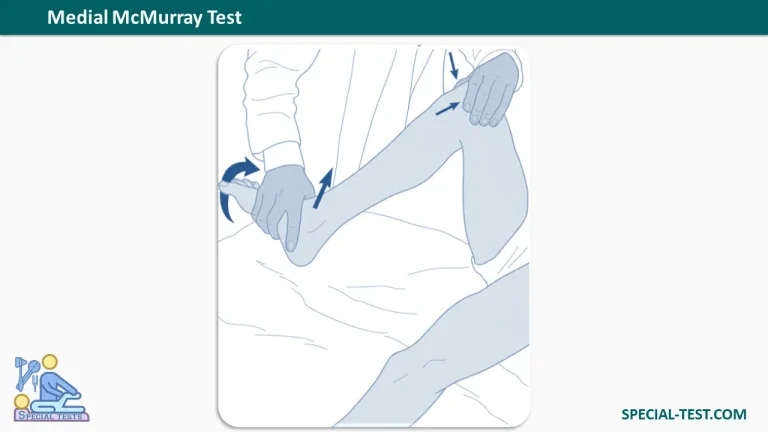
The test works by moving the knee from flexion into extension while rotating the tibia. If a torn fragment of meniscus is trapped or displaced, the examiner may feel or hear a click or catch at the joint line.
How to Perform the Medial McMurray’s Test
Follow these steps:
- Position the patient. The patient lies supine (face up) with the affected hip and knee flexed.
- Place the proximal hand. Cup one hand over the knee, with the palm over the patella and the fingers and thumb along the joint line, so you can feel any click.
- Hold the heel. Grasp the patient’s heel with the other hand to control the lower leg.
- Extend with rotation. Slowly extend the knee while applying external rotation of the tibia. This stresses the medial meniscus.
Some clinical texts also add a valgus stress during this motion. The version above follows Clinical Tests for the Musculoskeletal System and Dutton’s Orthopaedic Examination, Evaluation, and Intervention. Move slowly and stop if the patient has significant pain. Compare the result with the unaffected knee.
What Counts as a Positive Result?
A positive sign is a click or catch felt or heard as the knee extends. Pain at the medial joint line during the maneuver supports the finding.
A negative test does not completely rule out a meniscal tear. Many tears, especially some degenerative or partial ones, do not produce a click, so a normal result should never end the work-up when symptoms persist.
How Accurate Is the Medial McMurray’s Test?
A prospective study published in PubMed Central compared McMurray’s test with arthroscopy, the gold standard. For diagnosing medial meniscus tear, it reported a sensitivity of 54%, a specificity of 79%, a positive predictive value of 68%, and a negative predictive value of 67.5%.
- Sensitivity of 54% means the test misses a substantial share of true medial meniscus tears.
- Specificity of 79% means a positive result is fairly reliable, because few people without a tear test positive.
The same study concluded that tests like McMurray’s and joint line tenderness have low diagnostic value when used individually.
Broader evidence points the same way. A systematic review of 11 studies found that McMurray’s test has relatively high specificity but low sensitivity, which limits its clinical value on its own. A BMJ Evidence-Based Medicine meta-analysis reported a pooled sensitivity of 61% and specificity of 84% for McMurray’s, and concluded that the accuracy of special tests for meniscal tears remains poor. Earlier, a JOSPT meta-analysis found no single physical examination test accurately diagnoses a torn meniscus.
Why the Test Should Not Be Used Alone
Because of its modest sensitivity, clinicians treat McMurray’s test as one piece of the puzzle. A sound knee assessment combines:
- The patient’s history, including the mechanism of injury, locking, catching, and swelling
- Joint line tenderness
- Other meniscal tests, such as Thessaly’s or Apley’s
- Imaging, usually MRI, when a tear is suspected
- Arthroscopy when diagnosis and treatment overlap
If you have knee pain, locking, or giving way, see a qualified clinician rather than relying on a self-performed test.
Frequently Asked Questions (FAQ)
What does the medial McMurray’s test check for?
It screens for an injury to the medial meniscus, the cartilage pad on the inner side of the knee.
What is a positive medial McMurray’s test?
A click or catch felt or heard when the knee is extended with external rotation of the tibia. Pain at the joint line supports the finding.
Does a negative McMurray’s test rule out a meniscus tear?
No. A negative result does not fully exclude a tear, because sensitivity is only moderate.
How accurate is the medial McMurray’s test?
One arthroscopy-controlled study found 54% sensitivity and 79% specificity. Pooled estimates from reviews vary, but they agree that the test is better at confirming than excluding a tear.
Can I perform the test on myself?
It is designed for trained examiners. Self-testing can aggravate an injured knee and is not a reliable diagnosis.
What other tests are used for meniscus injuries?
Joint line tenderness, Thessaly’s test, and Apley’s test are commonly used, and MRI confirms the diagnosis.
Is the test painful?
It can cause discomfort if the meniscus is injured. The examiner should move slowly and stop if pain becomes severe.
References
- Clinical Tests for the Musculoskeletal System, 3rd ed.
- Dutton’s Orthopaedic Examination, Evaluation, and Intervention, 3rd ed.
- McMurray’s Test and Joint Line Tenderness for Medial Meniscus Tear: Are They Accurate? Ethiop J Health Sci. 2016 (PMC5389077): https://pmc.ncbi.nlm.nih.gov/articles/PMC5389077
- Validity of the McMurray’s Test and Modified Versions of the Test: A Systematic Literature Review. J Man Manip Ther. 2009 (PMC2704345): https://pmc.ncbi.nlm.nih.gov/articles/PMC2704345
- Smith BE et al. Special tests for assessing meniscal tears within the knee: a systematic review and meta-analysis. Evid Based Med. 2015;20(3):88: https://ebm.bmj.com/content/20/3/88
- Hegedus EJ et al. Physical examination tests for assessing a torn meniscus in the knee: a systematic review with meta-analysis. J Orthop Sports Phys Ther. 2007 (doi:10.2519/jospt.2007.2560)