Medial Plica Shelf Test: Technique, Positive Sign & Accuracy
What Is the Medial Plica Shelf Test Used For?
The medial plica shelf test is a clinical special test for plica syndrome of the knee. It checks whether a medial synovial plica, a fold of joint lining on the inner side of the knee, has become irritated and is a source of pain.
A plica is a leftover fold of synovial tissue from fetal development. Most people have one and never notice it. A PubMed review of synovial plicae notes that the medial plica is a normal structure that only rarely becomes symptomatic, usually after blunt trauma or knee overuse. When it does, it can cause:
- Pain on the inner (medial) side of the kneecap
- Snapping, popping, or crepitus during knee movement
- Swelling or a catching sensation
These symptoms closely mimic a medial meniscus tear or patellofemoral pain, which is why a targeted physical exam matters.
How to Perform the Medial Plica Shelf Test
The test is quick and needs no equipment beyond a bolster or the examiner’s thigh.
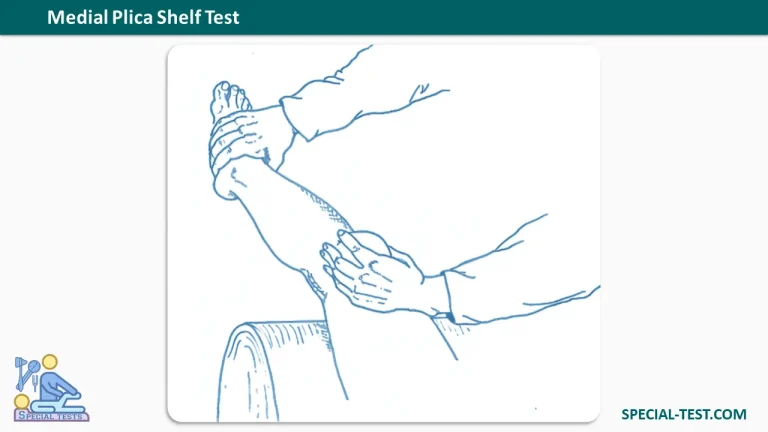
- Position the patient. The patient lies supine on the examination bed.
- Flex the knee. Support the knee in about 30 degrees of flexion, using a bolster or your own thigh.
- Place your hands. Put both thumbs together on the lateral edge of the patella.
- Push medially. Gently glide the patella toward the inner side of the knee, and watch and listen for pain or a click.
Test both knees so you can compare sides. Perform the test slowly and with controlled pressure.
What Is a Positive Result?
The test is positive if it produces a painful click. This suggests a symptomatic mediopatellar synovial plica, meaning the fold is catching or impinging against the medial femoral condyle or patellar surface.
A painless click is not enough to call the test positive. Plicae are common in healthy knees, and an arthroscopic study cited in PubMed found a medial synovial shelf present in the majority of the 500 knees examined. The key finding is whether the maneuver reproduces the patient’s familiar pain.
How Accurate Is the Test?
A systematic review and meta-analysis in The Knee (Stubbings & Smith, 2014; indexed on PubMed) pooled seven studies covering 492 knees. It found the following:
| Assessment | Sensitivity | Specificity |
|---|---|---|
| Medial patellar plica physical exam test | 0.90 | 0.89 |
| Ultrasound | 0.90 | 0.83 |
| MRI | 0.77 | 0.58 |
The physical examination test performed as well as or better than imaging, which shows how valuable a careful hands-on exam is. The authors rated the methodological quality as moderate, so results should be read alongside the full clinical picture.
Related Tests for Plica Syndrome
Clinicians often combine several tests, as listed on OrthoFixar’s clinical test resources:
- Hughston plica test
- Stutter test (patellar stutter test)
- Mediopatellar plica test
Findings from these tests, together with the history and imaging, help rule out meniscal tears, patellofemoral syndrome, and cartilage injury.
What Happens After a Positive Test?
A positive test does not by itself confirm the diagnosis. A mini-review in Current Rheumatology Reviews reports that the mediopatellar plica is found in roughly 18% to 60% of people, so many plicae are incidental. MRI or ultrasound can help show the plica’s size and location.
Treatment is usually conservative first: rest, activity modification, anti-inflammatory medication, physiotherapy, and quadriceps strengthening. PubMed-indexed studies report that arthroscopic resection is considered when conservative care fails, and one study of patients over 40 reported satisfaction rates of 85.5% at a minimum of three years.
Frequently Asked Questions (FAQ)
What is the medial plica shelf test used for?
It screens for a symptomatic medial synovial plica, the cause of plica syndrome of the knee.
What position is the patient in?
The patient lies supine with the knee supported in about 30 degrees of flexion.
What counts as a positive result?
A painful click when the patella is pushed medially suggests a symptomatic mediopatellar synovial plica.
Is the medial plica test reliable?
A PubMed-indexed meta-analysis found a pooled sensitivity of 0.90 and specificity of 0.89, higher than MRI in the same review.
Can plica syndrome be mistaken for other knee problems?
Yes. It commonly mimics a medial meniscus tear and patellofemoral pain syndrome, so the history and several tests should be considered together.
Does a positive test mean I need surgery?
No. Most cases are managed first with rest, physiotherapy, and strengthening. Arthroscopic surgery is reserved for cases that do not respond.
Should I perform this test on myself?
No. This is a clinical examination. If you have persistent inner-knee pain, clicking, or swelling, see a physician or physiotherapist.
References
- Stubbings N, Smith T. Diagnostic test accuracy of clinical and radiological assessments for medial patella plica syndrome: a systematic review and meta-analysis. The Knee. 2014;21(2):486-490. PubMed 24280039
- Synovial plicae of the knee: controversies and review. PubMed-indexed review. QxMD summary
- Medial plica-related abrasion syndrome in middle and old age. PubMed 25906102
- Medial plica irritation: diagnosis and treatment. PMC2684145
- El Ghoch MI. Clinical management of medial patellar plica syndrome: mini review. Current Rheumatology Reviews.
- Medial plica and plica syndrome tests. OrthoFixar (orthofixar.com).
- Clinical Tests for the Musculoskeletal System, 3rd Edition.
- Dutton’s Orthopaedic Examination, Evaluation, and Intervention, 3rd Edition.