Bounce Home Test: Knee Meniscus Tear and Loose Body Exam
What Is the Bounce Home Test Used For?
The Bounce Home Test is a quick orthopedic physical examination maneuver used to screen for intra-articular knee pathology that blocks terminal extension. It is mainly used to assess for:
- Meniscus tear, particularly a displaced tear that mechanically limits full extension
- Loose bodies (intra-articular fragments of cartilage or bone)
The logic is simple. A healthy knee extends fully when released from flexion and stops with a sharp, definite end point. A torn meniscus fragment or a loose body can interfere with this movement. Joint effusion can also limit terminal extension [1].
How to Perform the Bounce Home Test
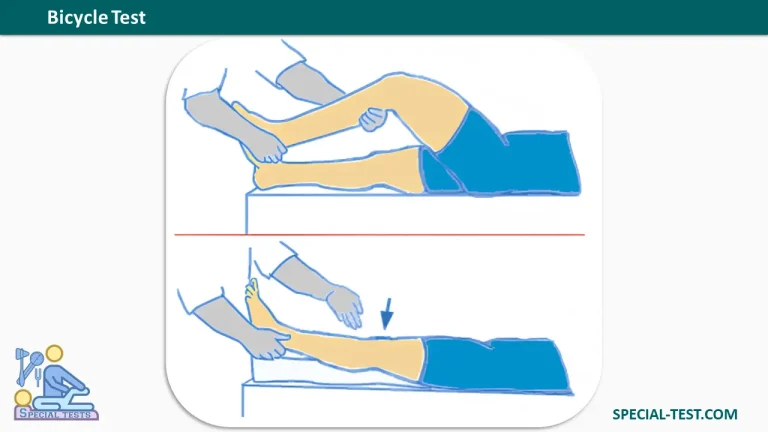
- Place the patient supine on the examination table with the leg relaxed.
- Cup the patient’s heel or foot in your hand and passively flex the knee.
- Let the knee fall into extension under gravity, without pushing or resisting the movement.
- Observe how far the knee extends and note the quality of the end feel.
Perform the test on both knees. The uninjured side gives you a baseline for that patient’s normal end-range extension.
Interpreting the Result
Positive test: The knee does not fully extend, or it stops with an abnormal end feel.
- Rubbery or springy end feel at the joint line: this suggests a torn meniscus, where a displaced fragment may be blocking extension.
- Hard end feel: this may suggest intra-articular fragments such as loose bodies.
Negative test: The knee “bounces home” into full extension with a sharp, definite end point and no pain.
A positive result is a clinical flag, not a diagnosis. It should prompt a fuller knee examination and, where appropriate, imaging such as MRI.
Diagnostic Accuracy
Reported accuracy figures for the Bounce Home Test are modest:
| Measure | Reported value |
|---|---|
| Sensitivity | 47% |
| Specificity | 67% |
With a sensitivity below 50%, the test misses more than half of the tears it is meant to detect, so a negative result cannot rule out a meniscus tear. With a specificity of 67%, about one in three patients without a tear may still test positive. For this reason the test works best as one part of a cluster of findings, not as a stand-alone tool [1]. Systematic reviews of meniscal examination tests reach a similar conclusion: no single physical test reliably confirms or excludes a tear, and combining history, joint line tenderness and provocative tests such as McMurray’s, Apley’s and Thessaly performs better than any one maneuver [2].
Clinical Context: Why Accurate Diagnosis Matters
Not every meniscus tear needs surgery. In the NEJM trial by Katz et al., patients with a meniscal tear and mild to moderate knee osteoarthritis improved similarly with physical therapy alone or with arthroscopic partial meniscectomy [3]. Mechanical symptoms such as a true locked knee or a persistent extension block are different. They are the findings that most often push the decision toward surgery, which is why a test that detects an extension block still has a role at the bedside.
Limitations
Evidence for the Bounce Home Test is limited. The accuracy values above come from textbook-level sources, and high-quality diagnostic accuracy studies against arthroscopy or MRI are scarce. Results also depend on examiner experience, patient relaxation, pain, swelling and hamstring guarding. Use the test alongside the full clinical picture, not on its own.
Frequently Asked Questions (FAQ)
What is the Bounce Home Test?
It is a passive knee extension test that screens for a torn meniscus or loose bodies by assessing whether the knee reaches full extension with a normal end feel.
What does a positive Bounce Home Test mean?
It means the knee fails to extend fully or has an abnormal end feel. A rubbery end feel points toward a meniscus tear, and a hard end feel suggests loose bodies.
How accurate is the Bounce Home Test?
Reported sensitivity is 47% and specificity is 67%. This is modest accuracy, so the test should not be used alone.
Can a negative Bounce Home Test rule out a meniscus tear?
No. Because sensitivity is below 50%, many meniscal tears will still be missed.
What other tests should be combined with it?
Joint line tenderness, McMurray’s test, Apley’s test and the Thessaly test are commonly used with it, and MRI is used when the diagnosis is unclear [2].
Does a meniscus tear always require surgery?
No. Many degenerative tears respond well to structured physical therapy, while mechanical symptoms or persistent locking may need surgical evaluation [3].
Who should perform this test?
Physicians, orthopedic surgeons, physical therapists and trained clinicians as part of a complete knee examination.
References
- Magee DJ. Orthopedic Physical Assessment. 6th ed. St. Louis, MO: Saunders Elsevier; 2014.
- Hegedus EJ, Cook C, Hasselblad V, Goode A, McCrory DC. Physical examination tests for assessing a torn meniscus in the knee: a systematic review with meta-analysis. J Orthop Sports Phys Ther. 2007;37(9):541-550. (PubMed-indexed)
- Katz JN, Brophy RH, Chaisson CE, et al. Surgery versus physical therapy for a meniscal tear and osteoarthritis. N Engl J Med. 2013;368(18):1675-1684. doi:10.1056/NEJMoa1301408. (PubMed-indexed)