Thessaly Test for Meniscus Tears: How to Perform It, Positive Signs & Accuracy
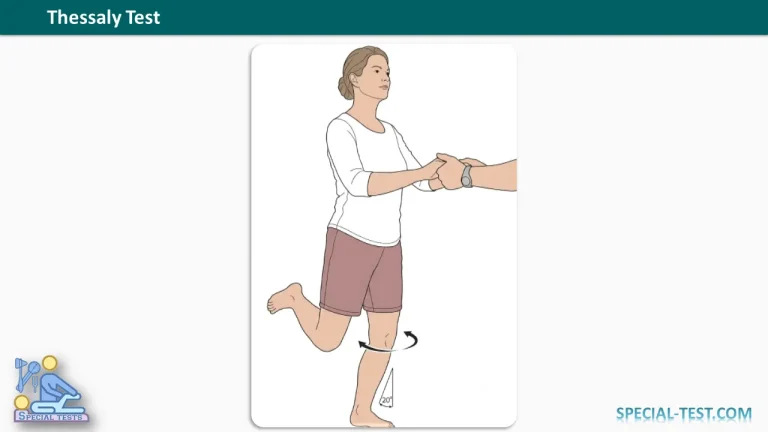
Knee pain, catching, and a feeling that the joint is “locking” are common reasons people see an orthopedic specialist or physiotherapist. One bedside screening tool used for these complaints is the Thessaly test, a weight-bearing clinical test designed to help detect meniscal tears. This guide explains what the test is, how it is done, how to read the result, and how reliable it is.
What Is the Thessaly Test Used For?
The Thessaly test is used to detect lateral or medial meniscal tears of the knee. The menisci are two C-shaped pieces of cartilage that cushion the knee and help stabilize it. When one is torn, people often report joint line pain, swelling, catching, or locking. Because the Thessaly test loads the knee while the patient stands and twists, it reproduces the forces that tend to provoke symptoms from a damaged meniscus.
How to Perform the Thessaly Test
The test is performed by a trained clinician, such as an orthopedic doctor or physical therapist. The steps are:
- Starting position: The patient stands flat-footed on one leg (the affected knee is tested). The examiner supports the patient by holding their outstretched hands for balance.
- First stage, 5° of knee flexion: The patient bends the knee to about 5° and rotates the femur on the tibia, turning the body inward (medially) and outward (laterally) three times while keeping the 5° of flexion.
- Second stage, 20° of knee flexion: The same twisting movement is repeated with the knee bent to 20°.
The test is usually performed on the healthy knee first, so the clinician can compare it with the painful side.
What Is a Positive Thessaly Test?
The test is considered positive for a meniscus tear if the patient experiences:
- Medial or lateral joint line discomfort, or
- A sense of locking or catching in the knee.
A positive result raises suspicion of a medial or lateral meniscal tear. It is not a diagnosis on its own.
How Accurate Is the Thessaly Test?
According to the figures reported in the clinical literature summarized by Orthofixar and in American Family Physician (Grover, 2012):
- Sensitivity: about 64-66%
- Specificity: about 39-53%
Sensitivity tells us how often the test is positive in people who truly have a tear. Specificity tells us how often it is negative in people who do not. With these values, a positive result can occur in people without a tear, and a negative result does not fully exclude one. Accuracy figures vary between studies, partly because of differences in patient populations and in how experienced the examiner is.
Why the Thessaly Test Should Not Be Used Alone
Because of its moderate accuracy, the Thessaly test works best as one part of a complete knee examination. Clinicians typically combine it with:
- The patient’s history, such as a twisting injury or mechanical symptoms
- Joint line tenderness
- Other meniscal tests
- Assessment of swelling and range of motion
- Imaging such as MRI when needed
A thorough assessment of acute knee injuries, including ligament and meniscal evaluation, is described in American Family Physician (Grover, 2012).
Frequently Asked Questions (FAQ)
What is the Thessaly test used for?
It is a clinical test used to detect medial or lateral meniscal tears of the knee.
How is the Thessaly test performed?
The patient stands on one leg while holding the examiner’s hands, bends the knee to 5° and twists the femur on the tibia inward and outward three times, then repeats the movement at 20° of flexion.
What does a positive Thessaly test mean?
It means the patient felt medial or lateral joint line discomfort, or a sense of locking or catching. This suggests a possible meniscus tear.
How accurate is the Thessaly test?
Reported sensitivity is about 64-66% and specificity about 39-53%, so it should be interpreted alongside other findings.
Can the Thessaly test confirm a meniscus tear?
No. It helps raise or lower suspicion, but a diagnosis usually requires a full clinical examination and, in many cases, MRI.
Is the Thessaly test painful?
It can provoke discomfort if a meniscal problem is present, since that is what a positive result looks for. It should be done gently and stopped if pain is severe.
Who should perform the Thessaly test?
A trained clinician, such as an orthopedic physician or physiotherapist.
Can a normal result rule out a meniscal tear?
Not completely. Because sensitivity is only moderate, a tear can still be present, especially if symptoms continue.
References
- Grover ML. Evaluating acutely injured patients for internal derangement of the knee. American Family Physician. 2012;85(3):247-252. Link
- Thessaly Test | Orthofixar