Apley’s Compression Test: How to Perform It and Interpret Results for Meniscus Tears
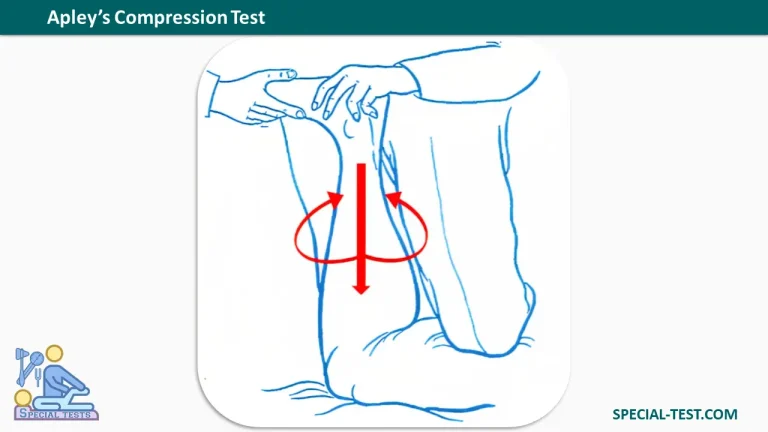
Apley’s Compression Test: A Clinical Guide to Meniscal Assessment
Apley’s compression test, also called the Apley grind test, is a classic physical examination maneuver for the knee. It is used to screen for a meniscal tear, and many clinicians pair it with Apley’s distraction test to help separate meniscal from ligamentous pain.[1][2] This guide covers how to perform it, how to read the result, and what the evidence says about its diagnostic value.
What Is Apley’s Compression Test Used For?
The test assesses the integrity of the medial and lateral menisci, the C-shaped fibrocartilage structures that absorb load, stabilize the knee, and help distribute forces across the tibiofemoral joint. Meniscal tears are common in both athletes and older adults with degenerative knees. Because the history and examination guide the decision to order MRI, a reliable bedside test is valuable.[3]
The test is performed in two parts. The compression component targets the menisci, while the distraction component stresses the ligaments and capsule. Pain that appears with compression but not with distraction points toward the meniscus.[2]
How to Perform Apley’s Compression Test
- Position the patient prone on the examination table.
- Flex the affected knee to 90°.
- Position your hands. One hand grasps the heel and ankle, and the other stabilizes the thigh or leg.
- Compress the joint. Push the foot and tibia down toward the table, loading the flexed knee and compressing the menisci between the femur and tibia.
- Rotate the tibia internally and externally while maintaining compression, and note where the patient reports pain.
- Compare with the unaffected knee for baseline tolerance.
Keep the compression firm but controlled. Excessive force in an already painful knee can cause false-positive responses.
Interpreting a Positive Result
A positive test is reproduction of the patient’s pain during compression with rotation:
- Pain on the medial aspect: suggests medial meniscus injury.
- Pain on the lateral aspect: suggests lateral meniscus injury.
If pain is present with both compression and distraction, a ligamentous or other non-meniscal source is more likely.[2]
How Accurate Is Apley’s Compression Test?
This is where clinicians should be cautious. A PubMed-indexed systematic review and meta-analysis by Hegedus et al. pooled data from multiple studies and found a sensitivity of 60% and specificity of 70% for Apley’s test. The review concluded that no single physical examination test accurately diagnoses a torn meniscus.[1] A later diagnostic accuracy study of 255 patients summarized reported ranges for Apley’s test of 13–61% sensitivity and 70–94% specificity, and found that combining McMurray’s and Apley’s tests gave the best accuracy for limiting false positives.[3] A separate meta-analysis found that the available studies on Apley’s test were few and its sensitivity and specificity were not clearly correlated, so estimates are unstable.[4]
What this means in practice:
- A positive test raises suspicion but does not confirm a tear.
- A negative test does not reliably rule one out.
- Accuracy depends on examiner technique, how a “positive” is defined, and the reference standard (MRI or arthroscopy).
- Results are best interpreted together with history, joint line tenderness, McMurray’s test, and the Thessaly test, then confirmed with imaging when needed.
Limitations of the Evidence
Published studies vary widely in how they perform and define the test, in patient populations, and in study quality, and review and verification bias can inflate sensitivity. Pooled figures should therefore be treated as approximate rather than fixed properties of the test.[1][4]
Frequently Asked Questions (FAQ)
What is Apley’s compression test used for?
It screens for meniscal injury of the knee, helping identify possible medial or lateral meniscus damage.
What is the difference between Apley’s compression and distraction tests?
Compression loads the menisci, so pain suggests a meniscal tear. Distraction unloads the menisci and stresses the ligaments, so pain suggests a ligamentous injury.
What position is the patient in?
Prone, with the knee flexed to 90°.
What counts as a positive Apley’s test?
Pain over the medial or lateral joint line during compression with tibial rotation, indicating medial or lateral meniscus injury respectively.
How accurate is Apley’s compression test?
Pooled PubMed-indexed data show moderate accuracy, about 60% sensitivity and 70% specificity, so it should not be used alone.[1]
Is Apley’s test better than McMurray’s test?
Pooled estimates for McMurray’s test were slightly higher (70% sensitivity, 71% specificity), but neither is definitive. Using them together improves accuracy.[1][3]
Do I need an MRI if the test is positive?
Not always. MRI is considered when symptoms, mechanical findings, and examination together suggest a tear that would change management.
Can the test be painful?
Yes, if a meniscal tear or arthritis is present, which is why the result is considered positive. Apply compression gradually.
References
- Hegedus EJ, Cook C, Hasselblad V, Goode A, McCrory DC. Physical examination tests for assessing a torn meniscus in the knee: a systematic review with meta-analysis. J Orthop Sports Phys Ther. 2007;37(9):541-550. PubMed: https://pubmed.ncbi.nlm.nih.gov/17939613/
- Orthofixar.com. Apley grind / distraction test pages (insert your exact article URLs here).
- Clinical reliability of 6 meniscal tests: a diagnostic accuracy study of 255 patients. Acta Orthop. https://actaorthop.org/actao/article/download/43906/50554
- Accuracy of physical diagnostic tests for assessing meniscal lesions of the knee: a meta-analysis. J Fam Pract. https://www.mdedge.com/jfponline/article/60679/accuracy-physical-diagnostic-tests-assessing-meniscal-lesions-knee-meta/page/0/2