Meta title: Thomas Test for Hip Flexor Tightness: How to Perform & Interpret
What Is the Thomas Test Used For?
The Thomas Test is a clinical orthopedic test that assesses hip flexor flexibility and shortening. Clinicians and physical therapists use it to screen for tightness in the muscles that cross the front of the hip, including:
- Iliopsoas muscle group
- Rectus femoris
- Pectineus
- Gracilis
- Tensor fasciae latae (TFL)
- Sartorius
Tight hip flexors are commonly discussed in relation to hip, pelvic, and lower back complaints, so the test is a quick and useful part of a lower-limb or lumbopelvic examination. It is often called a test for iliopsoas tightness, and it is also widely used in sports medicine to look at flexibility in athletes (Harvey, 1998).
How to Perform the Thomas Test
The test is simple, but positioning matters. If the pelvis or lower back is not controlled, the result can be misleading.
- Start position: The patient lies supine (on their back) on the examination table.
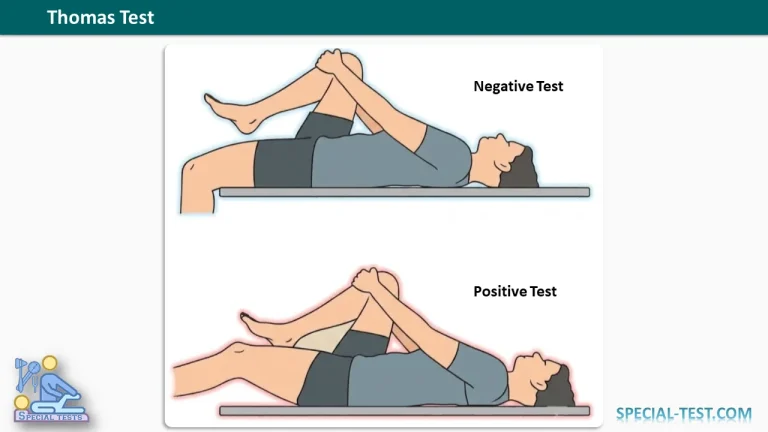
- Flex both knees: The patient brings both knees to the chest as far as possible. Using both arms, they pull the knees in so the lumbar spine is flexed and flat against the table. This avoids a posterior pelvic tilt.
- Lower the tested limb: While keeping the opposite hip and knee in full flexion, the patient lowers the tested leg toward the table. The held leg stabilizes the pelvis and flattens the lumbar lordosis.
- Observe: The examiner watches the position of the lower back and sacrum, the angle of the hip, and the angle of the knee.
- Repeat on the other side and compare.
How to Interpret the Results
Negative (normal) result
The test is negative when the lower back and sacrum stay on the table. In this case:
- The hip rests at about 10° of posterior tilt or hip extension.
- The knee can reach 90° of flexion.
Positive result
The test is positive when any of the following occur:
- The patient cannot keep the lower back and sacrum flat on the table.
- The hip shows a large posterior tilt, or hip extension greater than 15°.
- The knee cannot reach more than 80° of flexion.
As a rough guide, a hip that stays raised often points toward the iliopsoas, while limited knee flexion suggests the rectus femoris is involved. This is why many clinicians watch both the hip and the knee during the test.
Accuracy of the Thomas Test
The reported diagnostic accuracy is modest:
- Sensitivity: 31%
- Specificity: 57%
With sensitivity this low, a negative result cannot reliably rule out hip flexor tightness, and a positive one should not be read in isolation. Research on the test’s reliability points the same way: inter-rater agreement varies with method and examiner technique, which is why consistent positioning matters (Peeler & Anderson, 2007). The test works best as one part of a full assessment alongside history, observation, range of motion, and other special tests.
Tips for Reliable Testing
- Make sure the lumbar spine is flat before lowering the tested leg.
- Keep the non-tested hip in full flexion throughout.
- Use the same position and method each time if you plan to retest.
- Compare both sides, and record hip and knee angles rather than only “positive” or “negative.”
Frequently Asked Questions (FAQ)
What does a positive Thomas Test mean?
It suggests shortening or tightness of the hip flexor muscles, such as the iliopsoas, rectus femoris, or tensor fasciae latae. It is a screening finding, not a diagnosis.
Which muscles does the Thomas Test assess?
The iliopsoas group, rectus femoris, pectineus, gracilis, tensor fasciae latae, and sartorius.
What is a normal Thomas Test result?
The lower back and sacrum stay on the table, the hip rests at about 10° of extension or posterior tilt, and the knee reaches 90° of flexion.
Why must the opposite knee be held to the chest?
Holding it in full flexion stabilizes the pelvis and flattens the lumbar curve. Without this, the pelvis can tilt and hide or exaggerate hip flexor tightness.
How accurate is the Thomas Test?
Reported sensitivity is 31% and specificity is 57%, so it should be combined with other clinical findings.
Can the Thomas Test diagnose hip or back problems?
No. It measures hip flexor flexibility only, so a clinician should interpret it together with the rest of the examination.
Is the Thomas Test the same as testing for iliopsoas tightness?
It is commonly used for that purpose, and it also screens other hip flexors, including the rectus femoris and TFL.
References
- Clinical Tests for the Musculoskeletal System, 3rd Edition.
- Harvey D. Assessment of the flexibility of elite athletes using the modified Thomas test. Br J Sports Med. 1998;32(1):68-70. (PubMed)
- Peeler J, Anderson JE. Reliability of the Thomas test for assessing range of motion about the hip. Phys Ther Sport. 2007;8(1):14-21. (PubMed)
- Thomas Test | Iliopsoas Tightness, Orthofixar