Step Down Test (Lateral Step-Down Test): Procedure, Positive Signs & Accuracy
What Is the Step Down Test Used For?
The Step Down Test is a functional task for assessing movement quality in the lower limb. It places weight-bearing stress on the leg and challenges dynamic muscular control, so it shows how well the hip, knee, and ankle work together during a controlled single-leg movement.
You may also see it called the Lateral Step-Down Test (LSD Test). Clinicians and physiotherapists use it to watch how a patient controls the pelvis, trunk, and knee while lowering the body from a step.
How to Perform the Step Down Test
The test is quick and needs only a 20 cm step. The standard procedure is:
- Set the starting position. The patient stands on a 20 cm step with the foot of the tested limb close to the edge. The non-tested limb is positioned in front of the step, with the knee straight and the ankle at maximum dorsiflexion.
- Lower the body. The patient keeps the trunk straight and the hands on the waist, then bends the knee of the tested side until the heel of the non-tested limb touches the floor.
- Return to the start. Once the heel touches the floor, the patient must not put any weight on it. They immediately re-extend the knee of the tested limb to return to the starting position.
- Rate the performance. The examiner observes and rates the movement across five repetitions.
During the test, the examiner watches the pelvis, trunk, and knee alignment throughout the movement.
What Is a Positive Result?
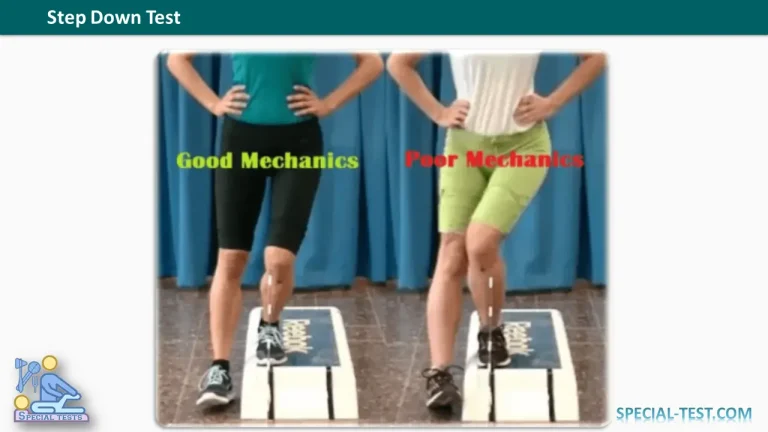
A positive Step Down Test shows two main signs:
- Pelvic drop: the pelvis tilts down and away from the supporting limb. This is known as the Trendelenburg sign.
- Medial knee collapse: the supporting knee collapses inward into valgus.
These signs suggest the patient has difficulty controlling the lower limb under load. This can point to poor dynamic muscular control during weight-bearing activity.
How Accurate Is the Step Down Test?
Reliability matters when you rely on a clinical test. For rating movement quality on the Forward Step Down test, the kappa coefficient was 0.80 (95% confidence interval: 0.57 to 1.00), and percent agreement was 85%. A kappa of 0.80 is generally considered good agreement between raters. This suggests that, with a standardized procedure, different examiners can rate the movement consistently.
Why Standardization Matters
Because the test relies on observation, results depend on consistent setup. Using the same step height (20 cm), the same hand and trunk position, and the same five-repetition rating helps keep findings comparable between sessions and between examiners. The test is best used as part of a broader clinical assessment rather than as a stand-alone diagnosis.
Frequently Asked Questions (FAQ)
What is the Step Down Test?
It is a functional test that assesses lower extremity movement quality, including weight-bearing stress and dynamic muscular control.
Is the Step Down Test the same as the Lateral Step-Down Test?
Yes. It is sometimes called the lateral step-down test (LSD Test).
What height should the step be?
The standard description uses a 20 cm step.
How many repetitions are performed?
The examiner rates the patient’s performance across five repetitions.
What does a positive Step Down Test look like?
The pelvis tilts down and away from the supporting limb (Trendelenburg sign), and the supporting knee collapses medially into valgus.
Why must the patient keep their hands on their waist?
Keeping the hands on the waist and the trunk straight standardizes the position, so the examiner can judge pelvic and knee control without compensation from the arms or trunk.
Is the test reliable?
Rating movement quality on the Forward Step Down test showed a kappa of 0.80 (95% CI: 0.57 to 1.00) and 85% agreement.
Can the test diagnose a specific condition?
No. It evaluates movement quality and control. Findings should be interpreted alongside a full clinical examination by a qualified healthcare professional.
References
- Orthofixar. Step Down Test (lateral step-down test)
- Piva SR, Fitzgerald GK, Irrgang JJ, et al. Reliability of measures of impairments associated with patellofemoral pain syndrome. BMC Musculoskeletal Disorders. 2006. Indexed on PubMed.