Seated Piriformis Stretch Test: Technique, Interpretation, and Accuracy
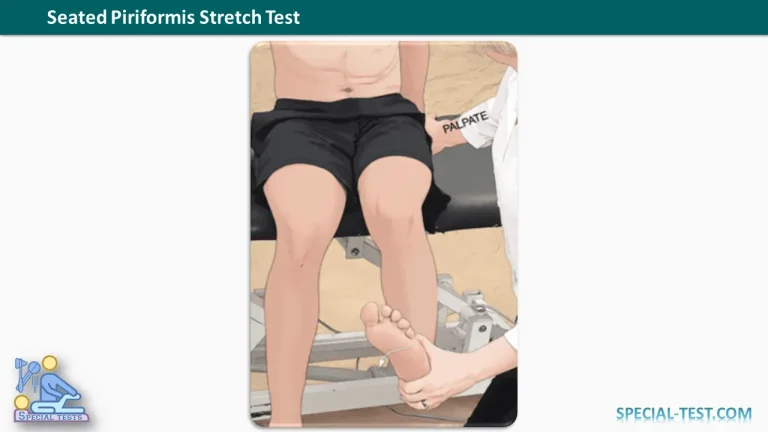
The Seated Piriformis Stretch Test is a hands-on clinical maneuver for evaluating buttock and sciatic-type pain. It helps clinicians judge whether the piriformis and the other deep hip rotators are contributing to a patient’s symptoms. This guide covers what the test is used for, how to perform it step by step, how to read the result, and what the research says about its accuracy.
What Is the Seated Piriformis Stretch Test Used For?
The test assesses irritation, tightness, or pathology of the piriformis muscle and its relationship to the sciatic nerve. Its purpose is to reproduce the patient’s familiar buttock or sciatic-type pain, which shows whether the deep external rotators of the hip play a role in the complaint.
Why the Piriformis Matters
The piriformis arises from the anterior surface of the sacrum and attaches to the greater trochanter of the femur. The sciatic nerve usually runs beneath the muscle and sometimes passes through it. Hip flexion, adduction, and internal rotation place the piriformis under maximum stretch. That position can irritate or compress the nerve, which is why this test is useful for spotting potential nerve entrapment.
How to Perform the Seated Piriformis Stretch Test
The test is quick and needs no equipment beyond an examination table. Rule out more common spinal and sacroiliac causes first.
Step-by-Step Technique
- Position the patient. The patient sits upright at the edge of the examination table with hips and knees flexed to about 90°.
- Extend the knee. The examiner extends the patient’s knee to put a gentle stretch on the sciatic nerve.
- Move the hip. While keeping the knee extended, the examiner passively flexes the hip further and moves it into adduction and medial (internal) rotation.
- Palpate the piriformis. The examiner palpates lateral to the ischial tuberosity or proximally at the sciatic notch. These are common sites where the piriformis may compress or irritate the sciatic nerve.
What Is a Positive Seated Piriformis Stretch Test?
A positive test reproduces the patient’s familiar pain in the piriformis region. If the sciatic nerve is involved, the pain may radiate along the posterior thigh.
Conditions a Positive Result Supports
A positive test raises suspicion of:
- Piriformis syndrome
- Deep gluteal syndrome
- Myofascial involvement of the deep hip rotators
The term “deep gluteal syndrome” is increasingly preferred over “piriformis syndrome.” Non-discogenic sciatic nerve entrapment in the subgluteal space can involve more than the piriformis, including fibrous bands, the gemelli-obturator internus complex, and the hamstring origin (Carro et al., 2016).
Seated Piriformis Stretch Test Accuracy
Martin et al. (2014) compared three tests against endoscopically confirmed sciatic nerve entrapment in the gluteal region. They found the following for the seated piriformis stretch test:
| Measure | Value |
|---|---|
| Sensitivity | 52% |
| Specificity | 90% |
| Positive likelihood ratio | 5.22 |
| Negative likelihood ratio | 0.53 |
| Diagnostic odds ratio | 9.82 |
How to Interpret These Numbers
- High specificity (90%) means a positive result is useful for supporting the diagnosis, because few people without entrapment test positive.
- Moderate sensitivity (52%) means a negative result does not rule entrapment out. Many true cases are missed.
Combining Tests Improves Accuracy
The same study found the best results when the active piriformis test and the seated piriformis stretch test were combined. Together they reached a sensitivity of 91% and a specificity of 80%, with a diagnostic odds ratio of 42. No single test should decide the diagnosis; it should be interpreted with the history, the wider physical examination, and imaging where appropriate.
Frequently Asked Questions (FAQ)
What does the Seated Piriformis Stretch Test diagnose?
It supports suspicion of piriformis syndrome, deep gluteal syndrome, and myofascial involvement of the deep hip rotators. It is not a stand-alone diagnosis.
What counts as a positive result?
Reproduction of the patient’s familiar pain in the piriformis region. The pain may radiate down the back of the thigh if the sciatic nerve is involved.
How accurate is the test?
Sensitivity is 52% and specificity is 90% for endoscopically confirmed sciatic nerve entrapment (Martin et al., 2014).
Can a negative result rule out piriformis syndrome?
No. With a sensitivity of 52%, the test misses many true cases. Clinicians usually combine it with other tests, such as the active piriformis test.
Why is the knee extended during the test?
Knee extension places a gentle stretch on the sciatic nerve. Adding hip flexion, adduction, and internal rotation then stretches the piriformis and loads the nerve where it may be compressed.
Where does the examiner palpate?
Lateral to the ischial tuberosity or proximally at the sciatic notch, both common sites of piriformis–sciatic nerve irritation.
Is piriformis syndrome the same as deep gluteal syndrome?
Not exactly. Deep gluteal syndrome is the broader term, covering sciatic nerve entrapment in the deep gluteal space from several possible structures, with the piriformis being only one.
Should I see a doctor for buttock pain radiating down the leg?
Yes. This test is a clinical tool for trained professionals. Persistent buttock or leg pain, numbness, or weakness should be assessed by a qualified healthcare provider.
References
- Martin HD, Kivlan BR, Palmer IJ, Martin RL. Diagnostic accuracy of clinical tests for sciatic nerve entrapment in the gluteal region. Knee Surg Sports Traumatol Arthrosc. 2014;22(4):882–888. PubMed
- Carro LP, Hernando MF, Cerezal L, et al. Deep gluteal space problems: piriformis syndrome, ischiofemoral impingement and sciatic nerve release. Muscles Ligaments Tendons J. 2016;6(3):384–396. PubMed
- OrthoFixar. Seated Piriformis Stretch Test. orthofixar.com