FADDIR Test: How to Perform the Hip Impingement Test, Interpret Results, and Understand Accuracy
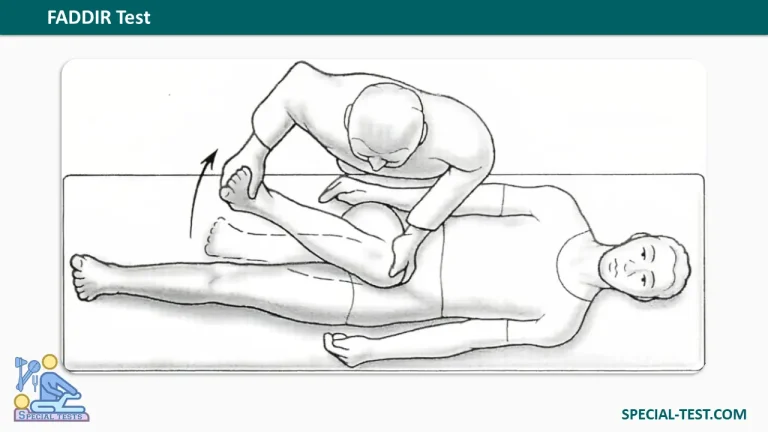
The FADDIR test (Flexion, ADDuction, Internal Rotation) is a common orthopedic hip examination used to screen for intra-articular hip pathology. Clinicians use it to evaluate suspected femoroacetabular impingement, anterior labral tears, and iliopsoas tendinitis in patients with groin or anterior hip pain. It is also known as the anterior hip impingement test or the anterior apprehension test.
This guide explains what the FADDIR test is used for, how to perform it step by step, how to interpret a positive result, and how accurate it is.
What Is the FADDIR Test Used For?
The FADDIR test helps clinicians screen for the following hip conditions:
- Femoroacetabular impingement (FAI) syndrome: abnormal contact between the femoral head-neck junction and the acetabular rim
- Anterior labral tear: injury to the acetabular labrum at the front of the hip
- Iliopsoas tendinitis: inflammation or irritation of the iliopsoas tendon
Because it provokes pain by compressing the anterior hip structures, it is often included in a physical examination for patients who report groin pain, clicking, or pain with hip flexion.
How to Perform the FADDIR Test (Step by Step)
- Position the patient supine (lying on their back) on the examination table.
- Flex the affected hip fully, or to approximately 90 degrees.
- Adduct the hip by moving the thigh toward and across the midline of the body.
- Internally rotate the hip while maintaining flexion and adduction.
Throughout the maneuver, watch the patient’s face and ask about pain, catching, or a feeling that the hip is about to give way.
What Is a Positive FADDIR Test Result?
A test is considered positive when it produces any of the following:
- Pain in the groin
- Reproduction of the patient’s usual symptoms, with or without a click
- Apprehension (the patient guards or resists the movement because it feels unstable or painful)
A positive result suggests intra-articular hip pathology but does not confirm a specific diagnosis.
FADDIR Test Accuracy: Sensitivity and Specificity
| Measure | Reported Range |
|---|---|
| Sensitivity | 41–60% |
| Specificity | 47–52% |
These values are modest. The FADDIR test cannot reliably rule a condition in or out on its own, so it should be interpreted alongside the patient’s history, other clinical tests (such as FABER and the log roll), and imaging (X-ray, MRI, or MR arthrography) when needed.
Frequently Asked Questions (FAQ)
What does FADDIR stand for?
FADDIR stands for Flexion, ADduction, and Internal Rotation, the three hip movements combined in the test.
What is the FADDIR test used for?
It is used to screen for femoroacetabular impingement syndrome, anterior labral tears, and iliopsoas tendinitis.
Is the FADDIR test the same as the anterior apprehension test?
Yes. The FADDIR test is also called the anterior apprehension test, as well as the anterior impingement test.
How do you perform the FADDIR test?
With the patient lying supine, flex the affected hip to about 90 degrees (or fully), then adduct the hip while internally rotating it.
What does a positive FADDIR test mean?
A positive test reproduces groin pain, the patient’s familiar symptoms (with or without a click), or apprehension. It suggests possible intra-articular hip pathology.
How accurate is the FADDIR test?
Reported sensitivity is 41–60% and specificity is 47–52%, so it has limited diagnostic accuracy when used alone.
Can the FADDIR test diagnose hip impingement on its own?
No. Because of its modest accuracy, it should be combined with history, other physical tests, and imaging for a reliable diagnosis.
References
- Clinical Tests for the Musculoskeletal System, 3rd Edition.