Pelvic Ligaments Tests: How to Perform and Interpret Results
Low back, buttock and groin pain is hard to pin down because several structures around the pelvis can refer pain to the same areas. The pelvic ligaments tests are a group of manual provocation maneuvers that help clinicians assess whether the ligaments around the pelvis are a source of a patient’s symptoms. This guide explains what the tests are for, how each one is performed, and how to interpret a positive result.
What Are the Pelvic Ligaments Tests Used For?
The pelvic ligaments tests are a set of clinical tests for the functional assessment of four ligaments:
- Iliolumbar ligament
- Sacrospinous ligament
- Sacroiliac ligament
- Sacrotuberous ligament
These ligaments stabilize the sacroiliac joint (SIJ) and the pelvic ring. The SIJ is recognized as an important source of pelvic girdle and low back pain. Research has also linked impaired pelvic ligament function to the onset of SIJ pain. Stressing each ligament in turn lets the examiner see which one reproduces the patient’s familiar pain.
How to Perform the Pelvic Ligaments Tests
The patient lies prone for all three maneuvers. Each one stresses a different ligament group.
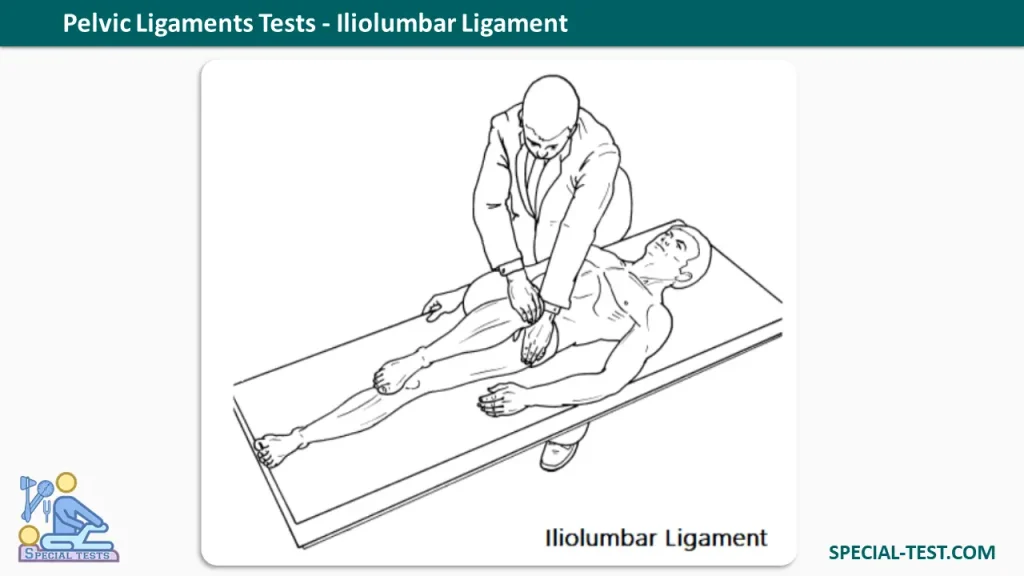
1. Iliolumbar ligament
- Flex the patient’s knee and hip.
- Adduct the leg toward the contralateral hip.
- While adducting, press on the knee to apply axial pressure along the femur.
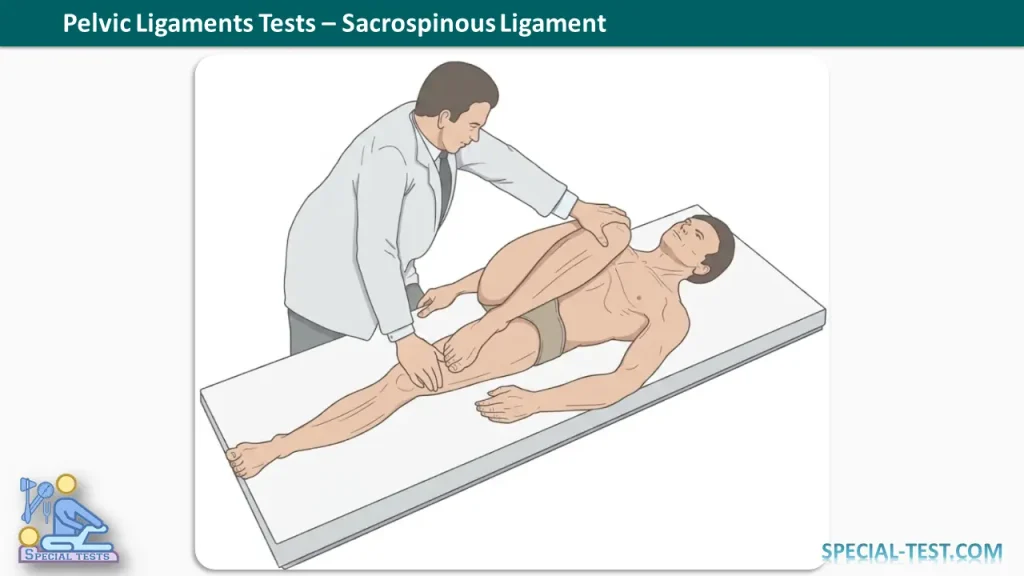
2. Sacrospinous and sacroiliac ligaments
- Flex the patient’s knee and hip maximally.
- Adduct the leg toward the contralateral shoulder.
- While adducting, press on the knee to apply axial pressure along the femur.
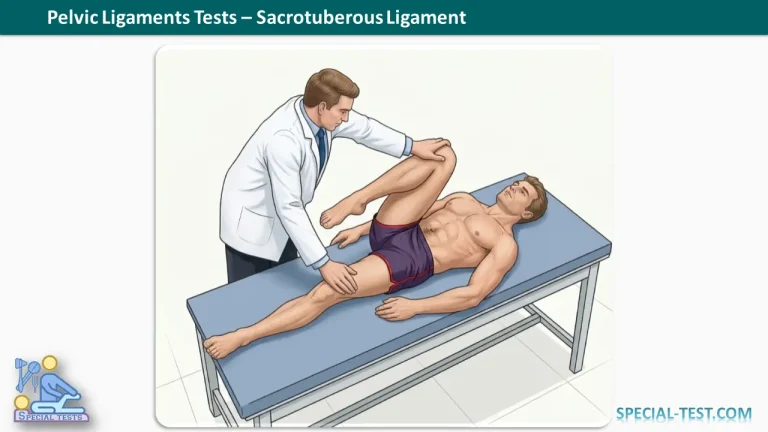
3. Sacrotuberous ligament
- Flex the patient’s knee and hip maximally.
- Move the leg toward the ipsilateral shoulder.
What Is a Positive Result?
Stretching pain that appears within a few seconds suggests functional shortening of the ligament and excessive stress on it. The same response can also occur in a hypermobile or motion-restricted sacroiliac joint, so the finding needs to be read in context.
The test is considered positive in these situations:
- Iliolumbar ligament: the pain is referred to the inguinal region. Because groin pain is also typical of hip disorders, the differential diagnosis should include the hip.
- Sacrospinous and sacroiliac ligaments: the pain is felt within the S1 dermatome, from a point posterolateral to the hip as far as the knee.
- Sacrotuberous ligament: the pain radiates into the posterior aspect of the thigh.
How Reliable Are Pelvic Provocation Tests?
No single provocation test can confirm the sacroiliac region as the pain source. A 2021 systematic review and meta-analysis in the Journal of Orthopaedic & Sports Physical Therapy found that clusters of SIJ pain provocation tests are not accurate enough to rule the joint in as the pain source, but a negative cluster lets clinicians rule it out with about 92% certainty. A smaller study of SIJ dysfunction similarly reported that most SI joint clinical tests have limited reliability and validity alone, whereas a multitest regimen is a reliable approach. An earlier study compared test results with diagnostic joint injections and concluded that composites of provocation tests are useful for diagnosing a symptomatic sacroiliac joint.
In practice, clinicians use the pelvic ligaments tests alongside other SIJ provocation tests, palpation, a detailed history and, when needed, imaging. A positive result is a clue to guide further assessment, not a diagnosis.
Frequently Asked Questions (FAQ)
What are the pelvic ligaments tests?
They are a set of manual tests that assess the function of the iliolumbar, sacrospinous, sacroiliac and sacrotuberous ligaments by stretching them while the patient lies prone.
Which position is the patient in?
Prone. The examiner moves the flexed leg in different directions to stress each ligament.
What does a positive pelvic ligaments test feel like?
Stretching pain that starts within a few seconds of the maneuver. This suggests functional shortening and excessive stress on the ligament, although it can also occur with a hypermobile or motion-restricted sacroiliac joint.
Where is the pain felt in each test?
Iliolumbar ligament pain is referred to the groin. Sacrospinous and sacroiliac ligament pain is felt in the S1 dermatome, from posterolateral to the hip down to the knee. Sacrotuberous ligament pain radiates into the back of the thigh.
Why is groin pain not always an iliolumbar ligament problem?
Hip disorders can cause groin pain too, so a hip examination is part of the differential diagnosis when this test is positive.
Can these tests diagnose sacroiliac joint pain on their own?
No. Research shows that individual tests have limited accuracy, and that combining several provocation tests with the clinical history gives a more dependable picture. A negative result is more useful for ruling the joint out than a positive one is for ruling it in.
Who should perform these tests?
A trained clinician, such as a physician, physiotherapist or osteopath. If you have persistent pelvic, back or groin pain, see a healthcare professional rather than self-testing.
References
- Diagnostic Accuracy of Clusters of Pain Provocation Tests for Detecting Sacroiliac Joint Pain: Systematic Review With Meta-analysis. J Orthop Sports Phys Ther. 2021;51(9):422-431. PubMed
- Telli H, Telli S, Topal M. The Validity and Reliability of Provocation Tests in the Diagnosis of Sacroiliac Joint Dysfunction. Pain Physician. 2018. PubMed
- Diagnosis of Sacroiliac Joint Pain: Validity of Individual Provocation Tests and Composites of Tests. PubMed
- Pelvic orthosis effects on posterior pelvis kinematics: an in-vitro biomechanical study. PubMed Central
- Clinical Tests for the Musculoskeletal System, 3rd ed.