Patrick’s Test (FABER Sign): Technique, Positive Results & Hip/SI Joint Diagnosis
What Is Patrick’s Test (FABER Sign)?
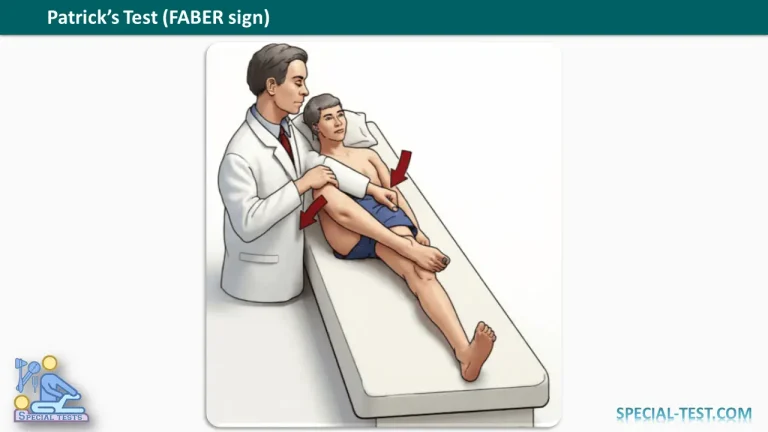
Patrick’s Test is a physical examination maneuver that helps clinicians assess pain in the hip, lumbar spine and sacroiliac (SI) joint region. It is also called the FABER sign or the figure-of-four test. FABER stands for Flexion, ABduction and External Rotation, the three hip movements that make up the test.
The test is a provocation test. The examiner moves the hip into a specific position and notes whether it reproduces the patient’s pain, and where in the body that pain appears. The location of the pain helps narrow down the possible source.
What Is Patrick’s Test Used For?
Patrick’s Test is mainly used to:
- Assist in diagnosing disorders of the hip joint
- Help identify problems in the sacroiliac joint
- Help separate hip-related pain from pain originating in the lumbar spine or pelvis
Because hip, back and pelvic problems often produce overlapping symptoms, a simple screening test like this is a useful early step in the clinical work-up.
How to Perform Patrick’s Test (FABER Sign)
The test is done with the patient lying on their back (supine). To test the right side:
- Ask the patient to flex the hip and knee of the right leg.
- Place the right foot on top of the left knee, so the leg forms a “figure four”.
- Gently press down on the right knee, moving the hip into abduction and external rotation.
- Stabilize the opposite side of the pelvis so it does not lift off the table.
- Note whether pain is reproduced, where it is felt, and whether the knee drops freely compared with the other side.
The movement should be gentle and controlled. Stop if the patient has sharp or intolerable pain. The test is usually performed on the unaffected side first so the examiner has a comparison.
What Is a Positive Result?
A positive test means the maneuver reproduces the patient’s familiar pain. Where the pain is felt gives clues about the likely source.
1. Sacroiliac joint pain on external hip rotation
- Sacroiliac joint dysfunction
- Sacroiliitis
2. Groin pain on external hip rotation
- Iliopsoas strain or iliopsoas bursitis
- Intra-articular hip disorders, including:
- Hip impingement (femoroacetabular impingement)
- Hip labral tear
- Hip loose bodies
- Hip chondral lesion
- Hip osteoarthritis
3. Posterior hip pain on external hip rotation
- Posterior hip impingement
Limitations of the FABER Test
Patrick’s Test should never be used alone to make a diagnosis. Research on hip and SI joint provocation tests shows that their accuracy varies, and that a single test has limited value on its own. Clinicians usually combine it with:
- A full history and physical examination
- Other hip and SI joint special tests
- Imaging such as X-ray or MRI when indicated
If you have persistent hip, groin, buttock or low back pain, see a qualified healthcare professional for a proper evaluation.
Frequently Asked Questions (FAQ)
What is the “Patrick’s Test (FABER sign)” used for?
It assists in diagnosing pathologies of the hip, lumbar and sacroiliac region. It is also known as the FABER sign (Flexion, ABduction, External Rotation).
How is Patrick’s Test (FABER sign) performed?
To test the right side, flex both hips and knees. Place the right foot on the left knee and gently press down on the right knee.
What is a positive result?
- Sacroiliac joint pain suggests sacroiliac joint dysfunction or sacroiliitis.
- Groin pain suggests iliopsoas strain or bursitis, or an intra-articular hip disorder (femoroacetabular impingement, labral tear, loose bodies, chondral lesion or osteoarthritis).
- Posterior hip pain suggests posterior hip impingement.
Does a positive FABER test confirm a diagnosis?
No. It points toward possible sources of pain, and further examination or imaging is usually needed to confirm.
Is the test painful?
It may reproduce your usual pain, but it should be performed gently and stopped if the pain becomes severe.
References
- OrthoFixar. Hip Special Tests: FABER (Patrick’s) Test. orthofixar.com
- Braly BA, Beall DP. Clin Sports Med. 2006 (groin and hip pain evaluation). PubMed.
- Wilson JJ, Furukawa M. Evaluation of the patient with hip pain. Am Fam Physician. 2014;90(1):27-34. PubMed.
- Reiman MP, et al. Diagnostic accuracy of clinical tests for the diagnosis of hip femoroacetabular impingement/labral tear: a systematic review with meta-analysis. Br J Sports Med. 2015;49:811-819. PubMed.
- Broadhurst NA, Bond MJ. Pain provocation tests for the assessment of sacroiliac joint dysfunction. J Spinal Disord. 1998;11(4):341-345. PubMed.