Log Roll Test for Hip Pain: Procedure & Results Explained
What Is the Log Roll Test?
The log roll test is a simple, hands-on physical exam used to evaluate hip pain. It is often described as one of the most specific bedside tests for problems inside the hip joint, because it gently rotates the thigh bone in the socket without loading the surrounding structures.
During the test, the femoral head (the “ball” of the hip) glides against the acetabulum (the “socket”). Because the muscles, tendons, and nerves around the hip are barely stressed, pain that appears during this movement points toward the joint itself rather than the soft tissues around it.
What Is the Log Roll Test Used For?
Hip pain can come from many places, including the lower back, groin muscles, bursae, tendons, and the joint itself. The log roll test helps clinicians:
- Assess for pathology within the hip joint, also called intra-articular pathology.
- Separate hip joint problems from extra-articular causes, such as muscle strain, tendinopathy, or referred pain from the spine.
- Guide next steps, such as imaging (X-ray, MRI, or MR arthrogram) or referral to an orthopedic specialist.
Clinicians typically combine it with other hip tests, your history, and imaging rather than relying on any single maneuver.
How Is the Log Roll Test Performed?
The test is quick, usually taking less than a minute, and should not require force.
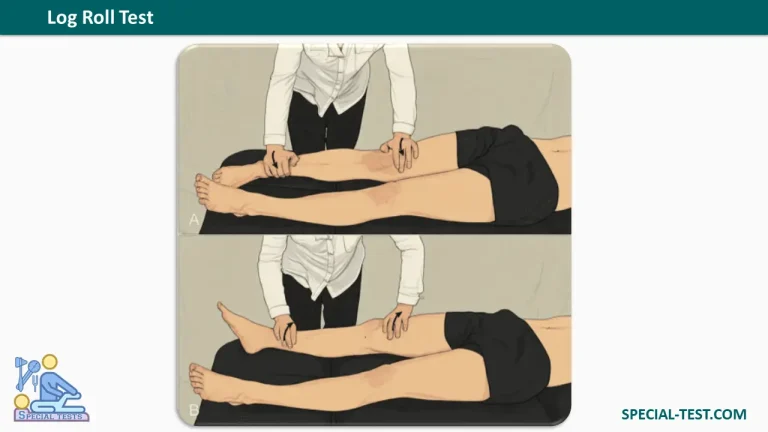
- Positioning: You lie flat on your back (supine) with your legs relaxed and extended.
- Hand placement: The examiner places a hand over the middle of your thigh.
- Movement: The examiner passively rolls the leg inward (internal rotation) and outward (external rotation), like rolling a log, to the end of the available range of motion.
- Comparison: The examiner repeats the movement on the other leg and compares motion, pain, and sounds between the two sides.
“Passively” means you stay relaxed while the examiner moves your leg, so your muscles aren’t doing the work.
What Does a Positive Log Roll Test Mean?
A positive result depends on what you or the examiner notice during the rotation:
| Finding | What it may suggest |
|---|---|
| Pain | Intra-articular (inside the joint) pathology |
| Clicking | A possible acetabular labral tear |
| Increased range of motion | Ligamentous laxity |
These findings are clues, not a diagnosis. Clicking, for example, can have several causes. A positive log roll usually leads to further evaluation, such as imaging or specialist assessment, to confirm what is going on in the joint.
Why the Log Roll Test Matters
Hip conditions such as labral tears, femoroacetabular impingement (FAI), early osteoarthritis, and joint laxity can look similar to muscular or spinal problems. Identifying early whether the joint is the source of pain helps avoid delays in treatment and prevents unnecessary treatment aimed at the wrong area.
When Should You See a Doctor?
Consider an evaluation by a physician, physical therapist, or orthopedic specialist if you have:
- Hip or groin pain lasting more than a few weeks
- Pain with turning, pivoting, or getting in and out of a car
- Clicking, catching, or locking in the hip
- A feeling that the hip is unstable
- Pain that interferes with sleep, walking, or sports
Frequently Asked Questions (FAQ)
1. What is the log roll test used to diagnose?
It screens for problems inside the hip joint, such as labral tears, joint irritation, or laxity, and helps distinguish them from pain originating outside the joint.
2. Is the log roll test painful?
It should not be. The movement is gentle and passive. Pain during the test is itself a meaningful finding and should be reported to the examiner.
3. Can the log roll test diagnose a labral tear?
Not by itself. Clicking may suggest a labral tear, but diagnosis generally requires a full clinical exam and usually imaging, such as MRI or MR arthrogram.
4. What does increased motion on the log roll test mean?
Excess rotation compared with the other side can point to ligamentous laxity, meaning the supporting ligaments allow more movement than usual.
5. Can I perform the log roll test on myself?
Self-testing is not recommended. The test is meant to be passive and compared side to side, and results are easy to misread without clinical training. If you have persistent hip pain, see a qualified professional.
6. Is the log roll test enough to confirm hip pathology?
No. It is one part of a broader assessment that includes your history, other physical tests, and often imaging.
7. Who performs the log roll test?
Orthopedic surgeons, sports medicine physicians, primary care providers, and physical therapists commonly perform it.
References
- Martin RL, Sekiya JK. The interrater reliability of 4 clinical tests used to assess individuals with femoroacetabular impingement. J Orthop Sports Phys Ther. 2008. Search the title on PubMed.
- Maslowski E, et al. The diagnostic validity of hip provocation maneuvers to detect intra-articular hip pathology. PM R. 2010. Available via PubMed.
- Reiman MP, et al. Diagnostic accuracy of clinical tests for the diagnosis of hip femoroacetabular impingement/labral tear: a systematic review with meta-analysis. Br J Sports Med. 2015. Available via PubMed.
- Orthofixar.com: link to the relevant hip examination or log roll test page on that site.