Ligamentum Teres Test: How to Perform It, Positive Results & Accuracy
Deep groin pain that doesn’t match a classic muscle strain can be hard to pin down. The ligamentum teres test is a physical examination maneuver that helps clinicians check one of the hip’s less well-known structures.
What Is the Ligamentum Teres Test Used For?
The test assesses the integrity and irritability of the ligamentum teres, also called the round ligament of the femoral head. This small intra-articular ligament runs from the acetabulum to the femoral head. It is an important stabilizer of the hip, particularly in flexion and external rotation. Tears of this ligament have been found in 8–51% of patients undergoing hip arthroscopy.
The ligament is hard to evaluate because there were no specific clinical tests until the LT test was described. Clinicians now use it to decide whether this ligament could be a source of hip pain.
How to Perform the Ligamentum Teres Test
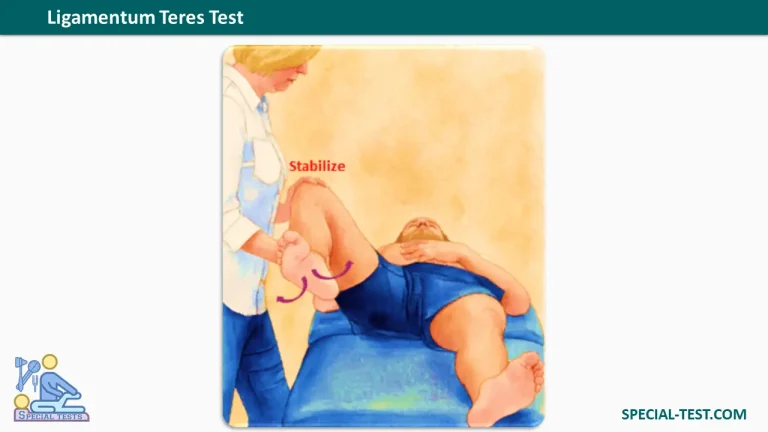
- Position the patient. The patient lies supine on the examination table. The pelvis must stay stable, with no rotation or compensatory movement.
- Position the clinician. Stand beside the hip being examined, so you control both hip and leg movement.
- Flex the hip and knee. Flex the knee to 90° and passively flex the hip to about 70°. Confirm that the pelvis stays neutral.
- Abduct, then adduct. Abduct the hip maximally, then adduct it to 30° short of the full abduction you reached. This places optimal tension on the ligamentum teres. This position minimizes the risk of bony or labral impingement, so pain is less likely to come from other structures.
- Rotate the hip. In this position, take the hip through full internal (medial) and external (lateral) rotation. These movements stress the ligament maximally without impingement from surrounding structures.
What Is a Positive Result?
A positive test is reproduction of concordant pain with either internal or external rotation in the final test position. In other words, the test is positive if pain appears during either:
- medial rotation, or
- lateral rotation.
Pain in this position suggests one or more of the following:
- Ligamentum teres sprain or tear
- Intra-articular irritation or synovitis
- Possible associated microinstability of the hip
A positive test does not prove a tear. It tells the clinician where to look next, usually with imaging and a full hip assessment.
Ligamentum Teres Test Accuracy
In a published series of 75 patients, two examiners performed the test on each patient, and compared with arthroscopic findings, the sensitivity was 90% and the specificity 85% for predicting a tear. The same review notes that the test worked equally well for partial and degenerative tears.
- Sensitivity: 90%. A negative test helps rule out a ligamentum teres tear.
- Specificity: 85%. A positive test makes a tear reasonably likely.
A rehabilitation-focused review in the same PubMed Central database reports matching figures. It lists a negative likelihood ratio of 0.11 and a positive likelihood ratio of about 6.6. Results from other groups are a little lower. A study of patients with moderate hip osteoarthritis, using MRI as the reference, found a sensitivity of 87.37% and a specificity of 73.47%. Accuracy therefore varies with the population and the reference standard.
Why the Result Matters Clinically
Patients with a ruptured ligament scored worse on function questionnaires. In the osteoarthritis study above, hips with an intact ligament had significantly higher HOOS and Harris Hip Scores than hips with a ruptured one. Recognizing ligamentum teres involvement early can help guide treatment decisions.
Frequently Asked Questions (FAQ)
What does the ligamentum teres test check?
It checks whether the ligamentum teres of the hip is injured or irritated.
Is the ligamentum teres test accurate?
Published data report a sensitivity of 90% and a specificity of 85% against arthroscopy. Other studies report somewhat lower values, so it works best as part of a full examination.
What does a positive ligamentum teres test mean?
Pain on medial or lateral rotation in the test position suggests a sprain or tear, synovitis, or possible microinstability. It is not a final diagnosis.
Can the test cause impingement pain?
The position is designed to avoid it. The positioning places tension on the ligament while keeping bony and labral impingement to a minimum.
Does a positive test always need surgery?
No. The test is a screening step. Imaging such as MR arthrography and a specialist’s evaluation guide further decisions.
Who should perform the test?
A trained clinician, such as a physiotherapist or orthopedic specialist. Self-testing is not recommended.
This article is for education and does not replace professional medical advice.