Hip Quadrant Test (Scour Test): How to Perform & Interpret It
What Is the Hip Quadrant Test Used For?
The hip quadrant test, also called the scour test, is a dynamic clinical test used to assess the inner (anteromedial) and outer (anterolateral) quadrants of the hip joint surface. Clinicians use it as a hip provocation maneuver. It reproduces or exaggerates a patient’s symptoms by loading the joint, its surrounding soft tissues, and the neighboring muscle attachments in a controlled arc of movement.
It is commonly used when a patient reports groin, anterior hip, or deep hip pain and the clinician wants to find out whether the pain comes from the hip joint itself or a structure around it.
How to Perform the Hip Quadrant Test
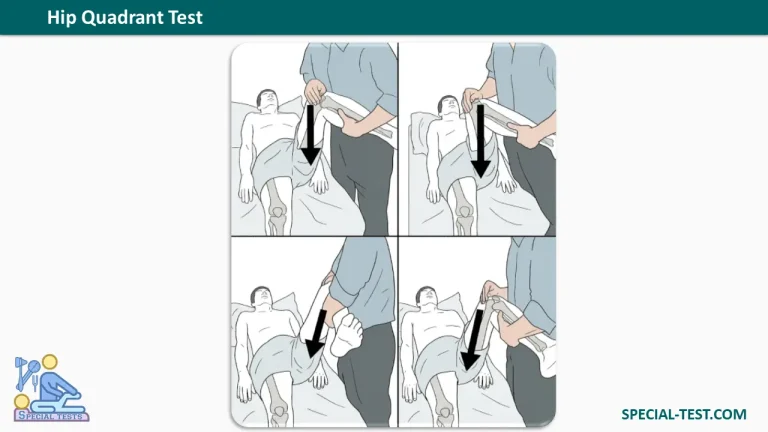
Patient position: The patient lies supine (on their back) close to the edge of the examination bed, with the hip flexed and the foot resting on the bed. The clinician places one hand over the top of the patient’s knee.
Step 1: Assess the inner quadrant
- Place the hip in 90 degrees of flexion, allowing the knee to flex comfortably.
- Adduct the hip until the patient’s pelvis begins to lift off the bed. This assesses the inner quadrant.
Step 2: Assess the outer quadrant
- At the end range of flexion and adduction, apply a compression force through the knee along the longitudinal axis of the femur.
- While maintaining compression, move the hip into flexion and abduction to examine the outer quadrant.
Key technique points: Throughout the whole movement, hold the femur midway between internal and external rotation. The hip should follow a smooth arc, like part of a circle.
What Is a Positive Hip Quadrant Test?
A positive test is resistance, apprehension, or pain felt anywhere along the arc.
Structures that may be responsible for pain
Pain can arise when the femur compresses or stresses any of these structures through the range of motion:
- The articular surfaces of the hip joint
- The labrum
- The hip joint capsule
- The insertions of the tensor fasciae latae and sartorius muscles
- The iliopsoas muscle
- The iliopsoas bursa and neurovascular bundle
- The insertion of the pectineus muscle
- The insertion of the adductor longus muscle
- The femoral neck
Possible causes of resistance
- Capsular tightness
- An adhesion
- A myofascial restriction
- A loss of joint congruity
Hip Quadrant Test Accuracy
Reported diagnostic accuracy for the test is:
- Sensitivity: 75%
- Specificity: 43%
Sensitivity of 75% means the test picks up many patients who have intra-articular hip pathology. Specificity of 43% means a positive result is not specific to one diagnosis, because many structures can produce a positive response. The test therefore works best as part of a cluster of hip provocation tests combined with patient history, range of motion, strength testing, and imaging when indicated. It should not be used alone to make a diagnosis.
A systematic look at hip provocation maneuvers is provided by Maslowski et al. (2010) in PM&R, which evaluated the diagnostic validity of these tests for detecting intra-articular hip pathology.
Clinical Tips
- Compare both sides, and begin with the less painful hip.
- Note where in the arc symptoms appear, since this helps narrow down which quadrant and structures are involved.
- Distinguish pain from apprehension and from mechanical resistance, as each suggests a different problem.
- Interpret the result alongside other hip tests and the full clinical picture.
Frequently Asked Questions (FAQ)
1. What is the hip quadrant test?
It is a dynamic hip examination, also known as the scour test, that assesses the inner and outer quadrants of the hip joint surface by moving the hip through an arc of flexion with adduction and abduction under compression.
2. Is the hip quadrant test the same as the scour test?
Yes. The two names refer to the same maneuver.
3. What does a positive hip quadrant test mean?
A positive test is resistance, apprehension, or pain at any point during the arc. It suggests that a structure in or around the hip, such as the joint surface, labrum, capsule, or a muscle insertion, is irritated or restricted.
4. Can the test diagnose a specific hip condition?
No. With a reported specificity of 43%, a positive result cannot identify one particular condition. It should be combined with other tests, the patient’s history, and imaging where appropriate.
5. How accurate is the hip quadrant test?
Reported sensitivity is 75% and specificity is 43%, so it is useful for flagging possible intra-articular involvement but limited for ruling in a specific cause.
6. Why does the clinician keep the femur midway between internal and external rotation?
Holding a neutral rotation keeps the movement consistent and allows the hip to follow a smooth arc, so any resistance or pain can be interpreted reliably.
7. Is the test painful?
It may reproduce the patient’s usual pain if a structure is irritated. It should be performed gently and stopped if pain becomes severe.
8. Should I see a professional if I have hip pain?
Yes. Persistent hip or groin pain should be evaluated by a physician or physical therapist, who can choose the right tests and treatment.
References
- Dutton, M. Dutton’s Orthopaedic Examination, Evaluation, and Intervention, 3rd Edition.
- Maslowski E, Sullivan W, Forster Harwood J, Gonzalez P, Kaufman M, Vidal A, Akuthota V. The Diagnostic Validity of Hip Provocation Maneuvers to Detect Intra-Articular Hip Pathology. PM&R. 2010;2:174-181. https://doi.org/10.1016/j.pmrj.2010.01.014