Fulcrum Test for Femoral Stress Fracture: Procedure & Results
What Is the Fulcrum Test?
The fulcrum test is a physical examination maneuver used to screen for a stress fracture of the femoral shaft, the long middle section of the thigh bone. It was introduced as a bedside tool because thigh pain in active people is often written off as a muscle strain, and femoral shaft stress fractures can be missed. The test was described by Johnson, Weiss and Wheeler in the American Journal of Sports Medicine in 1994, in a paper arguing that these fractures are more common in athletes than expected (PubMed ID 8198195).
A stress fracture is a small crack in the bone caused by repetitive loading rather than a single injury. Runners, military recruits, and athletes who suddenly increase training volume are among the people most often affected. The test costs nothing, requires no equipment, and takes less than a minute, which makes it useful for raising clinical suspicion before imaging.
Why a Clinical Test Matters
Early stress fractures may not show clearly on standard X-rays, so the examination is an important first step. A review of stress fractures of the pelvis and legs in athletes (Behrens et al., Sports Health, 2013) discusses the fulcrum test alongside history, physical findings and imaging as part of the diagnostic workup. The fulcrum test does not replace imaging. It helps the clinician decide whether further investigation is needed.
How Is the Fulcrum Test Performed?
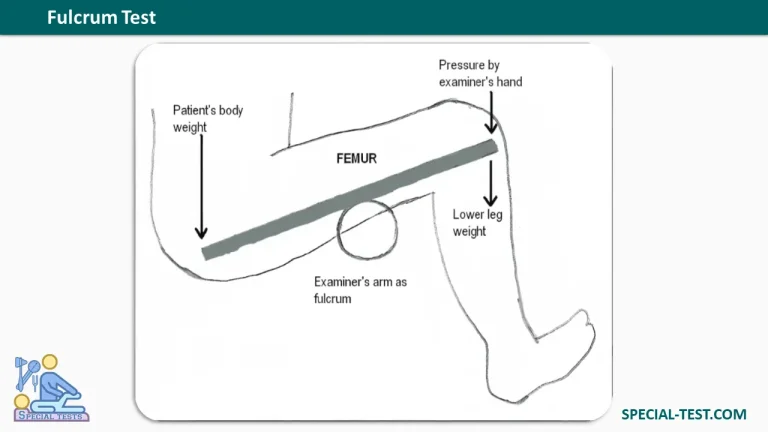
- Patient position: The patient sits at the edge of the examination bed with the knees bent over the edge and the lower legs dangling freely.
- Examiner’s arm placement: The clinician places one forearm under the thigh being tested, so it acts as a fulcrum (a pivot point) beneath the femur.
- Applying pressure: With the other hand, the clinician applies gentle downward pressure on the thigh, usually near the knee. The supporting arm is then moved along the thigh from proximal (near the hip) to distal (near the knee).
- Observation: The clinician watches the patient’s reaction as the fulcrum passes under each part of the femur.
The pressure should be gentle. The aim is to create a mild bending stress across the femur, not to force the bone.
What Is a Positive Result?
The test is positive when the patient reports sharp pain or shows apprehension (guarding, flinching or reluctance) as the clinician’s arm passes beneath the fracture site. Because the fulcrum moves along the thigh, the location where symptoms appear can also help pinpoint the likely level of the injury.
How Accurate Is the Fulcrum Test?
No sensitivity or specificity values are currently available for the fulcrum test. A positive result should therefore be treated as a reason for further evaluation rather than a definitive diagnosis, and a negative result does not fully exclude a stress fracture if symptoms persist. Clinicians generally combine the test with the patient’s history (recent training changes, activity-related thigh or groin pain) and appropriate imaging.
When to See a Healthcare Professional
Persistent thigh pain that worsens with activity, eases with rest, or causes pain on weight-bearing should be evaluated by a physician or sports medicine specialist. Only a qualified clinician can interpret examination findings and decide on imaging and treatment.
Frequently Asked Questions (FAQ)
What is the fulcrum test used for?
It is used to test for a stress fracture of the femoral shaft.
Who performs the fulcrum test?
It is performed by a clinician, such as a physician, orthopedic specialist or sports medicine provider, as part of a physical examination.
Does the fulcrum test hurt?
Gentle pressure is used. Pain, if it occurs, is the finding the clinician is looking for and signals a possible fracture site.
What position is the patient in?
The patient sits with their knees bent over the edge of the bed and their feet dangling.
What counts as a positive fulcrum test?
Sharp pain or visible apprehension when the clinician’s arm is placed under the fracture site.
How accurate is the fulcrum test?
Sensitivity and specificity figures have not been published, so it is used as a screening aid, not a stand-alone diagnostic test.
Can the fulcrum test diagnose a stress fracture on its own?
No. It raises suspicion, and the clinician combines it with history and imaging to confirm a diagnosis.
Who is most at risk of femoral shaft stress fractures?
Athletes and others who place repetitive stress on the legs, particularly after a sudden increase in training.
References
- Johnson AW, Weiss CB, Wheeler DL. Stress fractures of the femoral shaft in athletes: more common than expected. A new clinical test. Am J Sports Med. 1994;22(2):248-256. PubMed
- Behrens SB, Deren ME, Matson A, Fadale PD, Monchik KO. Stress fractures of the pelvis and legs in athletes: a review. Sports Health. 2013;5(2):165-174. doi:10.1177/1941738112467423