Craig Test: How to Measure Femoral Anteversion
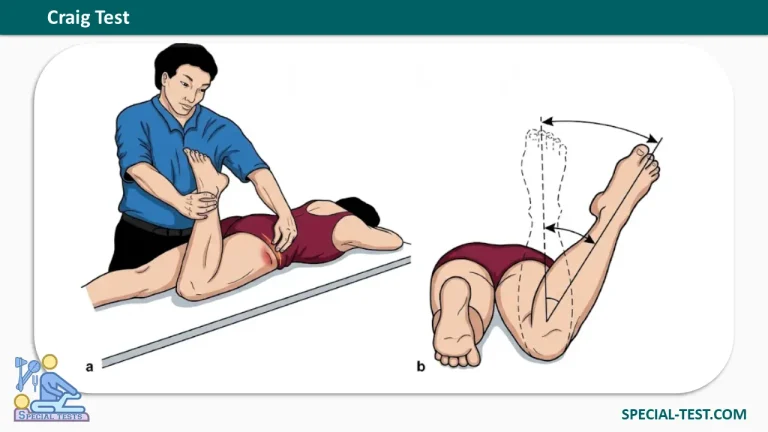
The Craig test, also called the femoral anteversion test or the trochanteric prominence angle test, is a hands-on clinical exam. It estimates how much the femoral neck is rotated forward (anteversion) or backward (retroversion) relative to the knee. It needs no equipment beyond an examination table and a goniometer, so it is widely used in orthopaedic and physical therapy settings.
What Is the Craig Test Used For?
The Craig test assesses anteversion and retroversion of the femoral neck. Femoral anteversion is the degree of forward projection of the femoral neck relative to the femoral condyles at the knee. It is not fixed throughout life. At birth the mean angle is about 30°, and it decreases during growth. In adults the mean is about 8° to 15°.
Increased anteversion is linked to in-toeing and “squinting” kneecaps. Orthofixar also notes that excessive anteversion is about twice as common in girls as in boys. Children with excessive anteversion often have more hip internal rotation than external rotation and prefer the “frog-sitting” posture. Clinicians therefore use the Craig test to evaluate in-toeing gait, especially in children.
How to Perform the Craig Test Step by Step
- Position the patient prone (face down) on a flat examination table.
- Flex the knee to 90 degrees on the side being tested.
- Palpate the greater trochanter on the outer side of the hip with one hand.
- Rotate the hip with the other hand, moving the lower leg through the full range of internal and external rotation.
- Find the end point. Stop where the greater trochanter feels most prominent on the outer side of the hip. At this point the femoral neck lies roughly in the horizontal plane.
- Measure the angle between the lower leg and the vertical line, with a goniometer or inclinometer.
How to Interpret the Results
The angle by which the lower leg deviates from vertical gives a direct estimate of the femoral anteversion angle. The knee condyles and lower leg indicate the angle while the femoral neck is horizontal.
- Normal: about 8–15° of internal rotation from vertical in adults.
- Positive (anteversion): the angle is greater than 8–15° in the direction of internal rotation, measured from the vertical and the long axis of the tibia.
- Retroversion: the neck rotates backward relative to the condylar plane. This may show as reduced internal rotation at the end point.
How Accurate Is the Craig Test?
According to Orthofixar, one study found the test accurate to within 4 degrees of intraoperative measurements. That study also found it more accurate than radiographic measurement techniques. Orthofixar adds that, in the hands of an experienced examiner, its precision is comparable to radiographic measurement.
Gelberman and colleagues (PubMed PMID: 3818738) noted that rotation shows greater variability when measured with the hip flexed. They recommended assessing rotation both in neutral, as in the Craig test, and at 90° of hip flexion. They also found that greater medial than lateral rotation in both positions was a better indicator of increased anteversion. Reliability of goniometer and inclinometer measurements in the Craig test has also been studied on PubMed (Choi & Kang, 2015, PMID: 25995575).
Examiner experience and consistent technique matter. If the result will guide surgical decisions, clinicians often confirm it with imaging.
Why Femoral Anteversion Matters
Femoral torsion describes the relative rotation between the femoral shaft and the femoral neck. Excessive anteversion directs the femoral head toward the front of the acetabulum when the knees point forward. Some studies suggest persistent anteversion predisposes to hip and knee osteoarthritis, though other studies disagree.
Frequently Asked Questions (FAQ)
What is the Craig test used for?
It assesses anteversion or retroversion of the femoral neck by estimating the rotational alignment of the femur.
Is the Craig test the same as the femoral anteversion test?
Yes. Both names, and the trochanteric prominence angle test, refer to the same exam.
What is the normal result on the Craig test?
In adults, the mean femoral anteversion is about 8° to 15° of internal rotation, measured from vertical.
What does a positive Craig test mean?
A positive test means the angle exceeds the normal range in the direction of internal rotation. This indicates increased femoral anteversion.
How accurate is the Craig test?
One study found it accurate to within 4° of intraoperative measurements. In experienced hands its precision is comparable to radiographic measurement.
Can children have the Craig test?
Yes. It is commonly used for in-toeing in children. Anteversion is about 30° at birth and gradually falls during growth.
Do I need imaging after a positive Craig test?
Not always. Imaging may be added when the result will influence treatment, especially surgical planning. Your clinician decides based on your symptoms and exam.
References
- Ruwe PA, Gage JR, Ozonoff MB, DeLuca PA. Clinical determination of femoral anteversion. J Bone Joint Surg Am. 1992;74(6):820-30. PubMed 1634572
- Choi BR, Kang SY. Intra- and inter-examiner reliability of goniometer and inclinometer use in Craig’s test. J Phys Ther Sci. 2015;27(4):1141-4. PubMed 25995575
- Gelberman RH, et al. Femoral anteversion: a clinical assessment of idiopathic intoeing gait in children. J Bone Joint Surg Br. 1987;69(1):75-9. PubMed 3818738
- Craig Test | Orthofixar
- Clinical Tests for the Musculoskeletal System, 3rd Edition.
- Dutton’s Orthopaedic Examination, Evaluation, and Intervention, 3rd Edition.