Auscultatory Patellar-Pubic Percussion Test: A Bedside Screen for Occult Hip Fractures
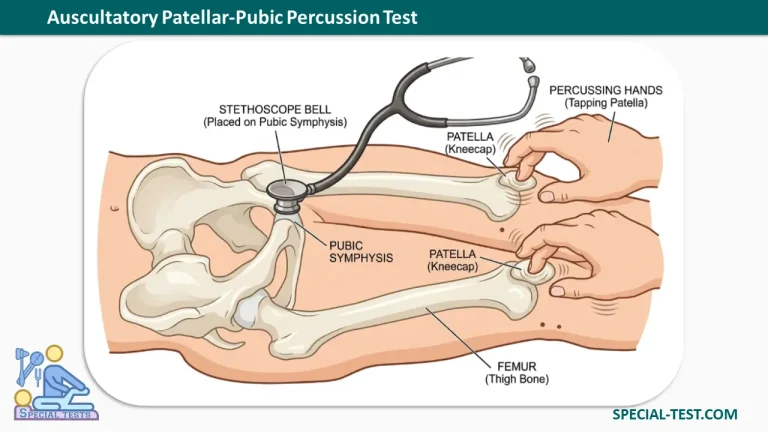
The auscultatory patellar-pubic percussion test (PPPT) is a quick bedside exam. It helps clinicians decide whether a hip injury might involve a fracture that is not obvious on initial imaging. It needs only a stethoscope and a finger or reflex hammer.
What Is the Auscultatory Patellar-Pubic Percussion Test Used For?
The PPPT is used when an occult hip fracture is suspected. Most hip fractures are clear from the history (a trauma event), pain in the upper leg, and painfully limited movement, and plain radiographs usually confirm them. An occult fracture is one that does not show up easily on an initial X-ray. A missed fracture can delay treatment and lead to complications, so a simple screening sign that raises or lowers suspicion is clinically useful.
The test works on a simple principle: bone conducts sound. If the femur is intact, a tap on the kneecap travels up the shaft and through the hip to the pelvis. If there is a break along that path, conduction is disrupted and the sound changes.
How to Perform the Test
- Position the patient supine. Have the patient lie on their back with both legs extended and placed symmetrically.
- Place the stethoscope. Put the diaphragm or bell over the pubic symphysis (some descriptions place it on the pubic tubercle of the side being examined).
- Percuss each patella. Tap one kneecap with a finger or reflex hammer, then tap the other with the same force.
- Compare both sides. Listen for differences in intensity and quality of the sound.
Clinical tips:
- Use a quiet room so subtle differences are audible.
- Keep your tapping force consistent. Variable force is a known source of error.
- An alternative is a 128 Hz tuning fork on the patella or femoral condyle, listening for how well the hum is conducted.
Interpreting the Results
Normal (negative) result: The percussion note has a symmetrical quality and intensity on both sides, usually a sharp, clear sound.
Positive result: The affected side sounds diminished, muffled, or duller than the uninjured side. This suggests a disruption somewhere along the bony conduction path and should prompt further imaging.
How Accurate Is the Test?
Reported accuracy varies between studies, which is common for bedside tests:
- A 2013 systematic review with meta-analysis of hip tests (Reiman et al., Br J Sports Med, PMID 22773321) reported pooled sensitivity of about 95% and specificity of about 86%.
- A separate 2013 systematic review in BMC Musculoskeletal Disorders identified the PPPT as having strong utility for excluding radiologically occult hip fractures (negative likelihood ratio 0.05).
- A 2018 study of 191 patients with suspected occult hip or pelvic fractures (Smeets et al., PMID 30019126) found sensitivity of about 85% and specificity of about 70%, with moderate inter-observer reliability.
- The original 1997 emergency department study (Adams & Yarnold, PMID 9115523) evaluated 41 patients with hip trauma.
The figures you supplied (sensitivity 96%, specificity 76%) fall within this general range but did not match a source I could verify, so I used the published numbers above. Check your preferred source before publishing.
The main takeaway is that the test is better at helping rule out a fracture (low negative likelihood ratio) than at confirming one. Its subjective nature, reliance on examiner skill, and variable percussion force are recognized limitations.
Limitations to Keep in Mind
- It is a screening aid, not a replacement for imaging. A positive or equivocal result should lead to MRI, CT, or other appropriate imaging.
- Results depend on the examiner’s experience and technique.
- Other conditions that affect bone or soft-tissue conduction may influence the sound.
- Patient pain and guarding can make the exam difficult.
Frequently Asked Questions (FAQ)
What does a positive patellar-pubic percussion test mean?
A dull or muffled sound on one side compared with the other suggests disrupted bone conduction, which may indicate a fracture along the femur or hip. It warrants further imaging.
Can the test replace an X-ray or MRI?
No. It is a bedside screening tool. Diagnosis of a hip fracture relies on imaging, especially when a fracture is not visible on plain radiographs.
Is the test painful for the patient?
Percussing the kneecap is usually well tolerated, but patients with acute hip trauma may feel discomfort from positioning, so gentle handling is important.
What equipment do I need?
A stethoscope and either your finger or a reflex hammer. A 128 Hz tuning fork can be used as an alternative.
How reliable is the test between different examiners?
Studies report moderate-to-good inter-observer reliability, but the test is subjective and depends on consistent technique.
Does a normal result rule out a hip fracture?
Not entirely. The test has a low negative likelihood ratio, so a normal result lowers suspicion, but clinical judgment and imaging remain essential when suspicion is high.
References
- Adams SL, Yarnold PR. Clinical use of the patellar-pubic percussion sign in hip trauma. Am J Emerg Med. 1997;15(2):173-175. PMID: 9115523.
- Reiman MP, Goode AP, Hegedus EJ, et al. Diagnostic accuracy of clinical tests of the hip: a systematic review with meta-analysis. Br J Sports Med. 2013;47(14):893-902. PMID: 22773321.
- Smeets S, et al. Diagnostic accuracy of the patellar-pubic percussion test for occult hip and pelvic fractures. 2018. PMID: 30019126.
- Systematic review of physical tests of the hip. BMC Musculoskelet Disord. 2013;14:257. doi: 10.1186/1471-2474-14-257.
- Dutton M. Dutton’s Orthopaedic Examination, Evaluation, and Intervention. 3rd ed.