Tethered Median Nerve Stress Test: Procedure & Results
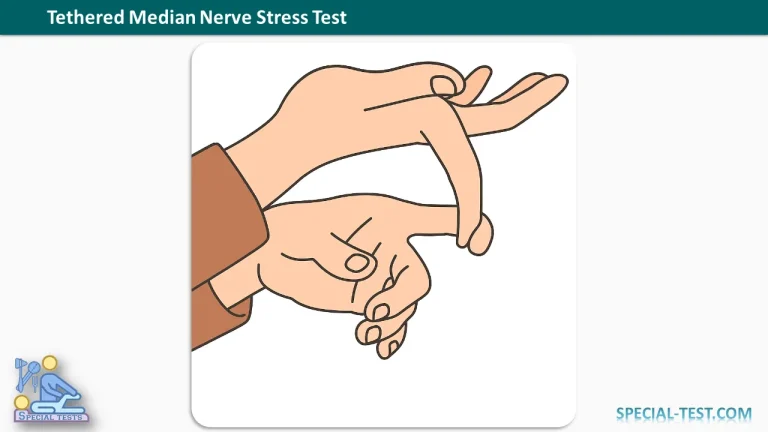
The Tethered Median Nerve Stress Test (TMNST) is a clinical examination technique used to assess median nerve irritation and possible nerve entrapment, particularly in patients with chronic carpal tunnel syndrome (CTS). The test involves extending the wrist and hyperextending the distal interphalangeal joint of the index finger to reproduce characteristic pain along the anterior forearm.
Unlike conventional carpal tunnel tests, which typically reproduce tingling or numbness in the fingers, the Tethered Median Nerve Stress Test focuses on pain radiating proximally along the volar (anterior) forearm.
The test was originally described by LaBan and colleagues in 1986 as a method of identifying chronic median nerve tethering. However, subsequent research has demonstrated limited diagnostic accuracy, meaning the test should be used as part of a comprehensive neurological and musculoskeletal examination rather than as a standalone diagnostic tool.
What Is the Tethered Median Nerve Stress Test Used For?
The primary purpose of the Tethered Median Nerve Stress Test is to identify symptoms suggestive of median nerve entrapment associated with chronic carpal tunnel syndrome.
It may be particularly relevant when evaluating patients with:
- Chronic or recurrent symptoms of carpal tunnel syndrome.
- Pain radiating along the anterior aspect of the forearm.
- Suspected median nerve irritation or restricted neural mobility.
- Numbness or tingling affecting the thumb, index finger, middle finger, or radial half of the ring finger.
- Persistent symptoms requiring further clinical investigation.
Early research suggested that a positive response occurs more frequently in patients with longstanding carpal tunnel syndrome than in those with acute symptoms.
Nevertheless, a positive test cannot independently establish the presence, location, or severity of median nerve compression.
How to Perform the Tethered Median Nerve Stress Test
The Tethered Median Nerve Stress Test is performed through controlled positioning of the elbow, forearm, wrist, and index finger.
Step-by-Step Procedure
- Patient position: Ask the patient to sit or stand comfortably with the affected upper limb relaxed.
- Elbow position: Position the elbow in flexion to allow comfortable manipulation of the forearm and hand.
- Forearm position: Supinate the forearm so that the palm faces upward.
- Wrist position: Place the wrist in slight extension. The original described maneuver combines wrist extension with index finger extension.
- Index finger movement: The examiner gently hyperextends the index finger at the distal interphalangeal (DIP) joint while maintaining the wrist and forearm positions.
- Symptom assessment: Ask whether the maneuver reproduces pain radiating proximally along the anterior forearm.
Published descriptions have assessed symptoms during sustained positioning for up to approximately 60 seconds. However, excessive force should be avoided, and the maneuver should be discontinued if substantial discomfort occurs.
The examiner should document the location, intensity, and character of the reproduced symptoms.
What Is a Positive Tethered Median Nerve Stress Test?
A positive Tethered Median Nerve Stress Test is characterized by reproduction of pain radiating proximally along the volar or anterior aspect of the forearm during wrist extension and index finger DIP joint hyperextension.
The important finding is not simply discomfort at the index finger or wrist, but the characteristic proximal radiation of symptoms.
A positive result may suggest increased median nerve mechanosensitivity or reduced mobility of the nerve in patients with suspected chronic carpal tunnel syndrome.
However, pain reproduced during the examination is not specific to median nerve entrapment. Therefore, the result must be interpreted alongside the patient’s symptoms, neurological findings, and other diagnostic examinations.
Why Is the Test More Likely to Be Positive in Chronic Conditions?
The proposed mechanism involves restricted movement of the median nerve caused by longstanding compression and associated tissue changes.
Normally, peripheral nerves glide relative to surrounding tissues during joint movement. Chronic compression may contribute to fibrosis, adhesions, and reduced neural excursion.
The original investigators suggested that adhesions involving the median nerve and surrounding carpal tunnel structures could limit its movement, producing traction-related symptoms when the wrist and index finger are extended.
An anatomical study published in 1989 also demonstrated movement of the median nerve during index finger hyperextension and proposed a possible vascular contribution to the reproduced pain.
These mechanisms provide a theoretical explanation for the test but do not establish that a positive finding proves fibrosis, adhesions, or nerve ischemia in an individual patient.
Diagnostic Accuracy and Clinical Reliability
Although the Tethered Median Nerve Stress Test has historical clinical significance, research demonstrates that its ability to diagnose carpal tunnel syndrome is limited.
In a study published by Raudino in 2000, the test was positive in 60 of 140 hands (42.8%) with electrophysiologically confirmed carpal tunnel syndrome. This indicates that many confirmed cases were not identified by the maneuver.
Another study by Kaul and colleagues evaluated 102 patients with symptoms suggestive of carpal tunnel syndrome and reported:
| Diagnostic Measure | Result |
|---|---|
| Sensitivity | 50% |
| Specificity | 59.1% |
| Positive predictive value | 61.7% |
| Negative predictive value | 47.3% |
These findings suggest that the test has limited ability to confirm or exclude carpal tunnel syndrome independently.
A negative result does not reliably rule out median nerve compression, while a positive result does not confirm the diagnosis.
For this reason, the Tethered Median Nerve Stress Test is best regarded as a supplementary clinical maneuver.
Tethered Median Nerve Stress Test vs. Other Carpal Tunnel Tests
Several other physical examination techniques are commonly used when carpal tunnel syndrome is suspected.
Phalen’s Test: The patient maintains wrist flexion to reproduce pain, numbness, or tingling within the median nerve distribution.
Tinel’s Sign: The examiner taps over the median nerve at the wrist, looking for tingling or electric-shock-like sensations in the innervated fingers.
Durkan’s Carpal Compression Test: Direct pressure is applied over the carpal tunnel to reproduce characteristic median nerve symptoms.
Median Nerve Upper Limb Neurodynamic Test (ULNT1): A sequence of shoulder, elbow, forearm, wrist, and finger movements is used to assess neural mechanosensitivity. This is a different examination from the Tethered Median Nerve Stress Test.
Current evidence indicates that individual provocative tests have variable sensitivity and specificity. Combining clinical history, symptom distribution, physical examination findings, and appropriate diagnostic investigations provides a more comprehensive assessment.
Clinical Importance and Limitations
The Tethered Median Nerve Stress Test may contribute useful information during the assessment of suspected chronic median neuropathy, particularly when symptoms are atypical or longstanding.
Nevertheless, clinicians should recognize several limitations:
- A positive result is not specific for carpal tunnel syndrome.
- A negative result cannot reliably exclude median nerve compression.
- Wrist, finger, tendon, or other musculoskeletal disorders may also produce discomfort during the maneuver.
- The test cannot determine the severity of median nerve damage.
- The available diagnostic studies do not support using the test as the sole basis for treatment decisions.
When clinically indicated, nerve conduction studies and electromyography may help confirm median neuropathy, evaluate severity, or distinguish carpal tunnel syndrome from alternative neurological conditions.
Frequently Asked Questions (FAQ)
1. What does the Tethered Median Nerve Stress Test assess?
The test evaluates symptom reproduction during movements intended to increase mechanical stress on the median nerve. It is primarily associated with the assessment of chronic carpal tunnel syndrome and suspected median nerve tethering.
2. What indicates a positive Tethered Median Nerve Stress Test?
A positive result occurs when wrist extension and index finger DIP joint hyperextension reproduce characteristic pain radiating along the anterior or volar forearm.
3. Is the Tethered Median Nerve Stress Test useful for chronic carpal tunnel syndrome?
The test was originally described in patients with chronic carpal tunnel syndrome, where positive responses were reported more frequently than in acute cases. However, later studies showed low diagnostic sensitivity, limiting its usefulness as an independent test.
4. Can a negative result rule out median nerve pathology?
No. A negative result does not exclude carpal tunnel syndrome or other median nerve disorders because many patients with confirmed carpal tunnel syndrome have negative findings.
5. Is the test the same as the Median Nerve Upper Limb Tension Test?
No. The Tethered Median Nerve Stress Test mainly uses wrist and index finger extension, whereas the median nerve upper limb neurodynamic test involves a broader sequence of upper limb movements, including shoulder and elbow positioning.
6. Why does index finger hyperextension cause forearm pain?
Index finger hyperextension can produce distal movement and mechanical loading of structures associated with the median nerve. In patients with chronic nerve compression, restricted neural movement or increased mechanosensitivity may contribute to pain radiating into the forearm. This mechanism is proposed rather than definitively established for every positive test.
7. Can the Tethered Median Nerve Stress Test diagnose carpal tunnel syndrome by itself?
No. The test should be interpreted alongside clinical history, sensory examination, muscle strength testing, other provocative maneuvers, and electrodiagnostic studies when appropriate.
Conclusion
The Tethered Median Nerve Stress Test is a clinical provocative maneuver historically used to evaluate median nerve tethering in patients with chronic carpal tunnel syndrome. It is performed by maintaining the forearm in supination, extending the wrist, and gently hyperextending the index finger at the distal interphalangeal joint.
Reproduction of radiating anterior forearm pain is considered a positive finding.
Although the test may provide supplementary clinical information, its limited sensitivity and specificity prevent it from being considered a reliable standalone diagnostic method. A complete clinical assessment remains essential for accurate identification of median nerve pathology.
References
- LaBan MM, Friedman NA, Zemenick GA. “Tethered” median nerve stress test in chronic carpal tunnel syndrome. Archives of Physical Medicine and Rehabilitation. 1986;67(11):803–804. PubMed – PMID: 3778174
- LaBan MM, MacKenzie JR, Zemenick GA. Anatomic observations in carpal tunnel syndrome as they relate to the tethered median nerve stress test. Archives of Physical Medicine and Rehabilitation. 1989;70(1):44–46. PubMed – PMID: 2916919
- Raudino F. Tethered median nerve stress test in the diagnosis of carpal tunnel syndrome. Electromyography and Clinical Neurophysiology. 2000;40(1):57–60. PubMed – PMID: 10782359
- Kaul MP, Pagel KJ, Dryden JD. Lack of predictive power of the “tethered” median stress test in suspected carpal tunnel syndrome. Archives of Physical Medicine and Rehabilitation. 2000;81(3):348–350. PubMed – PMID: 10724081
- Sevy JO, Sina RE, Varacallo MA. Carpal Tunnel Syndrome. StatPearls. NCBI Bookshelf. NCBI Bookshelf – NBK448179
- Sensitivity and Specificity of Examination Maneuvers for Carpal Tunnel Syndrome: A Meta-Analysis. Cureus. 2023. PubMed Central – PMC10446104
- Test Procedures and Positive Diagnostic Criteria of the Upper Limb Tension Tests Differ: A Systematic Review of the DiTA Database. 2023. PubMed Central – PMC10679807