Supination Lift Test for TFCC Tears: Purpose, Procedure, and Positive Findings
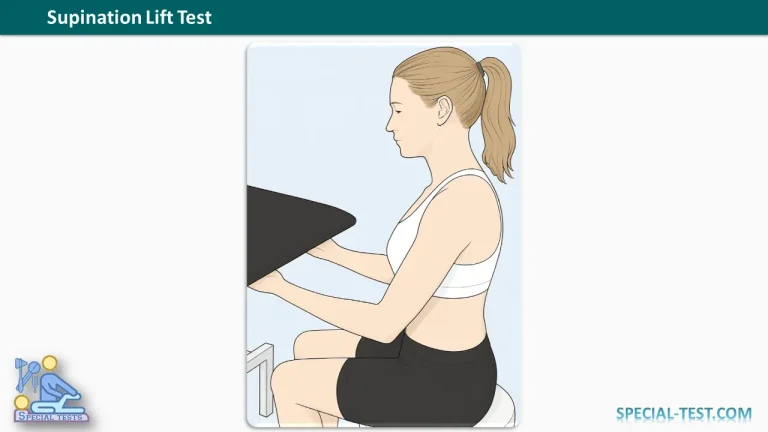
The Supination Lift Test is an orthopedic physical examination maneuver used to assess injuries involving the triangular fibrocartilage complex (TFCC) of the wrist. It is particularly useful when evaluating patients with ulnar-sided wrist pain and suspected peripheral dorsal TFCC tears.
The test places mechanical stress on the TFCC by combining forearm supination with resisted upward force. Reproduction of pain along the ulnar aspect of the wrist suggests possible TFCC pathology, especially when accompanied by difficulty generating lifting force.
The Supination Lift Test is commonly included in the clinical assessment of wrist injuries, particularly in athletes and individuals who experience pain during gripping, lifting, or forearm rotation.
What Is the Purpose of the Supination Lift Test?
The primary purpose of the Supination Lift Test is to identify possible TFCC injuries, especially peripheral tears involving the dorsal portion of the triangular fibrocartilage complex.
The TFCC is a group of fibrocartilaginous and ligamentous structures located on the ulnar (little-finger) side of the wrist. Its primary functions include:
- Stabilizing the distal radioulnar joint (DRUJ).
- Distributing loads between the forearm and wrist.
- Supporting normal forearm pronation and supination.
- Absorbing mechanical stress across the ulnocarpal joint.
TFCC injuries may develop after acute trauma, such as a fall onto an outstretched hand, or from repetitive wrist loading and degenerative changes.
Patients with TFCC tears frequently report pain on the ulnar side of the wrist, particularly during activities involving gripping, twisting, lifting, or weight-bearing.
The Supination Lift Test helps reproduce these symptoms under controlled conditions, providing information that can guide further clinical evaluation.
How to Perform the Supination Lift Test
The Supination Lift Test is a simple clinical examination that does not require specialized equipment. It can be performed using a stable examination table or the examiner’s hands to provide resistance.
Step-by-Step Procedure
- Patient positioning: Ask the patient to sit comfortably in a chair facing a stable table.
- Elbow position: Position both elbows in approximately 90 degrees of flexion.
- Forearm position: Instruct the patient to fully supinate the forearms so that the palms face upward.
- Hand placement: Ask the patient to place the palms flat against the underside of a heavy, stable table. Alternatively, the examiner may place their hands against the patient’s palms to provide resistance.
- Apply upward force: Instruct the patient to attempt to lift the table upward using the palms or to push upward against the examiner’s resistance.
- Observe the response: Assess whether the maneuver produces localized ulnar-sided wrist pain, weakness, or difficulty applying force.
- Compare both wrists: When appropriate, compare the symptomatic wrist with the unaffected side to identify differences in pain and functional performance.
The maneuver should be performed with controlled resistance. Excessive force should be avoided, particularly in patients with severe pain or suspected acute injuries.
What Is a Positive Supination Lift Test?
A positive Supination Lift Test occurs when the patient experiences characteristic pain along the ulnar side of the wrist while attempting to generate upward force.
The primary positive findings include:
- Localized ulnar-sided wrist pain: Pain is reproduced near the triangular fibrocartilage complex during resisted lifting.
- Difficulty applying force: The patient may struggle to lift or push against resistance because of pain.
- Reproduction of familiar symptoms: The maneuver provokes discomfort similar to the patient’s usual wrist pain.
These findings raise suspicion for a peripheral dorsal TFCC tear, although they do not independently establish the diagnosis.
A patient may also experience pain during forced ulnar deviation of the wrist. This additional finding can be associated with TFCC pathology or ulnocarpal impaction syndrome, but it is not part of the standard Supination Lift Test maneuver.
Clinical Significance of the Supination Lift Test
The Supination Lift Test is valuable because it reproduces mechanical loading of structures on the ulnar side of the wrist.
During the examination, the combination of forearm supination and resisted lifting increases stress across the TFCC and may produce dorsal impingement. If the peripheral dorsal portion of the complex is injured, this loading can reproduce the patient’s characteristic pain.
The test may be particularly helpful in evaluating:
- Athletes involved in racket sports, gymnastics, or other activities requiring repetitive wrist loading.
- Patients with persistent ulnar-sided wrist pain following trauma.
- Individuals experiencing painful gripping or forearm rotation.
- Patients with suspected TFCC injuries requiring further evaluation.
However, a positive Supination Lift Test is not specific enough to confirm a TFCC tear on its own. Other disorders, including ulnocarpal impaction syndrome, extensor carpi ulnaris tendon pathology, and distal radioulnar joint disorders, may produce similar symptoms.
Clinical interpretation must therefore consider the patient’s history, tenderness, range of motion, and other physical examination findings.
Supination Lift Test and Other TFCC Special Tests
Several additional orthopedic tests may be performed alongside the Supination Lift Test to investigate ulnar-sided wrist pain.
1. TFCC Compression Test
The examiner applies axial loading while positioning the wrist in ulnar deviation. Reproduction of ulnar-sided pain suggests TFCC or related ulnocarpal pathology.
2. Ulnar Fovea Sign
The examiner applies pressure to the soft tissue depression near the ulnar styloid and flexor carpi ulnaris tendon. Localized tenderness may indicate an injury involving the TFCC foveal attachment or adjacent ligamentous structures.
3. Press Test
The patient attempts to push upward from a chair using the hands. Reproduction of ulnar-sided wrist pain during weight-bearing raises suspicion for a TFCC tear.
4. Piano Key Test
This examination assesses distal radioulnar joint instability, which may occur in association with certain TFCC injuries.
Combining several examination findings generally provides a more useful clinical assessment than relying on a single provocative maneuver.
How Accurate Is the Supination Lift Test?
Although the traditional Supination Lift Test is described in orthopedic examination references, well-established sensitivity and specificity values for this exact maneuver are limited.
A 2025 study by Marcovici and colleagues investigated a related but distinct maneuver called the TFCC Table Lift Test in 314 patients with chronic ulnar-sided wrist pain. The authors reported high diagnostic accuracy for identifying Palmer type 1B TFCC lesions compared with arthroscopic findings.
However, the study used a specific fingertip-lifting technique and pain-scoring method. Its diagnostic accuracy figures should not be directly applied to the conventional Supination Lift Test.
When TFCC injury is suspected, further evaluation may include plain radiographs, MRI, or MR arthrography when clinically appropriate. Wrist arthroscopy remains the diagnostic reference standard for directly evaluating TFCC tears.
Frequently Asked Questions (FAQ)
1. What does the Supination Lift Test assess?
The Supination Lift Test assesses possible injuries of the triangular fibrocartilage complex, particularly peripheral dorsal TFCC tears. It evaluates whether loading the wrist in supination reproduces characteristic ulnar-sided pain.
2. What indicates a positive Supination Lift Test?
A positive result is characterized by pain along the ulnar side of the wrist when the patient attempts to lift a stable table or push upward against resistance. Pain-related difficulty generating force may also be observed.
3. Which TFCC tear is associated with a positive Supination Lift Test?
The traditional Supination Lift Test is primarily associated with peripheral dorsal TFCC tears. However, a positive result cannot reliably establish the exact location or severity of a tear without further evaluation.
4. Can the Supination Lift Test diagnose a TFCC tear?
No. The test is a clinical screening or provocative examination maneuver rather than a definitive diagnostic investigation. A positive finding supports suspicion of TFCC pathology but requires correlation with other findings and, when indicated, imaging or arthroscopy.
5. What causes pain during the Supination Lift Test?
Pain may result from mechanical loading of an injured TFCC during resisted lifting with the forearm supinated. Similar pain can also occur with other conditions affecting the ulnar side of the wrist.
6. Is the Supination Lift Test the same as the Press Test?
No. The Supination Lift Test involves pushing upward against resistance with the forearms supinated and the palms facing upward. The Press Test generally involves pushing downward through the hands to lift the body from a chair.
Both can provoke symptoms associated with TFCC injuries, but they use different wrist-loading positions.
7. What should be done after a positive Supination Lift Test?
A positive result should prompt a more comprehensive clinical assessment, including examination of the TFCC, distal radioulnar joint stability, and surrounding tendons. Imaging may be recommended when symptoms persist or when significant structural injury is suspected.
Conclusion
The Supination Lift Test is a useful orthopedic examination maneuver for evaluating suspected TFCC injuries, particularly peripheral dorsal tears associated with ulnar-sided wrist pain.
The test is performed with the patient seated, elbows flexed to 90 degrees, and forearms fully supinated while applying upward force against a stable surface or examiner resistance.
Reproduction of localized ulnar-sided wrist pain, particularly when accompanied by difficulty generating force, constitutes a positive finding.
Although the test can help identify possible TFCC pathology, its results should always be interpreted alongside the patient’s clinical history, additional orthopedic special tests, and appropriate imaging when necessary.
References
- Orthofixar. Supination Lift Test: Technique, Positive Findings, and Clinical Significance. Updated August 2025. https://orthofixar.com/special-test/supination-lift-test/
- Casadei K, Kiel J. Triangular Fibrocartilage Complex. StatPearls. NCBI Bookshelf. https://www.ncbi.nlm.nih.gov/books/NBK537055/
- Woitzik E, deGraauw C, Easter B. Ulnar Impaction Syndrome: A Case Series Investigating the Appropriate Diagnosis, Management, and Post-operative Considerations. J Can Chiropr Assoc. 2014;58(4):401–412. https://pmc.ncbi.nlm.nih.gov/articles/PMC4262812/
- Jawed A, Ansari MT, Gupta V. TFCC Injuries: How We Treat? J Clin Orthop Trauma. 2020;11(4):570–579. https://pmc.ncbi.nlm.nih.gov/articles/PMC7384326/
- Marcovici LL, et al. The TFCC Table Lift Test: A Clinical Tool for Detecting Palmer 1B TFCC Lesions. J Hand Microsurg. 2025;17(6):100348. https://pubmed.ncbi.nlm.nih.gov/40979303/
- Approach to Chronic Wrist Pain in Adults: Review of Common Pathologies for Primary Care Practitioners. PubMed Central. https://pmc.ncbi.nlm.nih.gov/articles/PMC11126282/