Scratch Collapse Test: Procedure, Positive Sign, Clinical Uses & Diagnostic Accuracy
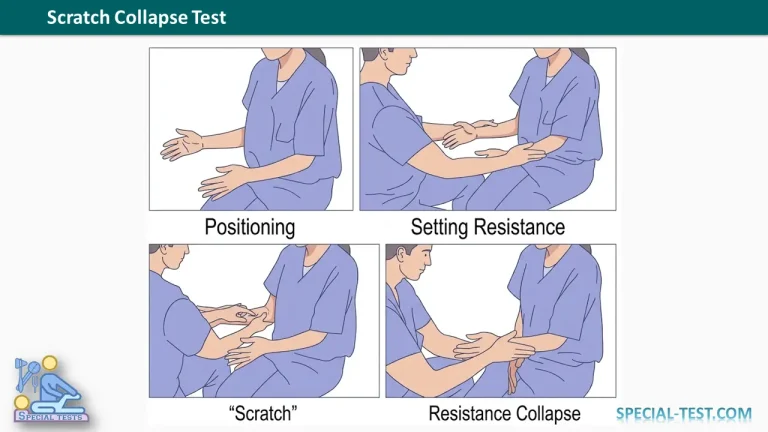
The Scratch Collapse Test (SCT) is a clinical examination technique used to help identify peripheral nerve compression syndromes. It is a provocative neurological test that evaluates a temporary reduction in shoulder external rotation resistance after stimulation of the skin over a suspected site of nerve entrapment.
The test is primarily used in the assessment of carpal tunnel syndrome (CTS) and cubital tunnel syndrome (CuTS), although researchers have also investigated its application to other peripheral nerve entrapments.
Unlike conventional provocative tests, which often reproduce pain, numbness, or tingling, the Scratch Collapse Test assesses a brief change in muscle resistance. However, its diagnostic reliability remains controversial, and it should be used alongside other clinical findings rather than as a standalone diagnostic tool. [1]
What Is the Scratch Collapse Test Used For?
The Scratch Collapse Test is used to help detect and localize areas of peripheral nerve compression. Its principal applications include:
- Carpal tunnel syndrome: Assessment of median nerve compression at the wrist, particularly within the carpal tunnel.
- Cubital tunnel syndrome: Evaluation of ulnar nerve compression around the elbow, commonly near the cubital tunnel.
- Common peroneal nerve compression: Investigation of nerve entrapment around the fibular neck.
- Other peripheral nerve entrapments: The test has been explored for pronator syndrome and several additional compression neuropathies, although supporting evidence varies considerably.
The principal clinical advantage of the Scratch Collapse Test is its potential to help localize a suspected nerve compression site during physical examination.
Nevertheless, a positive result does not independently establish the diagnosis of an entrapment neuropathy. [1, 4]
How to Perform the Scratch Collapse Test
The Scratch Collapse Test is performed with the patient seated and the examiner assessing resistance to shoulder internal rotation.
Step-by-Step Examination Procedure
- Patient positioning: Ask the patient to sit upright with both feet resting on the floor. Position the arms alongside the body, with the elbows flexed to approximately 90 degrees and the wrists in a neutral position.
- Establish baseline resistance: Place your hands against the dorsal aspect of the patient’s forearms. Ask the patient to maintain shoulder external rotation while you apply a gentle, controlled internal rotation force. Both sides should provide a consistent baseline resistance.
- Identify the suspected compression site: Locate the anatomical region where nerve entrapment is suspected. For example, examine the median nerve near the volar wrist in carpal tunnel syndrome or the ulnar nerve near the cubital tunnel in cubital tunnel syndrome.
- Apply cutaneous stimulation: Release the forearms and lightly scratch or stroke the skin directly over the suspected nerve compression site.
- Immediately repeat resistance testing: Reapply the same internal rotation force to the forearms while the patient attempts to maintain external rotation.
- Observe the response: Assess whether the patient’s resistance briefly decreases on the side corresponding to the stimulated nerve.
The examiner should maintain consistent force throughout the procedure and avoid excessive pressure that could influence the patient’s response.
Correct anatomical localization, patient cooperation, and examiner technique are important because the test depends on a subjective assessment of transient muscle resistance. [1]
What Is a Positive Scratch Collapse Test?
A positive Scratch Collapse Test occurs when the patient demonstrates a momentary reduction or loss of resistance to the examiner’s internal rotation force immediately after the skin over a suspected nerve compression site is scratched.
This response is commonly described as a brief collapse of shoulder external rotation resistance.
For example, when assessing carpal tunnel syndrome, stimulation over the median nerve at the wrist may be followed by a temporary reduction in external rotation resistance on the affected side.
Negative Scratch Collapse Test
A negative result occurs when there is no appreciable change in the patient’s resistance following stimulation.
Importantly, a negative Scratch Collapse Test does not rule out nerve compression, because the test has demonstrated relatively low sensitivity in several clinical studies.
Both positive and negative findings must therefore be interpreted in conjunction with the patient’s symptoms, neurological examination, and other diagnostic investigations.
How Does the Scratch Collapse Test Work?
The physiological mechanism responsible for the Scratch Collapse Test has not been conclusively established.
One proposed explanation involves a transient inhibitory response within the nervous system following stimulation of a compressed or irritated peripheral nerve.
According to this hypothesis, cutaneous stimulation may temporarily influence motor activity, producing the brief reduction in resistance observed during examination.
Researchers have investigated possible neurological reflex pathways and inhibitory responses, but the precise mechanism remains uncertain.
A 2024 systematic review by Faszholz and Cheng emphasized that further research is needed to improve test standardization, examiner agreement, and objective measurement of the observed response. [1]
Scratch Collapse Test Accuracy: Sensitivity and Specificity
Although early investigations reported promising diagnostic performance, subsequent studies have produced inconsistent results.
Sensitivity refers to the proportion of patients with a condition who have a positive test, whereas specificity refers to the proportion of patients without the condition who have a negative test.
Evidence From Clinical Studies
Initial clinical investigation (2008)
An early study evaluating carpal and cubital tunnel syndromes reported Scratch Collapse Test sensitivities of 64% for carpal tunnel syndrome and 69% for cubital tunnel syndrome. The investigators reported overall diagnostic accuracies of 82% and 89%, respectively. [2]
Makanji et al. (2014)
A prospective study of 88 adults undergoing evaluation for carpal tunnel syndrome reported:
- Sensitivity: 31%
- Specificity: 61%
The researchers concluded that the Scratch Collapse Test was not more sensitive than conventional physical examination maneuvers, including Phalen’s and Durkan’s tests. [3]
Systematic review and meta-analysis (2018)
A meta-analysis involving 165 patients found a pooled sensitivity of 32% and specificity of 62% for carpal tunnel syndrome, suggesting limited diagnostic accuracy as a screening examination. [4]
Systematic review (2023)
A larger pooled analysis reported an overall sensitivity of approximately 38% and specificity of 94% across multiple compression neuropathies.
For individual conditions, the reported results included:
| Condition | Sensitivity | Specificity |
|---|---|---|
| Carpal tunnel syndrome | 29.4% | 90.4% |
| Cubital tunnel syndrome | 60.5% | 97.8% |
| Common peroneal nerve compression | 76.9% | 98.6% |
The authors suggested that the Scratch Collapse Test might have greater usefulness as an adjunctive test than as an initial screening examination. [5]
Systematic review (2024)
A further review found substantial variability between studies. Across studies examining carpal tunnel syndrome, mean sensitivity was approximately 44% and mean specificity was approximately 79%. For cubital tunnel syndrome, mean sensitivity was approximately 64% and mean specificity was approximately 95%. [1]
These results highlight the importance of considering study design, examiner experience, and testing technique when interpreting diagnostic accuracy.
Clinical Interpretation
The available evidence suggests that the Scratch Collapse Test may provide supplementary information when peripheral nerve compression is suspected.
However, its sensitivity is frequently insufficient to reliably exclude disease, and its specificity varies between studies.
Consequently, the test should not replace established diagnostic approaches.
Scratch Collapse Test vs. Other Nerve Compression Tests
Several clinical maneuvers are commonly used to investigate peripheral nerve entrapment.
| Clinical test | Main assessment |
|---|---|
| Scratch Collapse Test | Temporary reduction in external rotation resistance after skin stimulation |
| Phalen’s Test | Reproduction of median nerve symptoms during wrist flexion |
| Tinel’s Sign | Tingling or paresthesia after percussion over a peripheral nerve |
| Durkan’s Compression Test | Reproduction of carpal tunnel symptoms during direct pressure over the carpal tunnel |
| Elbow Flexion Test | Provocation of ulnar nerve symptoms during sustained elbow flexion |
Unlike Phalen’s, Tinel’s, and Durkan’s tests, the Scratch Collapse Test primarily assesses a motor resistance response rather than symptom reproduction.
A comprehensive examination may include several of these tests, together with sensory testing, muscle strength assessment, and evaluation of symptom distribution.
Electrodiagnostic studies or nerve ultrasound may provide additional diagnostic information when the clinical presentation is uncertain or further evaluation is indicated. [6]
Limitations of the Scratch Collapse Test
Despite its simplicity and potential clinical applications, the Scratch Collapse Test has several important limitations:
- Variable sensitivity: Patients with confirmed nerve compression may have negative test results.
- Examiner dependence: Differences in technique, force application, and experience may influence findings.
- Limited standardization: The amount of scratching and resistance applied is not uniformly standardized.
- Interobserver variability: Different examiners may disagree about whether a collapse has occurred.
- Patient-related factors: Shoulder weakness, pain, limited mobility, or inconsistent effort may affect interpretation.
These limitations explain why the test remains controversial despite its continued use in some peripheral nerve examinations. [1, 5, 7]
Frequently Asked Questions (FAQ)
1. What does a positive Scratch Collapse Test indicate?
A positive Scratch Collapse Test indicates a brief reduction in shoulder external rotation resistance after skin stimulation over a suspected nerve compression site. It may support the clinical suspicion of peripheral nerve entrapment but does not confirm the diagnosis independently.
2. Is the Scratch Collapse Test reliable for carpal tunnel syndrome?
The reliability of the Scratch Collapse Test for carpal tunnel syndrome is limited. Studies have reported widely varying sensitivity and specificity, and systematic reviews have concluded that the test is inadequate as a standalone screening tool.
3. Can the Scratch Collapse Test diagnose cubital tunnel syndrome?
The test may assist in evaluating suspected ulnar nerve compression at the elbow. Some studies report relatively high specificity, but sensitivity varies substantially, so additional clinical assessment is necessary.
4. What is the difference between the Scratch Collapse Test and Tinel’s Sign?
Tinel’s Sign involves tapping over a nerve to reproduce tingling or paresthesia. In contrast, the Scratch Collapse Test involves scratching the skin over a suspected compression site and observing whether shoulder external rotation resistance temporarily decreases.
5. Can a negative Scratch Collapse Test rule out nerve compression?
No. A negative result cannot reliably exclude peripheral nerve compression because the test may produce false-negative findings. Further assessment may be needed when symptoms suggest an entrapment neuropathy.
6. Is the Scratch Collapse Test painful?
The procedure generally involves light skin stimulation and gentle resistance testing. It is usually well tolerated, although patients with sensitive or painful regions may experience discomfort.
7. Does the Scratch Collapse Test replace nerve conduction studies?
No. The test is an adjunctive physical examination maneuver. Nerve conduction studies and electromyography can provide additional information about peripheral nerve dysfunction, particularly when symptoms are atypical, the diagnosis is uncertain, or the severity of nerve injury needs assessment.
Conclusion
The Scratch Collapse Test is a provocative physical examination technique that may assist clinicians in identifying suspected peripheral nerve compression, particularly in carpal tunnel syndrome and cubital tunnel syndrome.
A positive test consists of a momentary decrease in shoulder external rotation resistance following cutaneous stimulation over the suspected nerve entrapment site.
Although the test is quick and noninvasive, scientific evidence demonstrates substantial variability in its diagnostic accuracy.
For this reason, the Scratch Collapse Test should be considered a supplementary clinical examination rather than a definitive diagnostic procedure. Patient history, conventional neurological examination, and appropriately selected diagnostic investigations remain essential for accurate assessment.
References
- Faszholz AM, Cheng J. (2024). Updates to the Physiologic Mechanism, Anatomical Sites, and Diagnostic Utility of the Scratch Collapse Test: A Systematic Review. Plastic and Reconstructive Surgery – Global Open. PubMed / NCBI
- Scratch Collapse Test for Evaluation of Carpal and Cubital Tunnel Syndrome. (2008). Journal of Hand Surgery. PubMed
- Makanji HS, Becker SJE, Mudgal CS, Jupiter JB, Ring D. (2014). Evaluation of the Scratch Collapse Test for the Diagnosis of Carpal Tunnel Syndrome. Journal of Hand Surgery (European Volume). PubMed
- Huynh MNQ, Karir A, Bennett A. (2018). Scratch Collapse Test for Carpal Tunnel Syndrome: A Systematic Review and Meta-analysis. Plastic and Reconstructive Surgery – Global Open. PubMed
- The Scratch-Collapse Test: A Systematic Review and Statistical Analysis. (2023). PubMed | NCBI Full Text
- Sucher BM, Schreiber AL. (2014). Carpal Tunnel Syndrome Diagnosis. Physical Medicine and Rehabilitation Clinics of North America. PubMed
- Evaluation of the Scratch Collapse Test for Carpal and Cubital Tunnel Syndrome—A Prospective, Blinded Study. (2020). PubMed