Hook of Hamate Pull Test: Procedure, Positive Sign, and Clinical Significance
What Is the Hook of Hamate Pull Test?
The Hook of Hamate Pull Test, also known as the Hamate Pull Test or Hamate Fracture Test, is a clinical examination maneuver used to detect suspected fractures of the hook of the hamate bone in the wrist.
This orthopedic special test is particularly useful in patients presenting with persistent ulnar-sided wrist pain, especially following sports-related trauma or repetitive gripping activities.
Hook of hamate fractures are frequently overlooked during initial assessment because symptoms may resemble wrist sprains or soft-tissue injuries. Furthermore, these fractures can be difficult to identify on standard wrist radiographs.
The test was described by Wright and colleagues in 2010 as a physical examination maneuver for identifying hook of hamate fractures.
Anatomy of the Hook of Hamate
The hamate is one of the eight carpal bones forming the wrist. It is located on the ulnar side of the distal carpal row, near the bases of the fourth and fifth metacarpals.
A distinctive feature of this bone is its hook-shaped projection, called the hamulus, which extends toward the palmar surface of the hand.
The hook of the hamate has important anatomical relationships with:
- The flexor tendons of the ring and little fingers.
- The ulnar nerve and ulnar artery, which pass nearby through Guyon’s canal.
- The transverse carpal ligament and surrounding soft-tissue structures.
Because of its location, the hook is vulnerable to direct trauma and repetitive stress, particularly during activities involving bats, clubs, or rackets.
What Is the Hook of Hamate Pull Test Used For?
The primary purpose of the Hook of Hamate Pull Test is to identify a suspected fracture of the hook of the hamate, including acute fractures and symptomatic nonunions.
The examination is especially relevant in patients with:
- Pain along the ulnar or little-finger side of the wrist.
- Localized tenderness over the hypothenar eminence.
- Wrist pain following golf, baseball, tennis, or other gripping sports.
- Reduced grip strength or pain during forceful gripping.
- Persistent palmar wrist pain despite normal initial X-rays.
The test provides valuable clinical information that can help determine whether additional diagnostic imaging is necessary.
How to Perform the Hook of Hamate Pull Test
The test should be performed by a trained healthcare professional as part of a complete wrist and hand examination.
Patient position: The patient is seated comfortably with the affected hand and forearm supported.
Examination procedure:
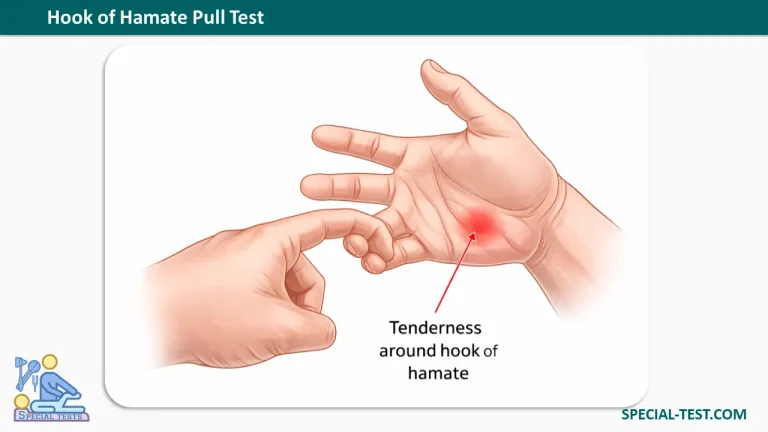
- Position the wrist: Place the patient’s wrist in ulnar deviation, moving the hand toward the little-finger side.
- Position the fingers: Ask the patient to flex the ring and little fingers, particularly at their distal interphalangeal (DIP) joints.
- Apply resistance: Instruct the patient to maintain finger flexion while the examiner applies gentle extension-directed resistance to the distal fingers. A simplified variation involves asking the patient to make a fist against resistance.
- Assess the response: Observe whether resisted finger flexion reproduces localized pain over the hook of the hamate or hypothenar region.
The maneuver should be performed carefully without excessive force, particularly when an acute fracture is suspected.
What Is a Positive Hook of Hamate Pull Test?
A positive Hook of Hamate Pull Test occurs when resisted flexion of the ring and little fingers reproduces sharp, localized pain along the volar-ulnar aspect of the wrist, especially near the base of the hypothenar eminence.
This finding raises clinical suspicion for a hook of hamate fracture.
Why Does the Test Cause Pain?
The flexor tendons of the ring and little fingers travel close to the hook of the hamate, which functions as part of their mechanical pulley system.
When these fingers flex against resistance, the tendons generate forces around the hook. If the hook is fractured, this loading can produce pain at the fracture site.
The mechanism explains why patients with hook of hamate fractures frequently experience discomfort when gripping, swinging a bat, or holding a golf club.
Clinical Accuracy and Significance
The Hook of Hamate Pull Test has been described as a sensitive clinical maneuver for suspected hook fractures.
In the original study by Wright et al. (2010), the test was positive in five consecutive patients with hook of hamate fractures. Another small clinical study reported positive findings in all four recently evaluated patients who underwent the test.
However, these studies involved small patient groups, and robust estimates of diagnostic sensitivity and specificity are not established.
Therefore, a positive test supports the suspicion of a hook of hamate fracture but does not independently confirm the diagnosis. Similarly, a negative test does not completely exclude the injury.
The findings should always be interpreted alongside the patient’s injury history, localized tenderness, neurological examination, and imaging results.
Imaging and Diagnosis of Hook of Hamate Fractures
If the Hook of Hamate Pull Test is positive or clinical suspicion remains high, further imaging may be required.
Plain radiographs: Standard wrist X-rays are usually obtained initially. However, nondisplaced hook fractures may not be visible on routine projections.
Special radiographic views: Carpal tunnel views may improve visualization of the hook of the hamate.
Computed tomography (CT): CT is particularly valuable for confirming suspected hook of hamate fractures, identifying fracture displacement, and evaluating injuries not detected on standard radiographs.
Magnetic resonance imaging (MRI): MRI may be considered when associated soft-tissue injury, bone marrow abnormalities, or another cause of persistent wrist pain is suspected.
According to the NCBI StatPearls review on hamate fractures, CT is often necessary when conventional radiographs fail to establish the diagnosis.
Why Is Early Diagnosis Important?
Delayed recognition of a hook of hamate fracture may result in persistent symptoms and complications, including:
- Fracture nonunion.
- Chronic ulnar-sided wrist pain.
- Ulnar nerve irritation or compression.
- Flexor tendon irritation or rupture.
- Persistent weakness of grip.
Early recognition allows clinicians to select appropriate management, which may include immobilization for selected nondisplaced fractures or surgical treatment in particular circumstances.
Treatment decisions depend on fracture displacement, chronicity, symptoms, occupational demands, and athletic requirements.
Frequently Asked Questions (FAQs)
1. What does the Hook of Hamate Pull Test assess?
The Hook of Hamate Pull Test assesses for a suspected fracture of the hook of the hamate, a small bony projection on the ulnar side of the wrist.
2. How do you perform the Hamate Pull Test?
The wrist is positioned in ulnar deviation, and the patient is instructed to flex the ring and little fingers against resistance. The examiner assesses whether the maneuver reproduces localized pain over the hook of the hamate.
3. What indicates a positive Hook of Hamate Pull Test?
A positive result is characterized by localized pain along the palmar-ulnar wrist, particularly near the hypothenar eminence, during resisted finger flexion. This finding suggests a possible hook of hamate fracture.
4. Is the Hook of Hamate Pull Test reliable?
The test has shown promising results in small published clinical studies. However, its sensitivity and specificity have not been established through large, high-quality diagnostic studies. It should not be used as the sole basis for diagnosing or excluding a fracture.
5. Can a hook of hamate fracture be missed on an X-ray?
Yes. Hook of hamate fractures, especially nondisplaced injuries, may be difficult to detect on standard wrist X-rays. CT imaging is frequently recommended when clinical suspicion persists despite negative radiographs.
6. Which athletes are at greater risk of hook of hamate fractures?
Athletes who participate in golf, baseball, tennis, and other sports requiring forceful gripping or repeated impact through a club, bat, or racket are at increased risk.
7. What is the best imaging test for a suspected hook of hamate fracture?
CT is generally considered the preferred imaging modality for detecting and characterizing a suspected hook of hamate fracture when standard radiographs are inconclusive.
Conclusion
The Hook of Hamate Pull Test is a useful orthopedic examination technique for evaluating patients with suspected hook of hamate fractures.
By placing the wrist in ulnar deviation and applying resistance to flexion of the ring and little fingers, clinicians can reproduce pain associated with injury to the hook of the hamate.
Although a positive finding increases suspicion for this fracture, definitive diagnosis generally requires appropriate imaging, particularly CT when radiographs are negative or inconclusive.
Recognizing the clinical significance of the Hamate Pull Test can help reduce missed diagnoses and facilitate timely treatment of patients with persistent ulnar-sided wrist pain.
References
- Wright TW, Moser MW, Sahajpal DT. Hook of Hamate Pull Test. Journal of Hand Surgery (American Volume). 2010;35(11):1887–1889. PubMed – PMID: 20961698
- Abrego MO, Ahmed AS, De Cicco FL. Hamate Fractures. StatPearls. NCBI Bookshelf. Updated July 20, 2023. NCBI Bookshelf
- Sahu MA, et al. Fractures of the Hamate Bone: A Review of Clinical Presentation, Diagnosis and Management in the United Kingdom. Cureus. 2024;16(11). PubMed – PMID: 39552736
- Isolated Hook of Hamate Fracture in Sports That Require a Strong Grip: Comprehensive Literature Review. Medicine. 2018. PubMed Central – Full Text
- Clinical and Radiographic Evaluation of Ulnar-Sided Wrist Pain. Current Reviews in Musculoskeletal Medicine. 2022. PubMed Central – Full Text
- Clinical Outcomes of Hook of Hamate Fractures and Usefulness of the Hook of Hamate Pull Test. PubMed – PMID: 23061944
- Hook of Hamate Pull Test: Diagnose Hamate Fractures With This Simple Exam. Orthofixar. Orthofixar – Special Tests