Gamekeeper’s Test: Procedure, Positive Signs & Thumb UCL Injury
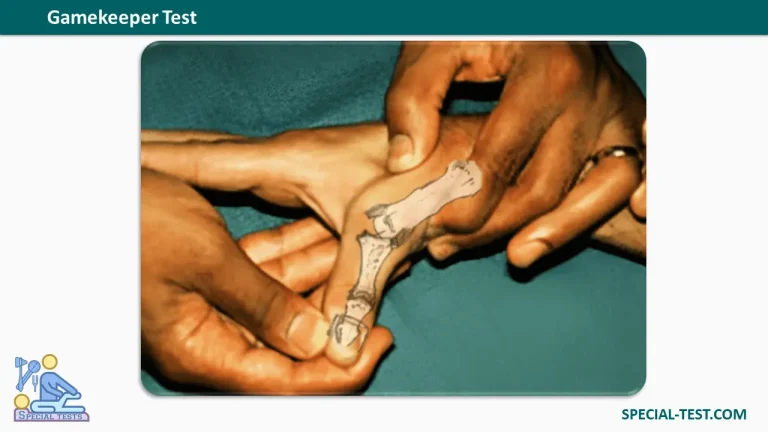
The Gamekeeper’s Test, also known as the Skier’s Thumb Test or thumb valgus stress test, is a clinical examination used to assess injury or rupture of the ulnar collateral ligament (UCL) of the thumb metacarpophalangeal (MCP) joint.
This orthopedic special test evaluates ligament stability by applying a valgus force to the thumb MCP joint. Increased joint laxity, particularly when accompanied by the absence of a firm endpoint, suggests a significant UCL injury.
The Gamekeeper’s Test is commonly performed when evaluating patients with thumb pain, swelling, weakness, or instability following sports injuries, falls, or repetitive thumb stress.
What Is the Gamekeeper’s Test Used For?
The primary purpose of the Gamekeeper’s Test is to detect partial or complete tears of the ulnar collateral ligament at the thumb MCP joint.
The UCL is an important stabilizer of the thumb during gripping, pinching, and other activities requiring precise hand movements. Injury to this ligament may compromise thumb stability and interfere with daily activities.
Two conditions are commonly associated with thumb UCL injuries:
- Gamekeeper’s thumb: Traditionally refers to chronic UCL injury resulting from repetitive stress and progressive ligament stretching.
- Skier’s thumb: Refers to an acute UCL injury, typically caused by sudden forced thumb abduction, such as a fall while holding a ski pole.
Although the underlying injury mechanisms differ, both conditions involve the thumb UCL and can be evaluated using valgus stress testing.
How to Perform the Gamekeeper’s Test
The Gamekeeper’s Test should be performed gently by a trained healthcare professional to assess the integrity of the thumb UCL without worsening a suspected injury.
Step-by-Step Examination Procedure
- Patient positioning: Ask the patient to sit comfortably with the affected hand supported and the thumb accessible for examination.
- Stabilization: The examiner stabilizes the first metacarpal with one hand while holding the proximal phalanx of the thumb with the other.
- Apply valgus stress: Gently apply a radial deviation or abduction force to the proximal phalanx at the MCP joint. This movement places tension on the ulnar collateral ligament.
- Test in extension: Perform the valgus stress examination with the thumb MCP joint in full extension (0° of flexion).
- Test in flexion: Repeat the examination with the thumb MCP joint positioned at approximately 30 degrees of flexion to assess the proper UCL more specifically.
- Compare both thumbs: Examine the unaffected thumb to assess baseline joint laxity and identify abnormal instability on the injured side.
- Evaluate the endpoint: Determine whether the joint has a firm mechanical endpoint or continues to open without a definite endpoint under stress.
Maintaining the thumb in neutral rotation during examination is important because pronation and supination can influence the apparent degree of ligament instability.
Why Is the Test Performed in Both Flexion and Extension?
The UCL consists of proper and accessory components that contribute to MCP joint stability in different positions.
- In approximately 30° of flexion: Valgus stress preferentially evaluates the proper ulnar collateral ligament.
- In extension: Valgus stress assesses combined stability provided by the UCL complex, accessory structures, and surrounding stabilizers.
Testing both positions helps clinicians evaluate the severity and extent of ligament injury.
What Is a Positive Gamekeeper’s Test?
A positive Gamekeeper’s Test is characterized by excessive valgus laxity of the thumb MCP joint, especially when there is no firm endpoint during stress examination.
Commonly described findings suggesting a significant or complete UCL tear include:
- More than 30–35 degrees of valgus angulation at the thumb MCP joint.
- More than 15 degrees of increased laxity compared with the opposite thumb.
- Absence of a firm endpoint, suggesting complete ligament disruption.
- Marked instability during valgus stress testing in flexion, extension, or both positions.
These thresholds are useful clinical indicators rather than absolute diagnostic rules. Studies have demonstrated considerable variation in normal thumb laxity, including differences between an individual’s right and left thumbs.
Consequently, the absence of a definite mechanical endpoint is particularly important when assessing a suspected complete UCL rupture.
Pain during stress testing may support the presence of an injury, but pain alone does not establish a positive test for ligament instability.
Clinical Significance of a Positive Test
A positive Gamekeeper’s Test raises concern for partial or complete thumb UCL injury.
Partial UCL tears generally retain some ligament continuity and may demonstrate mild or moderate laxity with a firm endpoint.
Complete UCL tears are associated with greater instability and frequently demonstrate no definite endpoint during valgus stress testing.
One important complication is a Stener lesion, in which the torn UCL becomes displaced superficial to the adductor pollicis aponeurosis. This displacement prevents the ligament from returning to its normal anatomical position and interferes with spontaneous healing.
A Stener lesion requires specialist evaluation and generally surgical repair. However, the Gamekeeper’s Test alone cannot reliably confirm its presence.
Additional Investigations for Thumb UCL Injury
Although clinical examination is central to evaluating thumb UCL injuries, diagnostic imaging may be necessary.
Plain radiographs (X-rays) help identify associated avulsion fractures or other bony injuries.
Ultrasound can evaluate the UCL and may help identify complete tears or displaced ligament tissue when performed by an experienced operator.
Magnetic resonance imaging (MRI) provides detailed visualization of the ligament and surrounding soft tissues and can help confirm the extent of injury or identify a Stener lesion.
The need for additional imaging depends on the clinical findings, severity of injury, and diagnostic uncertainty.
Treatment Considerations
Management of thumb UCL injuries depends on ligament stability, the extent of tearing, associated fractures, and the presence of a displaced ligament.
Stable partial injuries are commonly treated with immobilization using a thumb spica splint or cast, followed by appropriate rehabilitation.
Complete tears and injuries associated with significant instability require prompt assessment by a hand specialist. Treatment may involve immobilization or surgical repair, depending on the individual injury and shared clinical decision-making.
Early diagnosis is important because untreated UCL injuries can lead to chronic thumb instability, impaired pinch strength, persistent discomfort, and reduced hand function.
Frequently Asked Questions (FAQs)
1. What does the Gamekeeper’s Test assess?
The Gamekeeper’s Test evaluates the integrity and stability of the ulnar collateral ligament at the thumb MCP joint. It is primarily used to identify ligament injuries associated with gamekeeper’s thumb and skier’s thumb.
2. How is the Gamekeeper’s Test performed?
The examiner stabilizes the first metacarpal and applies gentle valgus stress to the proximal phalanx of the thumb. The examination is performed with the MCP joint in extension and approximately 30 degrees of flexion.
3. What indicates a positive Gamekeeper’s Test?
Excessive valgus movement, commonly greater than 30–35 degrees, or a side-to-side difference greater than 15 degrees can suggest a significant UCL injury. The absence of a firm endpoint is particularly concerning for complete ligament rupture.
4. What is the difference between gamekeeper’s thumb and skier’s thumb?
Gamekeeper’s thumb traditionally describes chronic UCL damage caused by repetitive stress, whereas skier’s thumb describes an acute traumatic UCL injury. Both affect the same ligament at the thumb MCP joint.
5. Can the Gamekeeper’s Test diagnose a complete UCL tear?
The test can strongly suggest complete UCL rupture when substantial instability and no firm endpoint are present. However, clinical findings may need confirmation with ultrasound or MRI, particularly when the diagnosis or presence of a Stener lesion is uncertain.
6. Why is the thumb flexed to 30 degrees during testing?
Positioning the MCP joint at approximately 30 degrees of flexion helps isolate the proper UCL and reduces the stabilizing contribution of other structures that may mask ligament instability.
7. What is a Stener lesion?
A Stener lesion occurs when the ruptured thumb UCL becomes displaced superficial to the adductor aponeurosis. This prevents normal ligament healing and generally requires surgical treatment.
8. Is the Gamekeeper’s Test painful?
The test may cause discomfort in patients with acute UCL injuries. It should be performed carefully, and forceful stress should be avoided. Severe pain, substantial swelling, or a suspected fracture may limit examination and require further assessment.
Conclusion
The Gamekeeper’s Test is an important orthopedic examination for identifying thumb ulnar collateral ligament injuries. The test involves applying valgus stress to the thumb MCP joint in extension and approximately 30 degrees of flexion.
Excessive laxity, particularly greater than 30–35 degrees, a substantial difference compared with the opposite thumb, or the absence of a firm endpoint suggests significant ligament disruption.
Interpretation should incorporate the injury history, clinical findings, and imaging when appropriate. Early recognition of UCL injuries helps guide treatment and reduce the risk of chronic thumb instability and functional impairment.
References
- Orthofixar. Gamekeeper Test – Skier’s Thumb Test. https://orthofixar.com/special-test/gamekeeper-test/
- Mohseni M, Sina RE, Graham C. Ulnar Collateral Ligament Injury (Gamekeeper’s Thumb). StatPearls. NCBI Bookshelf. https://www.ncbi.nlm.nih.gov/books/NBK482383/
- Malik AK, Morris T, Chou D, Sorene E, Taylor E. Clinical testing of ulnar collateral ligament injuries of the thumb. Journal of Hand Surgery (European Volume). 2009;34(3):363–366. https://pubmed.ncbi.nlm.nih.gov/19349298/
- Heyman P. Injuries to the Ulnar Collateral Ligament of the Thumb Metacarpophalangeal Joint. Journal of the American Academy of Orthopaedic Surgeons. 1997;5(4):224–229. https://pubmed.ncbi.nlm.nih.gov/10797225/
- Beutel BG, Melamed E, Rettig ME. The Stener Lesion and Complete Ulnar Collateral Ligament Injuries of the Thumb: A Review. Bulletin of the Hospital for Joint Diseases. 2019;77(1):11–20. https://pubmed.ncbi.nlm.nih.gov/30865860/
- Dean B, et al. Guideline on managing thumb ulnar collateral ligament injuries: the British Society for Surgery of the Hand Evidence for Surgical Treatment (BEST) findings and recommendations. Journal of Hand Surgery (European Volume). 2024;49(10):1195–1201. https://pubmed.ncbi.nlm.nih.gov/39315553/
- Heyman P, Gelberman RH, Duncan K, et al. Injuries of the ulnar collateral ligament of the thumb metacarpophalangeal joint: Biomechanical and prospective clinical studies on the usefulness of valgus stress testing. Clinical Orthopaedics and Related Research. 1993;(292):165–171. https://pubmed.ncbi.nlm.nih.gov/8519106/