Froment’s Sign Test: How to Perform It, Positive Results & Ulnar Nerve Assessment
What Is Froment’s Sign?
Froment’s sign, also known as the Froment sign test or Froment’s paper sign, is a clinical examination technique used to assess ulnar nerve motor weakness, particularly weakness or paralysis of the adductor pollicis muscle of the thumb.
The test evaluates the patient’s ability to maintain a key pinch grip between the thumb and index finger while resisting an external pulling force.
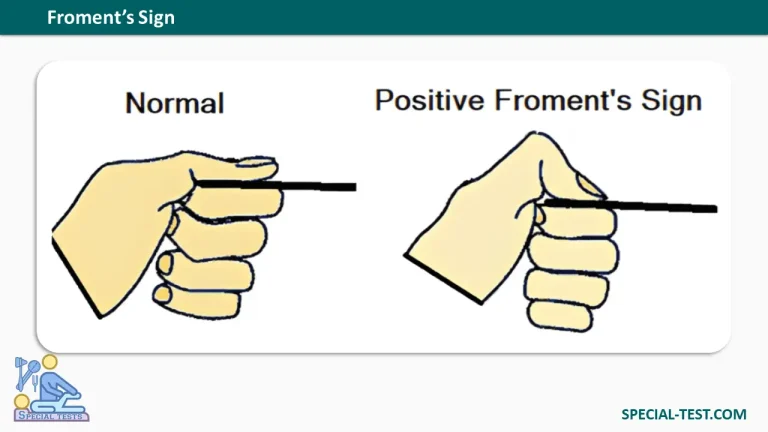
A positive Froment’s sign occurs when the patient compensates for weakness of the adductor pollicis by flexing the interphalangeal (IP) joint of the thumb using the flexor pollicis longus muscle.
This finding suggests ulnar nerve dysfunction and is commonly associated with conditions such as cubital tunnel syndrome, Guyon’s canal syndrome, and ulnar nerve injuries.
Froment’s sign was originally described by French neurologist Jules Froment in 1915 and remains an important component of the neurological examination of the hand.
What Is Froment’s Sign Used For?
The primary purpose of Froment’s sign is to identify motor dysfunction of the ulnar nerve, especially impairment of the adductor pollicis muscle.
The test is clinically useful when evaluating patients presenting with:
- Weakness of thumb adduction or key pinch grip.
- Difficulty holding objects between the thumb and index finger.
- Suspected ulnar nerve entrapment at the elbow (cubital tunnel syndrome).
- Suspected ulnar nerve compression at the wrist (Guyon’s canal syndrome).
- Hand muscle weakness following trauma or peripheral nerve injury.
- Muscle wasting or reduced fine motor control involving the intrinsic muscles of the hand.
Froment’s sign helps clinicians recognise weakness involving ulnar-innervated hand muscles. However, the test alone cannot determine the exact location or severity of an ulnar nerve lesion.
How to Perform Froment’s Sign Test
The Froment’s sign test is a simple clinical examination that requires only a small piece of paper.
Step-by-Step Examination Technique
- Patient position: Ask the patient to sit comfortably with the forearm and hand relaxed. The test may also be performed while standing.
- Paper placement: Place a piece of paper between the patient’s thumb and the radial (lateral) side of the index finger, using a key pinch grip.
- Patient instruction: Ask the patient to hold the paper firmly between the thumb and index finger while attempting to keep the thumb’s interphalangeal joint straight.
- Apply resistance: Gently pull the paper away while the patient attempts to maintain the grip.
- Observe thumb movement: Watch the interphalangeal joint of the thumb for abnormal flexion as the patient resists the pulling force.
- Compare both hands: Repeat the examination on the opposite hand to identify differences in pinch strength and thumb positioning.
Clinical tip: The examiner should observe the position of the thumb throughout the test rather than evaluating grip strength alone. Compensatory thumb flexion is the defining feature of a positive Froment’s sign.
What Is a Positive Froment’s Sign?
A positive Froment’s sign is demonstrated when the patient flexes the interphalangeal joint of the thumb while attempting to prevent the examiner from pulling the paper away.
This occurs because the adductor pollicis muscle is weakened or paralysed, reducing the ability to maintain a normal key pinch.
To compensate, the patient recruits the flexor pollicis longus muscle, which flexes the thumb’s IP joint to increase pressure against the paper.
This compensatory action indicates dysfunction of the ulnar nerve motor supply to the adductor pollicis.
Importantly, the paper does not necessarily need to slip out of the patient’s grasp for the test to be positive. The characteristic abnormal finding is flexion of the thumb IP joint during resisted pinch.
Positive vs. Negative Froment’s Sign
| Finding | Clinical interpretation |
|---|---|
| Positive Froment’s sign | Thumb IP joint flexion during resisted paper pinch, suggesting adductor pollicis weakness and possible ulnar nerve dysfunction. |
| Negative Froment’s sign | Patient maintains the paper without compensatory thumb IP flexion, indicating preserved adductor pollicis function during the examination. |
A negative result does not completely exclude mild or early ulnar neuropathy.
Anatomical Basis of Froment’s Sign
Understanding the anatomy of the thumb muscles is essential for correctly interpreting Froment’s sign.
Adductor Pollicis Muscle
The adductor pollicis is a deep intrinsic muscle of the hand responsible for bringing the thumb toward the index finger and providing strength during key pinch activities.
It has two heads:
- Oblique head: Originates from carpal bones and adjacent metacarpal bases.
- Transverse head: Originates primarily from the palmar surface of the third metacarpal.
The adductor pollicis receives its primary motor innervation from the deep branch of the ulnar nerve, with nerve roots predominantly from C8 and T1.
Flexor Pollicis Longus Muscle
The flexor pollicis longus is responsible for flexion of the thumb’s interphalangeal joint.
Unlike the adductor pollicis, it receives innervation from the anterior interosseous nerve, a branch of the median nerve.
When the ulnar nerve is impaired, the patient may recruit the flexor pollicis longus to compensate for reduced thumb adduction strength.
This explains why a positive Froment’s sign produces abnormal thumb IP flexion rather than maintaining a normal key pinch position.
Clinical Significance of Froment’s Sign
Froment’s sign is particularly useful during the examination of patients with suspected peripheral nerve injuries and compressive neuropathies affecting the ulnar nerve.
1. Cubital Tunnel Syndrome
Cubital tunnel syndrome results from compression of the ulnar nerve around the elbow.
Patients may experience numbness or tingling in the little finger and ulnar half of the ring finger, hand weakness, reduced grip strength, and difficulty performing fine motor activities.
A positive Froment’s sign suggests motor involvement of the ulnar nerve, especially when associated with weakness or wasting of intrinsic hand muscles.
2. Guyon’s Canal Syndrome
Compression of the ulnar nerve at the wrist within Guyon’s canal can affect the deep motor branch supplying the adductor pollicis.
Depending on the location of compression, patients may develop weakness of the intrinsic hand muscles with or without accompanying sensory disturbances.
Froment’s sign may therefore help identify motor dysfunction in patients with suspected ulnar nerve compression at the wrist.
3. Ulnar Nerve Injury
Traumatic injury to the ulnar nerve may cause weakness or paralysis of the intrinsic hand muscles.
A positive Froment’s sign can be one of several clinical findings used to assess motor impairment following nerve injury.
Additional findings may include interosseous muscle wasting, weakness of finger abduction or adduction, and clawing of the ring and little fingers in more advanced cases.
Froment’s Sign vs. Jeanne’s Sign
Froment’s sign and Jeanne’s sign are related clinical findings used during the evaluation of ulnar nerve motor dysfunction.
- Froment’s sign: Flexion of the thumb interphalangeal joint during resisted key pinch.
- Jeanne’s sign: Hyperextension of the thumb metacarpophalangeal (MCP) joint during pinch, which may accompany ulnar nerve dysfunction.
These findings may occur together, reflecting compensatory thumb positioning associated with impaired intrinsic muscle function.
Limitations of Froment’s Sign
Although Froment’s sign is a valuable bedside examination technique, it should not be interpreted as an isolated diagnostic test.
Joint hypermobility, ligamentous laxity, abnormal thumb mechanics, or differences in examination technique may influence the observed thumb position.
A variation known as a pseudo-Froment sign may also occur, particularly in patients with hypermobile joints, where the affected thumb has an abnormal position without obvious IP joint flexion.
A complete assessment should include muscle strength testing, sensory examination, and other relevant clinical signs. Nerve conduction studies, electromyography, and sometimes ultrasound may be appropriate when confirming and localising suspected ulnar neuropathy.
Frequently Asked Questions (FAQs)
1. What does a positive Froment’s sign indicate?
A positive Froment’s sign suggests weakness or paralysis of the adductor pollicis muscle, commonly caused by ulnar nerve dysfunction. It is characterised by compensatory flexion of the thumb IP joint during resisted pinch.
2. Which nerve is tested by Froment’s sign?
Froment’s sign primarily evaluates the motor function of the ulnar nerve, particularly its deep branch supplying the adductor pollicis muscle.
3. Which muscle is weak in a positive Froment’s sign?
The primary muscle affected is the adductor pollicis. Weakness of this muscle causes the patient to recruit the median nerve-innervated flexor pollicis longus during the pinch test.
4. How do you perform the Froment’s paper test?
Ask the patient to hold a piece of paper between the thumb and radial side of the index finger. Gently pull the paper while observing whether the patient flexes the thumb IP joint to maintain the grip.
5. Is Froment’s sign positive in cubital tunnel syndrome?
Yes. Froment’s sign may be positive in cubital tunnel syndrome when ulnar nerve compression has caused weakness of the adductor pollicis muscle. However, it is not present in every patient with cubital tunnel syndrome.
6. What is the difference between Froment’s sign and Wartenberg’s sign?
Froment’s sign assesses compensatory thumb IP flexion during resisted pinch, while Wartenberg’s sign describes persistent abduction of the little finger due to weakness of ulnar-innervated intrinsic hand muscles.
Both findings may indicate ulnar nerve motor dysfunction.
7. Can a negative Froment’s sign exclude ulnar nerve injury?
No. A negative Froment’s sign does not rule out ulnar neuropathy, particularly in patients with mild disease or predominantly sensory symptoms. Additional clinical examination and diagnostic studies may be necessary.
Conclusion
Froment’s sign is an important clinical test for assessing ulnar nerve motor weakness and adductor pollicis dysfunction.
The test is performed by asking the patient to hold a piece of paper between the thumb and index finger while the examiner attempts to pull it away.
A positive result is demonstrated by compensatory flexion of the thumb’s interphalangeal joint due to activation of the flexor pollicis longus muscle.
Froment’s sign is particularly helpful in evaluating suspected cubital tunnel syndrome, Guyon’s canal syndrome, and traumatic ulnar nerve injuries. However, it should always be interpreted alongside other clinical examination findings and, when indicated, electrodiagnostic investigations.
References
- Orthofixar. Froment Sign Test – Ulnar Nerve Examination. https://orthofixar.com/special-test/froment-sign/
- NCBI Bookshelf – StatPearls. Anatomy, Shoulder and Upper Limb, Hand Adductor Pollicis. https://www.ncbi.nlm.nih.gov/books/NBK526059/
- Andrews K, Rowland A, Pranjal A, Ebraheim N. Cubital tunnel syndrome: Anatomy, clinical presentation, and management. Journal of Orthopaedics. 2018;15(3):832–836. https://pmc.ncbi.nlm.nih.gov/articles/PMC6104141/
- Dy CJ, Mackinnon SE. Ulnar neuropathy: evaluation and management. Current Reviews in Musculoskeletal Medicine. 2016;9(2):178–184. https://pubmed.ncbi.nlm.nih.gov/27080868/
- NCBI Bookshelf – StatPearls. Electrodiagnostic Evaluation of Ulnar Neuropathy. https://www.ncbi.nlm.nih.gov/books/NBK564408/
- NCBI Bookshelf – StatPearls. Ulnar Nerve Entrapment. https://www.ncbi.nlm.nih.gov/books/NBK555929/