ECU Synergy Test: Procedure, Positive Sign, Accuracy & Clinical Significance
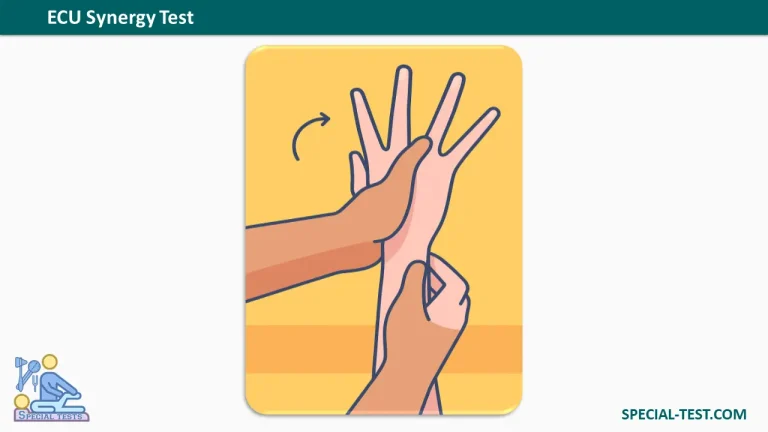
The ECU Synergy Test, also known as the Extensor Carpi Ulnaris Synergy Test, is a clinical orthopedic examination used to evaluate extensor carpi ulnaris (ECU) tendinitis, tendinopathy, and tenosynovitis in patients experiencing pain along the dorsal ulnar aspect of the wrist.
This provocative test helps healthcare professionals distinguish ECU tendon pathology from other causes of ulnar-sided wrist pain, including triangular fibrocartilage complex (TFCC) injuries and intra-articular wrist disorders.
Originally described by Ruland and Hogan in 2008, the ECU Synergy Test uses resisted thumb abduction to produce an isometric contraction of the ECU tendon, allowing the examiner to identify tendon-related pain without requiring significant wrist movement.
What Is the Purpose of the ECU Synergy Test?
The primary purpose of the ECU Synergy Test is to identify extensor carpi ulnaris tendinitis or tendinopathy as a potential cause of dorsal ulnar-sided wrist pain.
The test is particularly useful when examining patients who report:
- Pain over the dorsal ulnar aspect of the wrist.
- Tenderness along the extensor carpi ulnaris tendon.
- Wrist discomfort during gripping, lifting, or rotational activities.
- Pain associated with resisted wrist extension or ulnar deviation.
- Persistent wrist symptoms following repetitive sports or occupational activities.
The ECU Synergy Test can assist in differentiating extra-articular ECU tendon disorders from intra-articular conditions involving the TFCC, lunotriquetral ligament, or distal radioulnar joint (DRUJ).
However, it should be interpreted alongside the patient’s history and a complete wrist examination rather than used as a standalone diagnostic test.
Anatomical Basis of the ECU Synergy Test
The extensor carpi ulnaris muscle originates from the lateral epicondyle of the humerus and posterior border of the ulna. Its tendon passes through the sixth dorsal extensor compartment and inserts at the base of the fifth metacarpal.
The ECU contributes to wrist extension, ulnar deviation, and dynamic wrist stabilization.
During resisted thumb abduction, the extensor carpi ulnaris and flexor carpi ulnaris (FCU) contract synergistically to stabilize the wrist.
This coordinated activation allows the examiner to place tension on the ECU tendon while minimizing movement of adjacent wrist structures.
If the ECU tendon is inflamed or affected by tendinopathy, this isometric contraction may reproduce the patient’s characteristic pain.
How to Perform the ECU Synergy Test
The ECU Synergy Test is performed with the patient seated and the affected upper extremity supported on an examination table.
Step-by-Step Procedure
- Patient positioning: Ask the patient to sit comfortably with the affected arm resting on a table and the elbow flexed to 90 degrees.
- Forearm positioning: Position the forearm in full supination, with the palm facing upward.
- Wrist positioning: Maintain the wrist in a neutral position and instruct the patient to keep the fingers fully extended.
- Examiner hand placement: The examiner faces the patient and grasps the patient’s thumb and long (middle) finger with one hand.
- ECU tendon palpation: Place the other hand over the ECU tendon along the dorsal ulnar aspect of the wrist, near the distal ulna.
- Resisted thumb abduction: Instruct the patient to radially abduct the thumb against the examiner’s resistance while maintaining the neutral wrist position.
- Assessment: Palpate the ECU tendon during contraction and ask whether the maneuver reproduces the patient’s usual wrist pain.
During the maneuver, the ECU and FCU contract isometrically to maintain wrist stability. The examiner may feel the tendons become prominent beneath the palpating fingers.
The maneuver should be performed in a controlled manner without forcing the wrist into painful movement.
What Is a Positive ECU Synergy Test?
A positive ECU Synergy Test occurs when resisted thumb abduction reproduces pain along the ECU tendon at the dorsal ulnar aspect of the wrist.
The pain is usually localized near the distal ulna or ulnar head and may extend along the tendon.
A positive result suggests ECU tendon pathology, particularly:
- ECU tendinitis.
- ECU tendinosis or tendinopathy.
- ECU tenosynovitis.
Localized reproduction of the patient’s familiar pain is more clinically meaningful than nonspecific wrist discomfort.
A positive result does not independently confirm ECU tendon instability or exclude an associated intra-articular injury.
What Does a Negative ECU Synergy Test Mean?
A negative ECU Synergy Test occurs when resisted thumb abduction does not reproduce the patient’s characteristic dorsal ulnar wrist pain.
This finding makes symptomatic ECU tendon pathology less likely but does not completely exclude it.
If symptoms persist despite a negative result, the examiner should evaluate other possible causes, including TFCC injuries, lunotriquetral ligament disorders, and distal radioulnar joint pathology.
Diagnostic Accuracy of the ECU Synergy Test
Clinical research supports the usefulness of the ECU Synergy Test for identifying ECU tendon abnormalities.
In a prospective study published by Sato and colleagues in the Journal of Ultrasound in Medicine (2016), researchers evaluated 40 symptomatic wrists from 39 patients with chronic dorsal ulnar-sided wrist pain.
The test demonstrated the following diagnostic performance when compared with ultrasonographic findings:
| Diagnostic Measure | Result |
|---|---|
| Sensitivity | 73.7% |
| Specificity | 85.7% |
| Positive predictive value | 82.4% |
| Negative predictive value | 78.3% |
These findings suggest that the ECU Synergy Test can provide clinically useful information when evaluating suspected ECU abnormalities.
However, the findings were based on a relatively small study population. The accuracy values describe detection of sonographic ECU abnormalities in the studied patients and should not be interpreted as definitive diagnostic performance in every clinical setting.
Earlier research by Ruland and Hogan (2008) evaluated 55 patients with chronic dorsal ulnar-sided wrist pain. Their findings supported incorporating the ECU Synergy Test into a broader diagnostic approach to help distinguish tendon-related pain from intra-articular wrist pathology.
Differential Diagnosis of Ulnar-Sided Wrist Pain
Several wrist disorders can produce symptoms similar to ECU tendinitis.
Important differential diagnoses include:
- Triangular fibrocartilage complex (TFCC) injury: May cause ulnar-sided wrist pain, particularly during loading and forearm rotation.
- ECU tendon subluxation or dislocation: Often associated with painful snapping or abnormal tendon movement.
- Lunotriquetral ligament injury: May produce pain, tenderness, or instability on the ulnar side of the wrist.
- Distal radioulnar joint pathology: May cause discomfort during pronation and supination.
- Ulnocarpal impaction syndrome: May produce activity-related ulnar wrist pain, especially with loading.
A positive ECU Synergy Test does not rule out these associated conditions, as multiple wrist abnormalities may coexist.
Clinical Significance and Additional Evaluation
The ECU Synergy Test is valuable because it is a quick, noninvasive examination that does not require specialized equipment.
When combined with palpation, resisted wrist movements, and other orthopedic special tests, it can help clinicians identify patients who may have ECU tendon pathology.
If the diagnosis remains uncertain, additional investigations may include:
- Musculoskeletal ultrasound: Useful for evaluating ECU tendon abnormalities and assessing tendon movement dynamically.
- Magnetic resonance imaging (MRI): May help identify tendon pathology, associated TFCC injuries, and other soft-tissue abnormalities.
- Wrist radiographs: May be indicated to evaluate possible bony abnormalities or alternative causes of pain.
Management of ECU tendinopathy generally begins with activity modification, appropriate immobilization when indicated, and progressive rehabilitation. Anti-inflammatory medication may be considered when clinically appropriate.
Persistent symptoms, significant tendon instability, or suspected associated injuries may require specialist evaluation.
Frequently Asked Questions (FAQ)
1. What does the ECU Synergy Test assess?
The ECU Synergy Test assesses the extensor carpi ulnaris tendon for pain associated with tendinitis, tendinopathy, or tenosynovitis. It is commonly used when examining dorsal ulnar-sided wrist pain.
2. How do you perform the ECU Synergy Test?
The patient sits with the elbow flexed to 90 degrees, the forearm supinated, and the wrist neutral. The examiner palpates the ECU tendon while the patient radially abducts the thumb against resistance.
3. What indicates a positive ECU Synergy Test?
A positive result is the reproduction of pain along the ECU tendon on the dorsal ulnar side of the wrist during resisted thumb abduction. This finding supports suspected ECU tendon pathology.
4. What is the sensitivity and specificity of the ECU Synergy Test?
A prospective study reported a sensitivity of 73.7% and a specificity of 85.7% for detecting ECU tendon abnormalities identified by ultrasound in patients with chronic dorsal ulnar-sided wrist pain.
5. Can the ECU Synergy Test diagnose ECU tendon subluxation?
The ECU Synergy Test primarily evaluates pain associated with ECU tendon pathology. Although tendon instability may coexist, suspected subluxation is better assessed with specific dynamic examination maneuvers and, when indicated, ultrasound.
6. How can ECU tendinitis be differentiated from a TFCC injury?
ECU tendinitis commonly produces localized tenderness and pain during ECU activation, including a positive ECU Synergy Test. TFCC injuries may produce pain during ulnocarpal loading or with other specific examination maneuvers. A comprehensive clinical assessment is necessary because the conditions can coexist.
7. Is imaging necessary after a positive ECU Synergy Test?
Not always. A positive test can support a clinical diagnosis of ECU tendinopathy. Ultrasound or MRI may be appropriate when symptoms persist, tendon instability is suspected, or additional wrist pathology must be investigated.
Conclusion
The ECU Synergy Test is a useful orthopedic examination maneuver for evaluating extensor carpi ulnaris tendinitis and other ECU tendon abnormalities in patients with dorsal ulnar-sided wrist pain.
The test is performed by positioning the patient’s elbow at 90 degrees, supinating the forearm, maintaining a neutral wrist, and applying resistance during thumb abduction while palpating the ECU tendon.
Reproduction of localized ECU tendon pain indicates a positive test.
Although clinical studies demonstrate useful diagnostic accuracy, the ECU Synergy Test should always be interpreted alongside other examination findings and, when appropriate, diagnostic imaging.
References
- Ruland RT, Hogan CJ. The ECU synergy test: an aid to diagnose ECU tendonitis. Journal of Hand Surgery (American Volume). 2008;33(10):1777–1782. PubMed – PMID: 19084177
- Sato J, Ishii Y, Noguchi H. Diagnostic Performance of the Extensor Carpi Ulnaris (ECU) Synergy Test to Detect Sonographic ECU Abnormalities in Chronic Dorsal Ulnar-Sided Wrist Pain. Journal of Ultrasound in Medicine. 2016;35(1):7–14. PubMed – PMID: 26589644
- Campbell D, Campbell R, O’Connor P, Hawkes R. Sports-related extensor carpi ulnaris pathology: a review of functional anatomy, sports injury and management. British Journal of Sports Medicine. 2013. NCBI PubMed Central
- Ulnar-Sided Wrist Pain: Systematic Clinical Approach and Principles of Treatment. NCBI PubMed Central
- Extensor Carpi Ulnaris Subluxation. NCBI PubMed Central
- Approach to Chronic Wrist Pain in Adults: Review of Common Pathologies for Primary Care Practitioners. NCBI PubMed Central
- ECU Synergy Test: Evaluating Wrist Pathology. Orthofixar. Orthofixar – ECU Synergy Test