Derby Relocation Test: Purpose, Procedure, Positive Findings, and Clinical Significance
What Is the Derby Relocation Test?
The Derby Relocation Test is a clinical examination technique used to assess wrist instability, particularly suspected injuries involving the lunotriquetral interval and the supporting structures around the triquetrum and pisiform. It consists of a sequence of three examination maneuvers designed to evaluate a patient’s subjective feeling of wrist instability, reproduce symptoms, and determine whether specific manual stabilization techniques reduce pain.
The test is particularly relevant when evaluating patients who report a feeling of looseness, weakness, or instability in the wrist, especially on the ulnar side (the side of the little finger).
The lunotriquetral ligament connects the lunate and triquetrum, two carpal bones that contribute to the stability and coordinated movement of the wrist. Injury to this ligament or adjacent supporting structures may interfere with normal carpal mechanics and cause pain, clicking, reduced grip strength, or a sensation of instability during wrist movements.
The Derby Relocation Test uses controlled forces applied around the pisiform and triquetrum to assess whether changing the position or support of these structures modifies the patient’s symptoms.
Clinical note: The Derby Relocation Test should be interpreted alongside the patient’s history, physical examination, and appropriate imaging when indicated. A positive result may suggest a carpal instability pattern, but it does not independently establish a specific ligament tear.
What Is the Derby Relocation Test Used For?
The Derby Relocation Test is primarily used to investigate suspected carpal instability, with particular attention to the following conditions:
1. Lunotriquetral Interval Injury
The lunotriquetral interval is the region between the lunate and triquetrum, supported by the lunotriquetral ligament and associated capsular structures. Injury to these structures may impair coordinated movement between the two bones.
Patients may report ulnar-sided wrist pain, reduced grip strength, clicking, or discomfort during loading and rotation of the wrist. The Derby Relocation Test may help identify symptoms associated with this type of instability.
2. Peritriquetral Injuries
Peritriquetral injuries involve supporting structures surrounding the triquetrum. These structures contribute to the stability of the ulnar side of the wrist and its relationship with neighboring carpal bones.
The test examines whether symptoms change when the examiner applies controlled pressure to the pisiform or triquetrum while moving the wrist through specific positions.
3. Triquetrolunate and Related Carpal Instability
The test may also be used when a clinician suspects abnormal movement or injury involving the triquetrum and neighboring carpal structures. Findings should be interpreted carefully because several ligamentous and joint conditions can produce similar symptoms.
4. Wrist Instability and Grip Weakness
The initial question asks whether the patient experiences a feeling of wrist instability or looseness. The examiner then evaluates whether manual stabilization changes that sensation or allows the patient to maintain grip strength for longer.
This symptom-based approach can help identify patients whose complaints are related to altered carpal mechanics rather than pain alone.
Relevant Anatomy
Understanding the anatomy of the ulnar wrist helps explain the rationale behind the Derby Relocation Test.
- Lunate: A central carpal bone that articulates with the radius and neighboring carpal bones and contributes to wrist motion.
- Triquetrum: A proximal-row carpal bone located on the ulnar side of the wrist.
- Lunotriquetral ligament: Connects the lunate and triquetrum and contributes to intercarpal stability.
- Pisiform: A small sesamoid bone embedded within the tendon of the flexor carpi ulnaris, located on the palmar aspect of the triquetrum.
- Supporting capsular and ligamentous structures: Help maintain normal relationships among the carpal bones during wrist motion.
The examiner applies pressure to the pisiform or triquetrum and observes how the patient’s symptoms change during controlled wrist movements. These maneuvers are intended to assess symptom response to stabilization, not to measure ligament integrity directly.
How to Perform the Derby Relocation Test
The Derby Relocation Test consists of an initial screening question followed by three sequential maneuvers. The examiner evaluates the patient’s subjective sensation of instability, pain response, and ability to maintain grip strength.
The test should be performed by a trained healthcare professional using controlled movements and forces.
Initial Assessment: Ask About Wrist Instability
Before beginning the physical examination, ask the patient:
“Does your wrist feel unstable or loose?”
This question establishes the patient’s baseline symptoms and helps determine whether the examination maneuvers reproduce or relieve the familiar sensation of instability.
The examiner should also document the location of pain, any clicking or catching, grip weakness, and the circumstances in which symptoms occur.
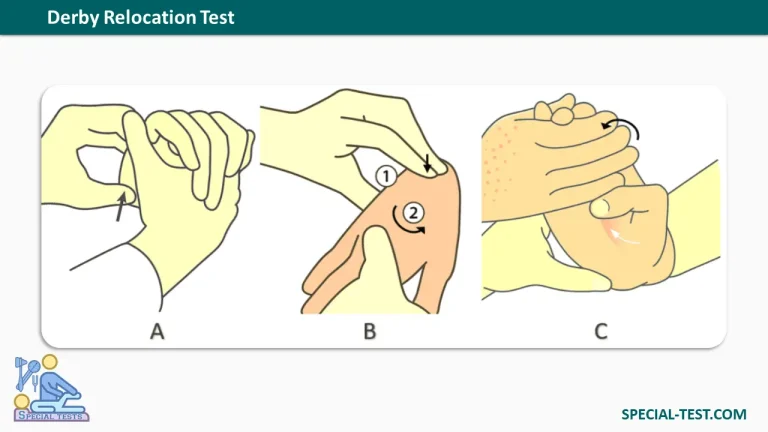
Test One: Initial Relocation Maneuver
Purpose: Assess whether manual stabilization reduces the sensation of wrist instability.
Patient position:
- Ask the patient to sit comfortably with the forearm resting on an examination table.
- Flex the elbow to approximately 90 degrees.
- Position the wrist in pronation, extension, and radial deviation.
Examiner technique:
- Place the examiner’s thumb on the anterior (palmar) aspect of the patient’s pisiform.
- Apply a posteriorly directed force to the pisiform.
- While maintaining the force, bring the patient’s wrist toward the neutral position.
- Ask whether the wrist feels more stable and assess whether the patient can maintain grip strength more effectively.
Positive test: The patient’s subjective feeling of instability resolves or improves, and grip strength or the ability to sustain gripping improves or can be maintained for longer.
The response suggests that manual stabilization may improve wrist mechanics or reduce symptoms. It should be interpreted in conjunction with the remaining maneuvers rather than considered diagnostic on its own.
Test Two: Provocation of Symptoms
Purpose: Reproduce the patient’s familiar symptoms during wrist movement.
Patient position and technique:
- Move the wrist until the patient’s original feeling of instability returns.
- Position the pronated wrist in radial deviation with the wrist in neutral flexion.
- Apply a posterior-to-anterior directed force to the dorsum of the triquetrum.
- While maintaining the force, move the wrist into ulnar deviation.
- Ask the patient whether the maneuver reproduces the familiar pain.
Positive test: Pain occurs during ulnar deviation while the examiner applies the directed force to the dorsum of the triquetrum.
The finding indicates symptom provocation in the ulnar-sided carpal region. It may support suspicion of a ligamentous or carpal stability problem, but pain alone does not identify the exact injured structure.
Test Three: Relocation and Symptom Reduction
Purpose: Determine whether stabilizing the pisiform reduces pain produced during Test Two.
Patient position and technique:
- Move the wrist until the patient’s subjective feeling of instability returns.
- Position the forearm in pronation, with the wrist in radial deviation and neutral flexion.
- Place the examiner’s thumb on the anterior (palmar) aspect of the pisiform.
- Apply a posteriorly directed force to the pisiform.
- While maintaining the force, move the wrist into ulnar deviation.
- Compare the patient’s pain response with the pain experienced during Test Two.
Positive test: The patient experiences less pain during ulnar deviation in Test Three than during Test Two.
The reduction in pain with stabilization is an important feature of the relocation sequence. It suggests that changing the support or position of the carpal structures modifies the patient’s symptoms.
Interpretation of the Derby Relocation Test
The Derby Relocation Test is best interpreted by comparing the patient’s symptoms across the three maneuvers rather than evaluating each finding in isolation.
| Test | Key finding |
|---|---|
| Initial question | The patient reports wrist instability or looseness. |
| Test One | Instability improves with manual stabilization; grip performance may improve. |
| Test Two | Ulnar deviation reproduces pain when force is applied to the triquetrum. |
| Test Three | Pain during ulnar deviation decreases when force is applied to the pisiform. |
The overall pattern may support a suspicion of lunotriquetral or related peritriquetral instability. However, the examiner must consider other causes of ulnar-sided wrist pain, including triangular fibrocartilage complex (TFCC) injury, pisotriquetral joint pathology, and other carpal ligament injuries.
Research reviews on lunotriquetral ligament injuries emphasize that clinical provocative tests have limitations and that several wrist conditions can produce similar findings.
Diagnostic Accuracy and Clinical Limitations
A positive Derby Relocation Test should not be interpreted as definitive proof of a lunotriquetral ligament tear. The test is a clinical examination maneuver, and its diagnostic accuracy should not be assumed without supporting validation studies.
The interpretation of any wrist instability test depends on the patient’s symptoms, the examiner’s technique, the severity of the injury, and the presence of associated ligament or joint abnormalities.
A comprehensive assessment may include:
- History and physical examination: Identify the mechanism of injury, pain location, grip weakness, clicking, and instability symptoms.
- Plain radiographs: Evaluate carpal alignment and identify fractures or other bony abnormalities. Normal radiographs do not exclude a lunotriquetral ligament injury.
- MRI or other advanced imaging: Consider when clinical suspicion persists despite inconclusive initial findings.
- Wrist arthroscopy: May be required for definitive assessment in selected patients when the diagnosis remains uncertain or treatment is being planned.
These diagnostic principles are consistent with published reviews of lunotriquetral ligament injuries.
Clinical Significance and Management
The clinical importance of a positive Derby Relocation Test is that it may help direct further investigation toward carpal instability when the patient’s symptoms are consistent with a ligamentous injury.
Management depends on the underlying diagnosis, injury severity, chronicity, and degree of instability. Some patients improve with activity modification, wrist immobilization, and appropriate rehabilitation. Persistent symptoms or significant mechanical instability may require evaluation by a hand and wrist specialist and, in selected cases, surgical treatment.
The Derby Relocation Test should therefore be used as one component of a comprehensive examination, not as the sole basis for deciding on treatment.
Frequently Asked Questions (FAQ)
1. What does the Derby Relocation Test assess?
The Derby Relocation Test assesses suspected lunotriquetral interval and related peritriquetral instability. It evaluates whether manual stabilization changes the patient’s sensation of wrist instability, grip performance, and pain during ulnar deviation.
2. What is a positive Derby Relocation Test?
A positive response involves improvement in the patient’s subjective wrist instability with the initial relocation maneuver, pain during the second maneuver, and reduced pain during the third maneuver compared with the second.
3. Which ligament is associated with the Derby Relocation Test?
The test is associated primarily with the assessment of suspected lunotriquetral ligament injury and related carpal instability. However, a positive result does not confirm an isolated tear of this ligament.
4. What is the purpose of the relocation maneuver?
The relocation maneuver applies controlled pressure to the pisiform to determine whether changing the support or position of the carpal structures reduces symptoms or improves the patient’s sense of stability.
5. Can the Derby Relocation Test diagnose a lunotriquetral ligament tear?
No. The test may support clinical suspicion, but it cannot independently confirm a ligament tear. Further evaluation, including imaging or wrist arthroscopy when indicated, may be needed.
6. What conditions can mimic lunotriquetral ligament injury?
Other causes of ulnar-sided wrist pain include TFCC injuries, pisotriquetral joint disorders, triquetral fractures, extensor carpi ulnaris tendon disorders, and other forms of carpal instability.
7. What should be done after a positive Derby Relocation Test?
A clinician should correlate the findings with the patient’s history and the rest of the wrist examination. If symptoms persist or significant instability is suspected, further investigation and referral to a hand and wrist specialist may be appropriate.
References
- Wilson MS. Diagnosis and Management of Lunotriquetral Ligament Injuries. Current Reviews in Musculoskeletal Medicine. 2023.
- Faucher GK, Moody MC. LT Ligament Tears. Hand Clinics. 2021.
- Zelenski NA, Sullivan MH, Shin AY. Lunotriquetral Instability: Diagnosis, Management, and Current Concept Review. Journal of the American Academy of Orthopaedic Surgeons. 2025.
- Reagan DS, Linscheid RL, Dobyns JH. Lunotriquetral Sprains. The Journal of Hand Surgery. 1984