Allen Test: Purpose, Procedure, Interpretation, and Accuracy
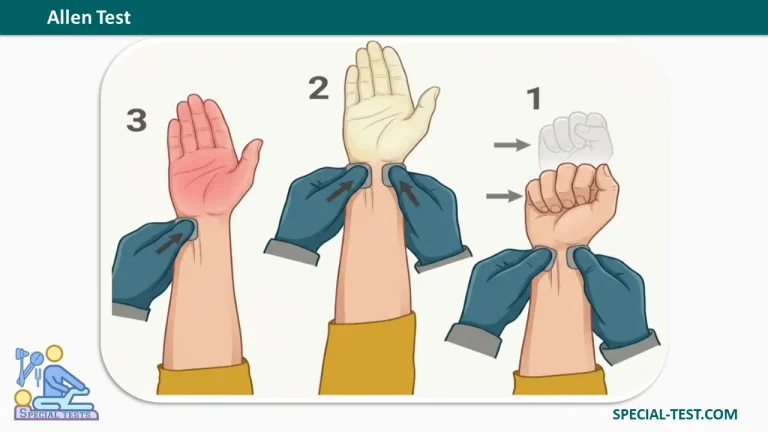
The Allen Test, also known as the Fist Closure Test, is a simple clinical examination used to assess blood circulation in the hand. It evaluates the patency of the radial and ulnar arteries and determines whether adequate collateral blood flow is available through the palmar arterial arches.
Healthcare professionals commonly use the Allen Test before procedures that may compromise blood supply to the hand, including radial artery catheterization, arterial blood sampling, and radial artery harvesting for coronary artery bypass grafting (CABG).
The original test was introduced in 1929 by Dr. Edgar Van Nuys Allen. A modified version, developed by Dr. Irving Wright in 1952, is now more commonly used in clinical practice. [1]
What Is the Purpose of the Allen Test?
The primary purpose of the Allen Test is to evaluate collateral circulation in the hand and determine whether one artery can provide sufficient blood flow when the other artery is compressed or obstructed.
The hand receives its arterial blood supply mainly from two vessels:
- Radial artery: Travels along the thumb side of the forearm and contributes significantly to the deep palmar arch.
- Ulnar artery: Travels along the little-finger side of the forearm and contributes primarily to the superficial palmar arch.
These arteries communicate through arterial arches that help maintain hand perfusion. However, anatomical variations may affect the adequacy of collateral circulation.
The Allen Test is particularly useful in the following clinical situations:
- Radial artery cannulation: Assessing collateral circulation before inserting an arterial catheter.
- Arterial blood gas (ABG) sampling: Evaluating hand perfusion before radial arterial puncture.
- Coronary artery bypass grafting: Assessing collateral circulation before harvesting the radial artery.
- Reconstructive surgery: Evaluating vascular supply before radial forearm flap harvesting.
- Vascular assessment: Supporting the examination of suspected arterial insufficiency or hand vascular injury.
Although widely used, the Allen Test is a screening examination rather than a definitive measurement of arterial blood flow. [1, 2]
How to Perform the Allen Test: Step-by-Step Procedure
The Modified Allen Test is the most commonly performed technique. It evaluates one hand at a time and can assess either radial or ulnar arterial circulation.
Modified Allen Test Procedure
- Patient positioning: Ask the patient to sit comfortably with the elbow flexed and the forearm supinated (palm facing upward).
- Clench the fist: Instruct the patient to close the hand tightly into a fist. This helps expel blood from the superficial vessels.
- Compress both arteries: Using the fingers, apply firm pressure over the radial and ulnar arteries at the wrist to temporarily interrupt arterial blood flow.
- Open the hand: Ask the patient to relax and open the hand without excessively extending the fingers. The palm should appear pale or blanched due to temporary arterial occlusion.
- Release the ulnar artery: Maintain pressure over the radial artery while releasing pressure over the ulnar artery.
- Observe color restoration: Assess how quickly normal pink coloration returns to the palm and fingers. This evaluates the ability of the ulnar artery and collateral vessels to perfuse the hand.
- Repeat for the radial artery: Reestablish the initial conditions, compress both arteries, and release the radial artery while maintaining ulnar artery compression.
- Compare findings: Record the time required for color to return after releasing each artery.
Clinical tip: Avoid excessive finger hyperextension during the examination because it can alter circulation and produce misleading results. [1, 3]
Allen Test Results and Interpretation
The results are interpreted according to how quickly blood flow returns to the hand after releasing arterial compression.
Normal Allen Test Result
A normal result indicates that sufficient collateral circulation is likely present.
Clinical findings include:
- Rapid restoration of normal palm coloration.
- Uniform pink or reddish color returning to the hand.
- No persistent blanching after the artery is released.
Color restoration often occurs within 5 seconds, although some established clinical protocols accept a return within 5–15 seconds.
Abnormal Allen Test Result
An abnormal result suggests that collateral blood flow may be reduced or insufficient.
Clinical findings include:
- Delayed return of normal palm coloration.
- Persistent pallor after releasing arterial compression.
- Incomplete or uneven restoration of hand perfusion.
For example, if the radial artery remains compressed and the palm stays pale after releasing the ulnar artery, this may suggest inadequate ulnar collateral circulation.
Similarly, delayed color restoration after releasing the radial artery while maintaining ulnar compression may indicate impaired radial arterial contribution.
Important: Medical references differ in their terminology. Some classify an abnormal result as a positive Allen Test, while others use positive to indicate adequate collateral circulation. Therefore, documenting the actual findings and whether circulation is adequate or inadequate is preferable to relying solely on the terms positive or negative. [1, 2, 4]
Allen Test Sensitivity and Specificity
The diagnostic accuracy of the Allen Test has been investigated in several clinical studies.
A study by Kohonen and colleagues, published in the European Journal of Cardio-Thoracic Surgery in 2007, evaluated 145 patients undergoing coronary artery bypass grafting.
The researchers compared the Allen Test with Doppler ultrasonography and digital plethysmography.
The study reported:
- Sensitivity: 73.2%
- Specificity: 97.1%
These findings suggested that the Allen Test could identify some abnormalities of hand circulation, although it was not completely sensitive. [4]
However, a 2017 systematic review and meta-analysis reported different results:
- Pooled sensitivity: 77%
- Pooled specificity: 93%
- Interobserver agreement: 71.5%
The review concluded that the modified Allen Test has limitations in detecting collateral circulation deficits and does not reliably predict hand ischemia following arterial puncture. [5]
Consequently, the Allen Test should not be considered a definitive method of assessing hand vascular sufficiency.
Limitations of the Allen Test
Despite being inexpensive, noninvasive, and easy to perform, the Allen Test has several limitations.
Its accuracy may be affected by differences in examiner technique, arterial compression, hand temperature, anatomical variations, and the criteria used to define normal color restoration.
The examination also relies on visual assessment, making interpretation somewhat subjective.
When additional confirmation is necessary, clinicians may use objective vascular investigations, including:
- Doppler ultrasonography: Evaluates arterial blood flow and helps identify vascular abnormalities.
- Duplex ultrasound: Combines vascular imaging with blood-flow assessment.
- Digital plethysmography: Measures changes in digital blood volume.
- Pulse oximetry: Can provide additional information about perfusion and pulse waveforms during arterial compression.
These investigations may be particularly valuable when the Allen Test is abnormal, inconclusive, or being used to assess circulation before a major vascular procedure. [1, 5]
Frequently Asked Questions About the Allen Test
1. What does the Allen Test assess?
The Allen Test assesses the patency of the radial and ulnar arteries and the adequacy of collateral blood circulation through the palmar arterial arches. It helps determine whether the hand can maintain perfusion when one of its major supplying arteries is temporarily obstructed.
2. What is the normal filling time for the Allen Test?
Normal color restoration is often rapid, typically within 5 seconds. However, some modified Allen Test protocols consider restoration within 5–15 seconds acceptable. The cutoff should be interpreted according to the clinical protocol being used.
3. What does a positive Allen Test indicate?
The interpretation depends on the terminology used. Some publications describe a positive result as delayed filling and potentially inadequate collateral circulation. Others define it as rapid restoration of color, indicating adequate circulation. For clarity, results should be reported as normal or abnormal, with the actual refill time documented.
4. Why is the Allen Test performed before radial artery puncture?
The test may be performed to evaluate whether the ulnar artery and palmar collateral circulation can maintain blood flow if radial artery perfusion is compromised during arterial puncture or cannulation. However, evidence does not establish that routine Allen testing reliably predicts post-puncture hand ischemia.
5. What is the difference between the original and modified Allen Test?
The original Allen Test was performed on both hands simultaneously, with selective arterial compression. The modified Allen Test evaluates one hand at a time and generally starts by compressing both radial and ulnar arteries before releasing one artery to assess collateral perfusion.
6. Can the Allen Test detect a blocked radial or ulnar artery?
An abnormal Allen Test may suggest impaired arterial circulation, but it cannot independently confirm an arterial blockage or identify its exact location. Doppler ultrasound or other vascular investigations may be necessary for diagnosis.
7. Is the Allen Test painful?
The Allen Test is generally painless and noninvasive. Patients may experience mild temporary discomfort from pressure applied to the wrist, but the examination does not require needles or surgical instruments.
Conclusion
The Allen Test is a valuable bedside examination for assessing radial and ulnar artery circulation and collateral blood supply to the hand. Its simplicity makes it useful during vascular assessment and preparation for certain arterial procedures.
However, the test has important diagnostic limitations. An abnormal result should prompt appropriate clinical evaluation and, when indicated, objective vascular testing.
Understanding the correct technique, normal filling time, and limitations of the Allen Test is essential for accurate clinical interpretation and patient safety.
References
- Beutel BG, Worley C, Zisquit J, Nedeff N. Allen Test. StatPearls. NCBI Bookshelf. https://www.ncbi.nlm.nih.gov/books/NBK507816/
- World Health Organization. WHO Guidelines on Drawing Blood: Best Practices in Phlebotomy. Annex I: Modified Allen Test. NCBI Bookshelf. 2010. https://www.ncbi.nlm.nih.gov/books/NBK138652/
- Orthofixar. Allen Test Steps: Ensuring Collateral Arterial Supply Before Puncture. https://orthofixar.com/special-test/allen-test/
- Kohonen M, Teerenhovi O, Terho T, Laurikka J, Tarkka M. Is the Allen test reliable enough? European Journal of Cardio-Thoracic Surgery. 2007;32(6):902–905. PubMed PMID: 17889550
- Romeu-Bordas Ó, Ballesteros-Peña S. Reliability and validity of the modified Allen test: A systematic review and meta-analysis. Emergencias. 2017;29(2):126–135. PubMed PMID: 28825257
- Jarvis MA, Jarvis CL, Jones PRM, Spyt TJ. Reliability of Allen’s test in selection of patients for radial artery harvest. Annals of Thoracic Surgery. 2000. PubMed PMID: 11081899