Prone Bridge Test: Procedure, Normal Values & Results
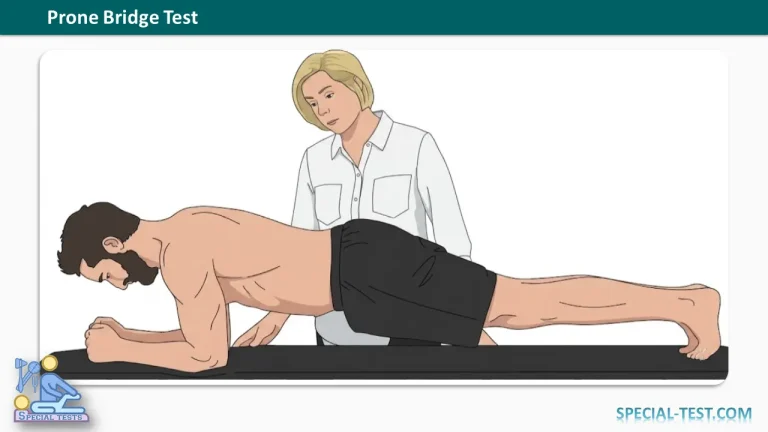
The Prone Bridge Test, also known as the Plank Test, is a widely used clinical assessment for evaluating core muscle endurance, abdominal strength endurance, and trunk stability. It measures an individual’s ability to maintain a neutral spinal position while supporting their body weight on their forearms and toes.
Healthcare professionals, physical therapists, sports medicine specialists, and athletic trainers use the Prone Bridge Test to assess muscular endurance, identify limitations in trunk stabilization, and monitor progress during rehabilitation or conditioning programs.
The test is simple, requires minimal equipment, and provides an objective measurement of how long a person can maintain proper body alignment under static loading conditions.
What Is the Purpose of the Prone Bridge Test?
The primary purpose of the Prone Bridge Test is to evaluate the isometric endurance of the core musculature and the individual’s ability to maintain lumbopelvic stability.
The test predominantly challenges the anterior trunk muscles, although additional muscles contribute to maintaining the position.
The major muscles involved include:
- Rectus abdominis: Helps resist excessive lumbar extension and maintain trunk alignment.
- Transversus abdominis: Contributes to abdominal stabilization and trunk control.
- Internal and external obliques: Assist with maintaining spinal and pelvic stability.
- Erector spinae and multifidus: Contribute to spinal positioning and stabilization.
- Gluteal muscles: Help maintain hip extension and pelvic alignment.
- Shoulder stabilizers: Support the upper body throughout the assessment.
The Prone Bridge Test is particularly useful for assessing anterior core endurance, evaluating static postural control, establishing baseline performance, and monitoring changes following exercise or rehabilitation.
However, it should not be considered an isolated test of back extensor strength or a comprehensive measurement of all components of core stability.
How to Perform the Prone Bridge Test
The Prone Bridge Test should be performed on a firm, comfortable exercise mat or examination surface. A stopwatch is required to measure the duration of the hold.
Step-by-Step Procedure
- Starting position: Instruct the patient to lie face down (prone) on the examination mat, with the legs extended and feet together.
- Upper-body positioning: Ask the patient to place both forearms on the surface, positioning the elbows directly beneath the shoulders. The forearms should rest comfortably on the mat, with the hands pointing forward.
- Assume the plank position: The patient lifts the chest, abdomen, pelvis, and knees away from the mat, supporting the body on the forearms and toes.
- Maintain neutral alignment: The head, shoulders, trunk, pelvis, and lower limbs should form a relatively straight line. The patient should avoid excessive lumbar arching, hip sagging, or raising the buttocks.
- Head and neck position: The neck remains neutral, with the patient’s gaze directed toward the floor.
- Begin timing: Start the stopwatch once the patient achieves the correct plank position.
- Maintain the position: Instruct the patient to hold the plank for as long as possible without losing proper alignment. Normal breathing should be maintained throughout the test.
- Terminate the assessment: Stop the timer when the patient voluntarily stops, develops significant discomfort, or repeatedly fails to maintain the required posture despite corrective instructions.
- Record the result: Document the total duration in seconds, the reason for stopping, and any compensatory movements observed during testing.
For reliable comparisons, use the same positioning instructions, testing surface, and termination criteria during subsequent assessments.
What Is a Positive Prone Bridge Test?
Unlike many orthopedic special tests, the Prone Bridge Test does not have a universally accepted positive-or-negative diagnostic result.
Instead, it produces a quantitative measurement of core endurance, expressed as the number of seconds the patient maintains the required position.
Clinical findings that may indicate limited endurance or impaired trunk control include:
- Inability to maintain neutral spinal alignment.
- Excessive lumbar extension or sagging of the pelvis.
- Elevation of the hips to compensate for muscular fatigue.
- Repeated loss of shoulder or pelvic control.
- Inability to maintain the position because of muscular fatigue.
- Early termination due to discomfort or loss of technique.
Mild muscular trembling can occur during sustained isometric contractions and does not necessarily indicate an abnormal result. However, increasing tremor accompanied by loss of alignment may indicate fatigue-related deterioration in motor control.
A short holding time alone does not confirm core muscle weakness, spinal instability, or a specific musculoskeletal disorder. Results must be interpreted in the context of the patient’s age, physical condition, symptoms, and functional abilities.
Prone Bridge Test Normal Values
Normal Prone Bridge Test holding times vary considerably across populations and testing protocols.
A study by Bohannon et al. (2018) examined 120 adults, including 60 younger participants aged 20–35 years and 60 older participants aged 60–79 years.
The researchers reported:
- Mean holding time: 145.3 seconds.
- Standard deviation: 71.5 seconds.
- Test-retest reliability: Intraclass correlation coefficient (ICC) of 0.915.
- Age-related findings: Younger adults demonstrated significantly longer holding times than older adults.
The researchers also observed that longer holding times were associated with greater physical activity participation, whereas higher body mass index and waist circumference were associated with shorter durations.
Another investigation by Schellenberg et al. (2007) reported an average prone bridge duration of 72.5 ± 32.6 seconds in 43 individuals without back pain, compared with 28.3 ± 26.8 seconds in 32 participants with chronic mechanical low back pain.
These differences emphasize the importance of considering the population and testing protocol when interpreting results.
Prone Bridge Test Performance Categories
The following practical performance categories are described by Orthofixar:
| Performance Rating | Holding Time |
|---|---|
| Excellent | Greater than 180 seconds |
| Good | 120–180 seconds |
| Average | 90–120 seconds |
| Below Average | 60–90 seconds |
| Poor | Less than 60 seconds |
A holding time of approximately 90 seconds is sometimes used as a general reference point for adequate core endurance.
However, these classifications are illustrative screening categories rather than universally validated clinical standards. A patient holding the plank for less than 90 seconds should not automatically be classified as having abnormal core function.
More specific reference values may be appropriate when evaluating different age groups, athletic populations, and rehabilitation patients.
For example, a study involving 471 college-aged participants reported average plank durations of 124 ± 72 seconds for men and 83 ± 63 seconds for women. Athletes also demonstrated longer average durations than non-athletes.
Factors Affecting Prone Bridge Test Results
Several factors may influence the duration of the test.
Age: Younger adults generally demonstrate greater endurance than older adults, although substantial variation exists within each age group.
Physical activity: Individuals who regularly participate in exercise or core training may achieve longer holding times.
Body composition: Greater body mass and waist circumference can influence the mechanical demands of maintaining the plank position.
Muscle fatigue: Previous exercise, insufficient recovery, and overall fatigue may reduce performance.
Pain and injury: Back pain, shoulder discomfort, and other musculoskeletal symptoms can limit endurance independently of muscular conditioning.
Testing technique: Differences in elbow placement, foot position, body alignment, familiarization, and stopping criteria may influence recorded times.
Clinical Significance of the Prone Bridge Test
The Prone Bridge Test has applications in orthopedic rehabilitation, sports medicine, physical therapy, and general fitness assessment.
Its clinical value includes establishing a baseline measure of anterior core endurance and monitoring changes over time.
It may be incorporated into assessments of patients with low back pain, athletes undergoing conditioning, and individuals participating in spinal stabilization programs.
Research supports the reliability and practical usefulness of the test for assessing abdominal endurance. Nevertheless, plank performance should be interpreted alongside other clinical findings rather than used independently to diagnose spinal disorders or predict future injuries.
Other assessments, including the side bridge test, trunk flexor endurance test, and Biering–Sørensen back extensor endurance test, may provide complementary information about different trunk muscle groups.
Frequently Asked Questions About the Prone Bridge Test
1. What does the Prone Bridge Test measure?
The Prone Bridge Test primarily measures isometric abdominal muscle endurance and the ability to maintain trunk and pelvic alignment during a sustained plank position. It also requires coordinated activation of the hip and shoulder stabilizers.
2. What is a normal Prone Bridge Test time?
There is no universally accepted normal holding time. One study reported a mean of 145.3 ± 71.5 seconds across younger and older adults, while other studies have reported shorter average durations. Normal values depend on the population and test protocol.
3. Is a 90-second plank considered good?
A 90-second plank may represent reasonable endurance for some individuals and appears in practical performance classifications. However, it is not a validated universal cutoff for healthy core function. Age, activity level, and technique must be considered.
4. What muscles are tested during the Prone Bridge Test?
The test primarily challenges the rectus abdominis, transversus abdominis, and abdominal obliques. The back extensors, gluteal muscles, and shoulder stabilizers also contribute to maintaining the required position.
5. What indicates poor performance on the Prone Bridge Test?
Poor performance may be characterized by early fatigue, an inability to maintain neutral alignment, repeated pelvic sagging, or premature termination. A short duration should be interpreted alongside symptoms, physical activity, and other clinical assessments.
6. Can the Prone Bridge Test assess patients with low back pain?
Yes. The test has been investigated in individuals with low back pain and may provide useful information about trunk endurance. However, patients with active symptoms should be assessed for suitability, and plank duration alone cannot determine the cause or severity of low back pain.
7. Is the Prone Bridge Test reliable?
Research supports good test-retest reliability when standardized procedures are used. Bohannon and colleagues reported an intraclass correlation coefficient of 0.915, suggesting that the test can provide reproducible measurements.
8. When should the Prone Bridge Test be stopped?
The test should end when the patient voluntarily stops, cannot maintain correct posture despite instructions, or experiences significant pain, dizziness, or other concerning symptoms. Maintaining proper technique is more important than achieving a particular holding time.
Conclusion
The Prone Bridge Test (Plank Test) is a practical and evidence-supported method for evaluating abdominal endurance and static trunk stabilization. It is easy to administer, requires minimal equipment, and can be useful for monitoring physical performance during rehabilitation and conditioning programs.
Although a 90-second holding time is sometimes used as a general benchmark, research demonstrates considerable variability in normal performance. Clinical interpretation should therefore prioritize correct technique, individual characteristics, and changes in performance over time rather than relying exclusively on fixed duration thresholds.
References
- Bohannon RW, Steffl M, Glenney SS, et al. (2018). The prone bridge test: Performance, validity, and reliability among older and younger adults. Journal of Bodywork and Movement Therapies, 22(2), 385–389. PubMed
- Schellenberg KL, Lang JM, Chan KM, Burnham RS. (2007). A clinical tool for office assessment of lumbar spine stabilization endurance: Prone and supine bridge maneuvers. American Journal of Physical Medicine & Rehabilitation, 86(5), 380–386. PubMed
- Strand SL, Hjelm J, Shope TC, Fajardo MA. (2014). Norms for an isometric muscle endurance test. Journal of Human Kinetics, 40, 93–102. NCBI / PubMed Central
- Criterion-Related Validity of Field-Based Fitness Tests in Adults: A Systematic Review. (2021). Journal of Clinical Medicine. NCBI / PubMed Central
- Orthofixar. Prone Bridge Test: Protocol for Quantifying Lumbopelvic Core Endurance. Orthofixar.com