Lateral Shear Test: Purpose, Procedure, Positive Signs & Diagnostic Accuracy
What Is the Lateral Shear Test?
The Lateral Shear Test, also known as the Atlantoaxial Lateral Shear Test or Lateral Transverse Shear Test, is an orthopedic physical examination technique used to assess potential instability of the upper cervical spine, particularly at the atlantoaxial joint between the first cervical vertebra (C1) and second cervical vertebra (C2).
The test evaluates abnormal lateral movement between these vertebrae, which may indicate ligamentous insufficiency or structural instability. It is traditionally described as a clinical assessment for atlantoaxial instability associated with odontoid dysplasia, although modified versions are also used to assess alar ligament integrity.
Atlantoaxial instability may occur following cervical trauma, congenital abnormalities of the odontoid process, or conditions that weaken the supporting ligaments of the upper cervical spine.
The Lateral Shear Test provides information about the mechanical stability of the cervical region. However, it should be interpreted alongside clinical history, neurological examination, and appropriate diagnostic imaging rather than used as a standalone diagnostic method.
Anatomy and Clinical Significance
The atlantoaxial joint connects two important cervical vertebrae:
- Atlas (C1): The first cervical vertebra, which supports the skull.
- Axis (C2): The second cervical vertebra, which contains the odontoid process (dens) and facilitates cervical rotation.
Several ligaments maintain stability in this region, particularly the transverse ligament of the atlas and the paired alar ligaments.
The transverse ligament helps prevent excessive anterior displacement of C1 relative to C2, while the alar ligaments limit excessive rotation and lateral movement of the upper cervical spine.
Damage to these structures may contribute to abnormal movement and potentially compromise nearby neurological structures.
Odontoid abnormalities, including odontoid hypoplasia and os odontoideum, may also be associated with atlantoaxial instability.
According to the NCBI reference on atlantoaxial instability, the underlying causes can include congenital abnormalities, inflammatory disorders, and traumatic injuries.
How to Perform the Lateral Shear Test
The Lateral Shear Test is a specialized examination that should be performed only by appropriately trained healthcare professionals after screening for cervical instability and neurological risk.
Patient Position
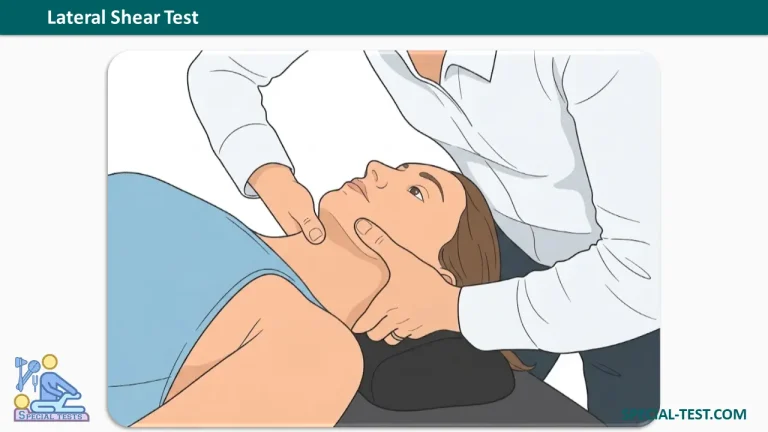
The patient lies in a supine position on an examination table, with the head comfortably supported and the cervical spine maintained in a neutral position.
Examiner Position
The examiner stands at the head of the examination table, positioning both hands near the upper cervical vertebrae.
Test Procedure
- Position the patient: Ensure that the patient is lying comfortably, with the head supported and the neck relaxed.
- Locate the cervical landmarks: Identify the transverse processes of the atlas (C1) and axis (C2).
- Place the hands: Position the radial side of the second metacarpophalangeal (MCP) joint of one hand against the transverse process of C1. Place the corresponding MCP joint of the opposite hand against the contralateral transverse process of C2.
- Apply controlled lateral stress: The examiner carefully approximates the hands, creating a gentle lateral shearing force between the two vertebrae while monitoring the movement and resistance.
- Assess the response: Evaluate whether excessive lateral translation, abnormal joint resistance, or concerning symptoms occur.
This procedure assesses the mechanical relationship between C1 and C2. Variations of the technique described in clinical research may stabilize C2 while translating the occiput and C1 laterally.
Safety precaution: The maneuver should not be performed when significant cervical instability, acute injury, or neurological compromise is suspected without an appropriate specialist assessment.
What Is a Positive Lateral Shear Test?
A positive Lateral Shear Test occurs when abnormal lateral translation is detected between the cervical vertebrae during the application of controlled lateral stress.
Positive Findings
Findings that may suggest upper cervical ligamentous instability include:
- Excessive lateral displacement between C1 and C2.
- An abnormally soft or poorly defined end-feel during lateral movement.
- A noticeable difference in joint stability between the two directions of testing.
These findings may indicate alar ligament insufficiency, abnormal atlantoaxial mobility, or another structural problem affecting upper cervical stability.
However, a positive result does not establish a specific diagnosis such as odontoid dysplasia or ligament rupture.
Negative Lateral Shear Test
A negative result is characterized by minimal lateral movement, firm mechanical resistance, and the absence of concerning symptoms.
Under normal conditions, the supporting ligaments restrict excessive motion between the cervical vertebrae.
Importantly, a negative result does not completely exclude cervical instability or ligament injury.
Lateral Shear Test Accuracy: Sensitivity and Specificity
The diagnostic accuracy of the Lateral Shear Test has been investigated in research examining the integrity of the alar ligaments.
A blinded case-control study published in the Journal of Manual & Manipulative Therapy in 2019 evaluated three manual examination techniques:
- Lateral Shear Test (LST).
- Side-Bending Stress Test (SBST).
- Rotation Stress Test (RST).
The study included 18 participants, comprising seven individuals with MRI-confirmed alar ligament lesions and 11 healthy controls.
Diagnostic Accuracy Results
| Clinical Test | Sensitivity | Specificity |
|---|---|---|
| Lateral Shear Test | 80% | 76.9% |
| Side-Bending Stress Test | 80% | 76.9% |
| Rotation Stress Test | 80% | 69.2% |
The Lateral Shear Test demonstrated a sensitivity of 80% and a specificity of 76.9% in the reported comparison.
Sensitivity describes the test’s ability to correctly identify individuals with the investigated condition, while specificity describes its ability to correctly identify individuals without it.
The researchers also reported that when all three manual tests were positive, specificity increased to 84.6% in the comparison highlighted in the study abstract.
How Reliable Is the Lateral Shear Test?
Although these findings suggest potential diagnostic usefulness, the evidence has several limitations.
The study involved a small number of participants and compared individuals with established alar ligament lesions against healthy volunteers. As a result, its findings may not accurately represent performance in routine clinical practice.
Furthermore, the reported accuracy figures specifically concern the identification of alar ligament lesions, not the diagnosis of odontoid dysplasia or all forms of atlantoaxial instability.
Additional research has investigated the reliability of modified lateral shear techniques, suggesting that examiner experience, assessment criteria, and comparisons of movement asymmetry may influence reproducibility.
Consequently, the Lateral Shear Test should be considered a supplementary clinical assessment rather than a definitive diagnostic investigation.
Clinical Applications and Safety Considerations
The Lateral Shear Test may be considered during specialized assessment of patients with suspected upper cervical ligament dysfunction, particularly when supported by a relevant medical history.
Symptoms potentially associated with cervical instability include neck pain, occipital headaches, restricted cervical movement, dizziness, and neurological disturbances. These symptoms are nonspecific and can occur with many other conditions.
Because the upper cervical spine surrounds vulnerable neurological structures, inappropriate mechanical stress may be hazardous in patients with significant instability.
Patients with recent cervical trauma, suspected fracture, known structural instability, spinal cord symptoms, or progressive neurological deficits require medical assessment rather than provocative manual testing.
When indicated, diagnostic imaging may include cervical radiographs, computed tomography (CT), or magnetic resonance imaging (MRI). CT is particularly helpful for evaluating bony abnormalities, while MRI is useful for assessing ligaments, the spinal cord, and other soft tissues.
Any dynamic imaging should be selected and supervised by the treating specialist.
Frequently Asked Questions (FAQs)
1. What is the Lateral Shear Test used for?
The Lateral Shear Test is used to assess abnormal lateral movement and potential instability of the upper cervical spine, particularly at the atlantoaxial joint between C1 and C2. Modified techniques may also help assess alar ligament integrity.
2. What does a positive Lateral Shear Test indicate?
A positive result indicates abnormal lateral translation or excessive mobility between the examined cervical segments. This may suggest ligamentous insufficiency or upper cervical instability, but further clinical evaluation is needed to establish the cause.
3. What is the sensitivity and specificity of the Lateral Shear Test?
A 2019 study reported a sensitivity of 80% and specificity of 76.9% for identifying alar ligament lesions. Because the study involved only 18 participants, these figures should be interpreted cautiously.
4. Is the Lateral Shear Test the same as the Sharp-Purser Test?
No. Both tests concern upper cervical stability, but they assess different mechanical characteristics. The Lateral Shear Test evaluates lateral displacement and is commonly associated with alar ligament assessment. The Sharp-Purser Test primarily evaluates possible transverse ligament insufficiency and anterior atlantoaxial instability.
5. Can the Lateral Shear Test diagnose odontoid dysplasia?
No. Although the test may reveal abnormal movement associated with cervical instability, it cannot independently diagnose odontoid dysplasia. Structural abnormalities of the odontoid process require appropriate medical imaging for confirmation.
6. Is the Lateral Shear Test safe?
The test involves applying mechanical stress to the upper cervical region. It should only be considered by trained clinicians after appropriate safety screening. It is not suitable for self-testing and may be unsafe in patients with suspected significant cervical instability or acute injury.
7. What happens after a positive Lateral Shear Test?
A positive result may prompt additional neurological examination, medical referral, or diagnostic imaging depending on the clinical presentation. Cervical manipulation and other provocative interventions should be avoided until clinically important instability has been adequately evaluated.
Conclusion
The Lateral Shear Test is a specialized orthopedic examination technique used to assess potential instability of the atlantoaxial joint and the integrity of supporting upper cervical ligaments.
A positive result is characterized by abnormal lateral translation between cervical segments, while a negative result typically involves minimal displacement and firm mechanical resistance.
Research has reported a sensitivity of 80% and specificity of 76.9% for identifying alar ligament lesions. However, the limited available evidence means that these results should not be generalized to every cause of atlantoaxial instability.
For accurate and safe clinical decision-making, the Lateral Shear Test should be interpreted within a comprehensive assessment, with appropriate medical imaging when indicated.
References
- Orthofixar. Lateral Shear Test: Technique, Accuracy, and Positive Signs. Revised June 2024.
https://orthofixar.com/special-test/lateral-shear-test/ - von Piekartz H, Maloul R, Hoffmann M, Hall T, Ruch MM, Ballenberger N. Diagnostic accuracy and validity of three manual examination tests to identify alar ligament lesions: results of a blinded case-control study. Journal of Manual & Manipulative Therapy. 2019;27(2):83–91.
PubMed – PMID: 30935337
NCBI Full Text – PMC6484502 - Lacy J, Bajaj J, Gillis CC. Atlantoaxial Instability. StatPearls. NCBI Bookshelf.
https://www.ncbi.nlm.nih.gov/books/NBK519563/ - Os Odontoideum. StatPearls. NCBI Bookshelf. Review of odontoid abnormalities, cervical instability, diagnosis, and management.
https://www.ncbi.nlm.nih.gov/books/NBK542297/ - Inter-examiner Reliability Study of Physical Examination Procedures to Assess the Cervical Spine. 2021. PubMed Central.
https://pmc.ncbi.nlm.nih.gov/articles/PMC8201716/ - Occult Hypermobility of the Craniocervical Junction: A Case Report and Review. PubMed. Discussion of modified lateral shear testing and upper cervical hypermobility.
https://pubmed.ncbi.nlm.nih.gov/21628827/