Bicycle Test of van Gelderen: Procedure, Positive Results & Clinical Significance
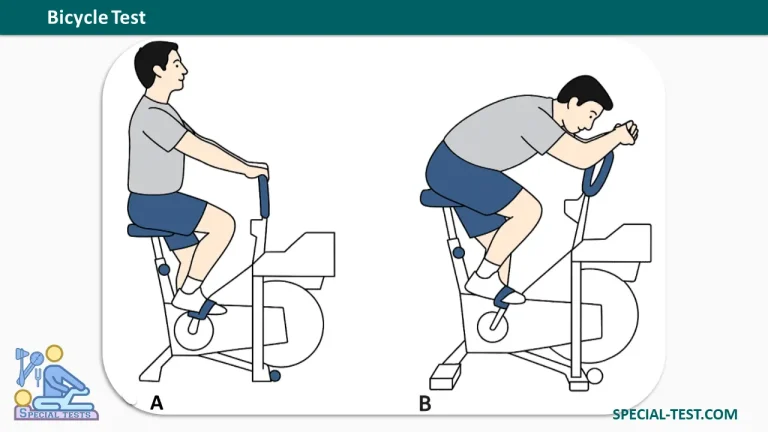
The Bicycle Test of van Gelderen is a clinical examination used to differentiate neurogenic intermittent claudication from vascular claudication in patients experiencing lower extremity pain during physical activity. It is particularly useful when evaluating individuals with suspected lumbar spinal stenosis, a condition characterized by narrowing of the spinal canal that may compress the spinal nerve roots.
The test involves cycling on a stationary exercise bicycle while changing the position of the lumbar spine. By comparing symptoms during lumbar extension and flexion, clinicians can determine whether leg pain is influenced by spinal posture.
Originally described by Dyck and Doyle in 1977, the Bicycle Test of van Gelderen remains a useful adjunct in the clinical assessment of patients with activity-related leg pain. However, its findings must be interpreted alongside the patient’s medical history, physical examination, and additional diagnostic investigations.
What Is the Purpose of the Bicycle Test?
The primary purpose of the Bicycle Test of van Gelderen is to help distinguish two important causes of exercise-induced leg pain:
- Neurogenic claudication: Typically associated with lumbar spinal stenosis and characterized by leg pain, numbness, tingling, or weakness that worsens during spinal extension and improves with lumbar flexion.
- Vascular claudication: Usually caused by peripheral arterial disease (PAD), in which reduced arterial blood flow produces muscular pain during exercise. Symptoms generally improve with rest rather than changes in spinal position.
The test is based on the relationship between spinal posture and the available space within the lumbar spinal canal.
During lumbar extension, the spinal canal and neural foramina may become narrower, increasing pressure on neural structures. Conversely, lumbar flexion generally increases the available space, potentially reducing nerve compression and improving symptoms.
This biomechanical principle explains why many patients with lumbar spinal stenosis tolerate cycling in a forward-flexed position better than standing or walking upright.
How to Perform the Bicycle Test of van Gelderen
The Bicycle Test is performed using a stationary exercise bicycle and consists of two consecutive phases.
Phase 1: Cycling With Lumbar Extension
- Position the patient comfortably on a stationary exercise bicycle.
- Instruct the patient to begin pedaling against a tolerable level of resistance.
- Ask the patient to maintain an upright or slightly backward-leaning position to accentuate lumbar lordosis and spinal extension.
- Observe the patient for the development of lower extremity symptoms, including buttock pain, posterior thigh pain, numbness, tingling, or weakness.
- Record the symptoms and the time required for their appearance.
Interpretation of Phase 1:
Reproduction of the patient’s characteristic leg symptoms during cycling with lumbar extension suggests that spinal positioning may contribute to neural compression.
In patients with lumbar spinal stenosis, extension may reduce the available space within the spinal canal and aggravate neurogenic claudication.
Phase 2: Cycling With Lumbar Flexion
- Without interrupting the cycling activity, ask the patient to lean forward over the bicycle handlebars.
- Encourage the patient to maintain approximately the same cycling resistance and speed.
- Observe whether the previously provoked symptoms decrease or disappear.
- If clinically appropriate and safely tolerated, ask the patient to return to the original upright position.
- Assess whether the symptoms recur when lumbar extension is restored.
Interpretation of Phase 2:
A reduction or disappearance of leg symptoms during forward flexion, despite continued cycling, supports a posture-dependent mechanism consistent with neurogenic claudication.
If symptoms recur when the patient returns to spinal extension, the findings provide additional support for lumbar spinal stenosis as a possible source of the patient’s complaints.
The test should be performed under appropriate clinical supervision and discontinued if the patient develops significant pain, weakness, dizziness, or other concerning symptoms.
What Is a Positive Bicycle Test?
A positive Bicycle Test of van Gelderen is characterized by the following clinical findings:
- Reproduction of the patient’s typical buttock or leg symptoms during cycling with lumbar extension.
- Significant improvement or relief of symptoms when the patient leans forward into lumbar flexion while continuing to pedal.
- Possible recurrence of symptoms when the patient returns to an upright or extended spinal position.
This pattern is suggestive of neurogenic intermittent claudication associated with lumbar spinal stenosis.
The improvement during continued exercise is particularly informative because it suggests that symptom relief is related to spinal positioning rather than simply the cessation of muscular activity.
However, a positive Bicycle Test does not independently confirm lumbar spinal stenosis. Clinical findings and imaging must be correlated before establishing a diagnosis.
What Does a Negative Bicycle Test Mean?
A negative or non-supportive Bicycle Test occurs when the patient’s symptoms do not demonstrate the expected relationship with lumbar posture.
For example, leg pain may persist during cycling regardless of whether the patient maintains an extended or flexed lumbar position.
If the symptoms are primarily related to exercise intensity and improve only after stopping activity, vascular claudication should be considered.
However, a negative Bicycle Test does not establish a diagnosis of peripheral arterial disease, nor does it exclude lumbar spinal stenosis.
A study by Dong and Porter involving 30 patients found that posture-dependent walking and cycling tests lacked sufficient sensitivity to reliably distinguish neurogenic from vascular claudication.
Therefore, the test should be regarded as a supportive clinical examination rather than a definitive diagnostic procedure.
Bicycle Test: Neurogenic vs. Vascular Claudication
| Clinical Feature | Neurogenic Claudication | Vascular Claudication |
|---|---|---|
| Main underlying cause | Lumbar spinal stenosis | Peripheral arterial disease |
| Primary mechanism | Neural compression and associated circulatory changes | Inadequate arterial blood flow during exercise |
| Effect of lumbar extension | Often worsens symptoms | Usually little direct effect |
| Effect of lumbar flexion | Often improves symptoms | Usually no immediate relief |
| Symptoms during cycling | May improve when leaning forward | May persist during exertion |
| Relief with rest | Often requires sitting or forward flexion | Usually improves after stopping exercise |
| Common pain location | Buttocks, thighs, or legs | Frequently the calves, but may involve the thighs or buttocks |
| Additional clinical findings | Possible sensory changes or weakness | Possible diminished peripheral pulses or vascular changes |
These features represent typical clinical patterns, and considerable overlap may occur. Both conditions can also coexist in the same patient.
Clinical Significance of the Bicycle Test
The Bicycle Test of van Gelderen provides clinicians with a practical method for evaluating the relationship between lumbar posture and exercise-induced leg symptoms.
Its significance is closely associated with the shopping cart sign, a characteristic feature of lumbar spinal stenosis.
Patients with neurogenic claudication frequently report that walking becomes easier when they lean forward over a shopping cart or walking aid. Similarly, walking uphill may be more comfortable than walking downhill because uphill walking tends to encourage lumbar flexion.
By reproducing this postural change during cycling, the Bicycle Test helps clinicians identify symptoms that may originate from narrowing of the lumbar spinal canal.
Nevertheless, the test has important diagnostic limitations. Published research has not established sufficiently reliable sensitivity and specificity for its use as a standalone diagnostic test.
Patients with suspected lumbar spinal stenosis may require magnetic resonance imaging (MRI), while those with suspected vascular claudication may require peripheral pulse examination, ankle-brachial index (ABI) measurement, or additional vascular investigations.
A comprehensive evaluation is particularly important when spinal stenosis and peripheral arterial disease are both possible.
Frequently Asked Questions (FAQ)
1. What is the Bicycle Test of van Gelderen used for?
The Bicycle Test of van Gelderen is used to help differentiate neurogenic intermittent claudication caused by lumbar spinal stenosis from vascular claudication associated with peripheral arterial disease. It evaluates whether symptoms change with lumbar spinal positioning during continued cycling.
2. What indicates a positive Bicycle Test?
A positive test occurs when lumbar extension during cycling reproduces the patient’s characteristic leg symptoms, while forward lumbar flexion reduces or relieves those symptoms without stopping exercise. This finding supports a neurogenic source of pain.
3. Why does leaning forward relieve symptoms in lumbar spinal stenosis?
Forward lumbar flexion generally increases the available space within the spinal canal and neural foramina. This may decrease pressure on compressed neural structures and improve symptoms associated with neurogenic claudication.
4. Can the Bicycle Test diagnose lumbar spinal stenosis?
No. The Bicycle Test is a supportive clinical assessment rather than a definitive diagnostic investigation. A diagnosis of lumbar spinal stenosis requires correlation of symptoms with physical examination findings and, when indicated, imaging studies such as MRI.
5. How does the Bicycle Test distinguish vascular from neurogenic claudication?
Neurogenic claudication is commonly posture-dependent, improving during forward flexion. Vascular claudication is primarily related to inadequate blood supply during exertion and generally improves when exercise stops. However, the Bicycle Test alone cannot reliably distinguish all patients with these conditions.
6. What is the difference between the Bicycle Test and the shopping cart sign?
The Bicycle Test is a structured clinical examination performed on a stationary bicycle. The shopping cart sign is a historical finding in which patients report reduced leg symptoms when leaning forward while walking. Both rely on the beneficial effect of lumbar flexion in some patients with spinal stenosis.
7. Is the Bicycle Test reliable?
The Bicycle Test can provide useful clinical information, but evidence regarding its diagnostic accuracy is limited. Research has shown that posture-dependent cycling tests are not sufficiently sensitive to serve as standalone diagnostic tools. Their results should be combined with other clinical findings.
Conclusion
The Bicycle Test of van Gelderen is a useful clinical maneuver for assessing posture-dependent lower extremity symptoms and differentiating possible neurogenic from vascular claudication.
A positive test is characterized by reproduction of symptoms during lumbar extension and improvement during lumbar flexion while cycling continues. This response supports the possibility of neurogenic claudication associated with lumbar spinal stenosis.
Although the Bicycle Test can contribute valuable information during the physical examination, its limited diagnostic accuracy means that it should be used in conjunction with clinical history, neurological assessment, vascular examination, and appropriate imaging.
References
- Dyck P, Doyle JB Jr. “Bicycle test” of van Gelderen in diagnosis of intermittent cauda equina compression syndrome. Case report. Journal of Neurosurgery. 1977;46(5):667–670. PubMed – PMID: 845655
- OrthoFixar. Bicycle Test of van Gelderen: Neurogenic vs. Vascular Claudication. OrthoFixar – Clinical Special Tests
- Dong G, Porter RW. Walking and cycling tests in neurogenic and intermittent claudication. Spine. 1989;14(9):965–969. PubMed – PMID: 2551051
- Lumbar Spinal Stenosis. StatPearls. National Center for Biotechnology Information, NCBI Bookshelf. NCBI Bookshelf – NBK531493
- Common iliac artery occlusion presenting with back and leg pain: Case report and differential diagnosis considerations for neurogenic/vascular claudication. PMC. NCBI PubMed Central – PMC6237159
- Objective physical performance and exercise tests of patients with lumbar spinal stenosis: A systematic scoping review. 2026. NCBI PubMed Central – PMC13049872
- 2024 ACC/AHA Multisociety Guideline for the Management of Lower Extremity Peripheral Artery Disease. NCBI PubMed Central – PMC12728805