Waldron’s Test: How to Perform It and What a Positive Result Means
What Is Waldron’s Test?
Waldron’s test is an orthopedic special test that clinicians use to screen for patellofemoral pain syndrome (PFPS), commonly called runner’s knee. It is a functional, weight-bearing test. The examiner watches and feels how the kneecap (patella) behaves while the patient bends the knee under load. This makes it useful for people whose pain appears during squatting, stair climbing, running, or after prolonged sitting.
PFPS is one of the most common causes of anterior knee pain, especially in runners, athletes, and active adolescents. The pain comes from the patellofemoral joint, where the back of the patella glides over the femoral groove. Maltracking, overload, or irritation of the joint surfaces can make that glide painful or noisy. Waldron’s test lets the examiner reproduce these symptoms in a controlled setting.
What Is Waldron’s Test Used For?
Clinicians use it to:
- Screen for patellofemoral pain syndrome (runner’s knee)
- Check for pain during loaded knee flexion
- Detect crepitus, a grinding or crunching sensation under the kneecap
- Observe poor patellar tracking during movement
Some clinicians also use the test when they suspect chondromalacia patellae, which involves softening of the cartilage behind the patella. The findings are not specific to one condition, so the result should always be read alongside the patient’s history and the rest of the knee examination.
How to Perform Waldron’s Test
- Position the patient. The patient stands in a relaxed, upright position.
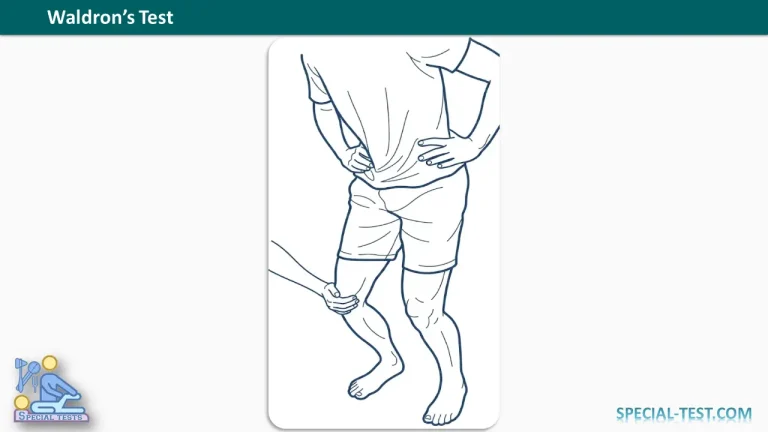
- Palpate the patella. The examiner places a hand over the patella so they can feel its movement and any crepitus.
- Perform knee bends. The patient slowly bends the knees into a partial squat and returns to standing. The examiner stays in contact with the patella throughout.
- Observe and feel. The examiner notes at what point in the range pain appears, whether crepitus is felt, and whether the patella tracks smoothly or deviates.
Slow, controlled movement gives the examiner the best chance of noticing subtle tracking problems or grinding. The test should be done on both knees so the symptomatic side can be compared with the unaffected side.
What Is a Positive Result?
A positive Waldron’s test includes any of the following:
- Pain felt around or behind the patella during the knee bend
- Crepitus, a palpable or audible grinding under the kneecap
- Poor patellar tracking, meaning the kneecap does not glide smoothly in the trochlear groove
A positive result suggests patellofemoral dysfunction and supports a diagnosis of PFPS. It is not a diagnosis on its own.
How Reliable Is Waldron’s Test?
Clinicians should know the limits of patellofemoral special tests. A systematic review in Physiotherapy (2012) looked at the accuracy of clinical tests for PFPS. It found that many studies had design or reporting weaknesses, and that the tests with the best-looking results often came from the lowest-quality studies. The authors concluded that identifying the single best diagnostic test for PFPS remains difficult.
A separate diagnostic accuracy study in Physiotherapy Canada reported that no single physical finding was a perfect diagnostic marker for PFPS. It also found that single findings were not related to disability scores.
Waldron’s test therefore works best as one part of a full knee assessment. A thorough evaluation also includes:
- Patient history and pain pattern (for example, pain with stairs, squatting, or prolonged sitting)
- Patellar mobility and tilt assessment
- Palpation of the patellar facets and surrounding soft tissue
- Muscle strength and flexibility testing
- Other patellofemoral tests, such as the patellar grind test (Clarke’s sign)
For more on related examination techniques, see the knee special test guides on Orthofixar.com.
Key Takeaways
- Waldron’s test screens for patellofemoral pain syndrome (runner’s knee).
- The patient performs slow knee bends while the examiner palpates the patella.
- Pain, crepitus, or poor patellar tracking make the test positive.
- Diagnostic accuracy of individual PFPS tests is limited, so combine the result with history and other findings.
Frequently Asked Questions (FAQ)
What is Waldron’s test used for?
It screens for patellofemoral pain syndrome (runner’s knee) by reproducing pain, crepitus, or abnormal patellar movement during loaded knee flexion.
How do you perform Waldron’s test?
The patient stands while the examiner palpates the patella. The patient then performs slow knee bends while the examiner feels for pain, grinding, and tracking problems.
What does a positive Waldron’s test mean?
Pain, crepitus, or poor patellar tracking during the knee bend. It suggests patellofemoral dysfunction but does not confirm a diagnosis by itself.
Is Waldron’s test enough to diagnose runner’s knee?
No. Research shows that individual clinical tests for PFPS have limited diagnostic accuracy, so clinicians combine the test with history, other special tests, and functional assessment.
What is the difference between Waldron’s test and Clarke’s test?
Waldron’s test is a standing, functional test using knee bends. Clarke’s test (patellar grind test) is done with the patient lying down, with the examiner pressing the patella while the patient contracts the quadriceps.
Can Waldron’s test detect chondromalacia patellae?
Crepitus and pain with knee flexion can point toward patellofemoral cartilage problems. The test cannot confirm chondromalacia, which needs a full clinical evaluation and sometimes imaging.
When should I see a doctor for knee pain?
See a healthcare professional if anterior knee pain lasts more than a few weeks, limits daily activity, comes with swelling or locking, or follows an injury.
References
- Cook C, Mabry L, Reiman MP, Hegedus EJ. Best tests/clinical findings for screening and diagnosis of patellofemoral pain syndrome: a systematic review. Physiotherapy. 2012;98(2):93-100. doi:10.1016/j.physio.2011.09.001. PubMed 22507358
- Cook C, Hegedus E, Hawkins R, Scovell F, Wyland D. Diagnostic accuracy and association to disability of clinical test findings associated with patellofemoral pain syndrome. Physiother Can. 2010;62(1):17-24. doi:10.3138/physio.62.1.17. PMC2841549
- Dutton M. Dutton’s Orthopaedic Examination, Evaluation, and Intervention, 3rd ed. (original source of the test description).
- Orthofixar.com: knee special test guides.