Swain Test of the Knee: Purpose, Steps & Positive Findings
What Is the Swain Test?
The Swain test is a clinical special test used in knee examination. Clinicians use it to assess the integrity of the medial collateral ligament (MCL) complex, the band of tissue on the inner side of the knee that connects the femur to the tibia and keeps the joint stable against sideways and rotational stress.
The MCL is one of the most commonly injured ligaments of the knee. Injuries often follow a blow to the outer knee, a twisting movement, or a sudden change of direction in sport. Because the MCL complex includes the superficial MCL, the deep MCL and the posteromedial structures, a single test rarely tells the whole story. That is why the Swain test is normally used alongside other tests, such as the valgus stress test.
What Is the Swain Test Used For?
The Swain test is used to:
- Check the integrity of the MCL complex
- Provoke symptoms from the posteromedial structures of the knee
- Support the clinical picture when a patient reports medial knee pain after trauma or rotation
How to Perform the Swain Test: Step by Step
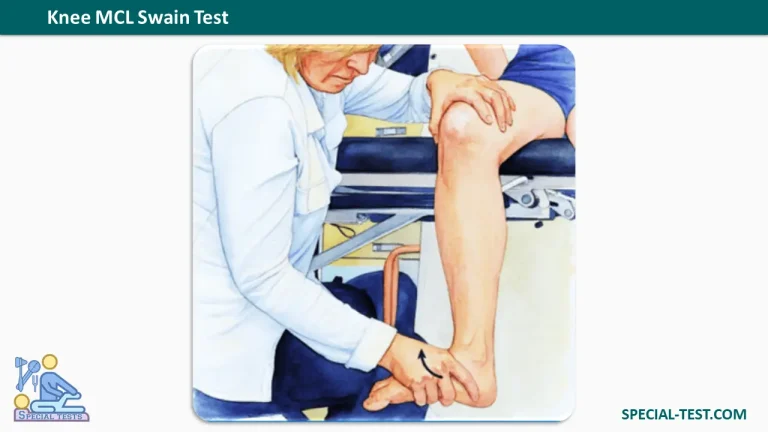
- Position the patient. The patient sits on the examining table with both knees flexed to 90°, legs hanging freely over the edge.
- Test the uninjured leg first. The examiner passively applies lateral (external) rotation of the tibia on the femur in the healthy leg. This gives you a baseline for that patient’s normal response.
- Repeat on the injured leg. Perform the same movement, with the same speed and pressure, on the painful knee.
- Compare both sides. On the healthy side, the movement should be smooth and pain-free. The diagnostic value comes from comparing the injured knee with the patient’s own normal baseline.
Practical tips:
- Keep the movement slow and controlled, and stop if the patient reports sharp pain.
- Make sure the thigh stays relaxed and the legs can hang freely, since muscle guarding can mask or exaggerate findings.
- Always test the uninjured side first. Normal rotation and sensitivity vary between people.
What Is a Positive Swain Test?
The test is considered positive when the patient reports:
- Pain along the medial joint line, or
- Localized tenderness at the MCL or posteromedial structures
A positive result suggests involvement of the MCL complex. It does not by itself grade the injury or rule out other problems, such as meniscal or cruciate ligament injury, which can occur together with MCL damage.
Why Combining Tests Matters
Research supports using several findings together rather than relying on one test. A prospective study of 134 patients with traumatic knee injury, published in The American Journal of Medicine and indexed on PubMed, compared history and physical examination findings with MRI. Of those patients, 35 had an MCL lesion on MRI. Individual findings, such as pain on valgus stress at 30°, had modest diagnostic value on their own. Combining history with pain and laxity on valgus stress at 30° raised the positive likelihood ratio to 6.4. Specific tests like the Swain test are most useful when interpreted together with the injury history and other examination findings.
Frequently Asked Questions (FAQ)
What is the Swain test used for?
It assesses the integrity of the medial collateral ligament (MCL) complex of the knee.
Is the Swain test painful?
It should not be painful on the healthy knee. Pain on the injured side is the finding the examiner is looking for, so the movement should always be gentle.
Why is the uninjured leg tested first?
It sets a personal baseline. Comparing the injured knee with the patient’s own healthy knee is what gives the test its diagnostic value.
What position is the patient in?
Sitting on the examining table with knees flexed to 90° and legs hanging freely over the edge.
What does a positive Swain test mean?
Pain along the medial joint line or localized tenderness at the MCL or posteromedial structures suggests MCL complex involvement.
Can the Swain test diagnose an MCL tear on its own?
No. It is one part of the knee examination. Diagnosis usually combines the injury history, other tests such as the valgus stress test, and sometimes MRI.
Can I do the Swain test on myself?
It is designed to be done by a trained examiner who can control the tibial rotation and compare both sides. If you suspect a knee injury, see a clinician.
What other conditions can cause medial knee pain?
Medial meniscus injury, anterior cruciate ligament injury, a medial knee contusion and joint degeneration can all cause similar pain.
Sources
- Kastelein M, et al. Assessing medial collateral ligament knee lesions in general practice. Am J Med. 2008;121(11):982-988 (PubMed).