Slocum Test of the Knee: Purpose, Technique, and Interpretation
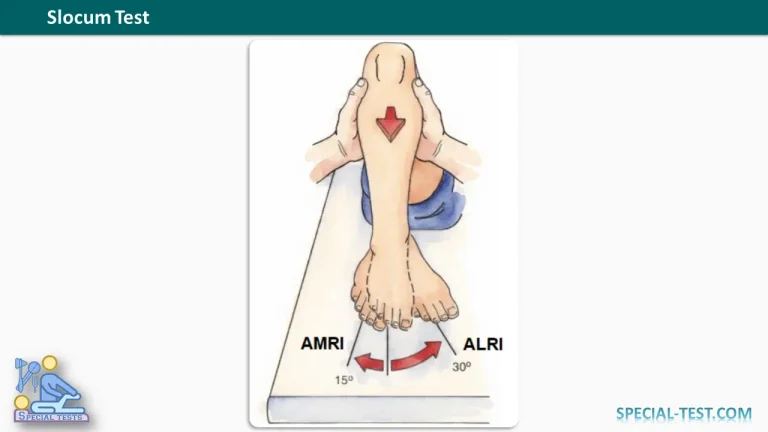
The Slocum test is a clinical examination for rotatory knee instability. It is an anterior drawer test performed with the foot in different rotations. Slocum and colleagues first described it in 1976 in Clinical Orthopaedics and Related Research (indexed in PubMed) as a clinical test for anterolateral rotary instability. Clinicians still use it to judge how much the knee’s ligaments and capsule contribute to rotational stability after injury.
What Is the Slocum Test Used For?
The test helps clinicians:
- Detect anterior rotary instability of the knee. This is abnormal forward movement of the tibia relative to the femur, combined with rotation.
- Differentiate anterolateral rotary instability (ALRI) from anteromedial rotary instability (AMRI). The foot position and the side of the knee where the tibia moves most point to the injured structures.
The test is one part of a full knee exam. It is normally paired with the Lachman test, the pivot shift test, and the standard anterior and posterior drawer tests.
How to Perform the Slocum Test
- The patient lies on their back (supine).
- The knee is flexed to about 80–90 degrees and the hip to about 45 degrees.
- The examiner stabilizes the foot by sitting gently on the forefoot.
- The examiner positions the foot in a set amount of rotation, depending on which pattern is being tested, and pulls the proximal tibia forward.
- The examiner compares the movement with the opposite, uninjured knee.
Comparing with the healthy side matters because normal laxity varies from person to person.
Slocum Test for Anterolateral Rotary Instability (ALRI)
- Rotate the foot about 30 degrees medially (internal rotation) and hold it firmly.
- Apply an anterior force to the proximal tibia.
- The test is positive when excessive forward movement occurs mainly on the lateral side of the knee and exceeds that of the uninjured knee.
A positive ALRI result may point to injury of one or more of these structures:
- Anterior cruciate ligament (ACL)
- Posterolateral capsule
- Arcuate–popliteus complex
- Lateral collateral ligament (LCL)
- Posterior cruciate ligament (PCL)
- Iliotibial band (IT band)
Slocum Test for Anteromedial Rotary Instability (AMRI)
This version is also called Lemaire’s T drawer test.
- Rotate the foot about 15 degrees laterally (external rotation).
- Apply an anterior force to the tibia.
- The test is positive when excessive forward movement occurs mainly on the medial side of the knee, more than on the unaffected side.
A positive AMRI result may indicate injury to:
- Medial collateral ligament (MCL), particularly the superficial fibers
- Posterior oblique ligament
- Posteromedial capsule
- Anterior cruciate ligament (ACL)
Limitations and Clinical Perspective
The Slocum test should never be read in isolation. Research on rotatory instability exams has found that a positive result does not always mean the same injury pattern. A Korean study comparing physical exam findings with surgical findings in 101 knees reported that the Slocum test could be negative, or positive only in neutral rotation, in isolated ACL tears. The Lachman test was positive in all ACL-torn knees in that series.
Physiotutors also notes that a related side-lying version of the Slocum test, a modification of the pivot shift, has not been included in diagnostic accuracy studies. Its clinical value therefore remains questionable.
In practice, clinicians combine the Slocum test with:
- The Lachman test and pivot shift test for ACL integrity
- Valgus and varus stress tests for collateral ligaments
- The posterior drawer test for the PCL
- MRI when the exam is unclear or multiple structures may be involved
Pain, swelling, muscle guarding, and examiner experience can all affect results, so an exam under anesthesia is sometimes more reliable in acute injuries.
Frequently Asked Questions (FAQ)
What is the Slocum test used for?
It evaluates anterior rotary instability of the knee and helps distinguish anterolateral from anteromedial instability.
What does a positive Slocum test mean?
Excessive forward tibial movement compared with the uninjured knee. With the foot internally rotated, movement on the lateral side suggests ALRI. With the foot externally rotated, movement on the medial side suggests AMRI.
Is the Slocum test the same as the Lemaire T drawer test?
The AMRI version of the Slocum test, with the foot externally rotated about 15 degrees, is also called Lemaire’s T drawer test.
Which ligaments can be injured with a positive ALRI test?
The ACL, posterolateral capsule, arcuate–popliteus complex, LCL, PCL, and IT band.
Which structures are involved in a positive AMRI test?
The superficial MCL, posterior oblique ligament, posteromedial capsule, and ACL.
Can the Slocum test diagnose an ACL tear on its own?
No. It can be negative in isolated ACL tears, so it is combined with the Lachman test, pivot shift test, and often MRI.
Is the Slocum test painful?
It is usually well tolerated, but it can be uncomfortable in an acutely injured, swollen knee. The examiner may delay or modify it if pain or guarding is significant.
Can I perform the Slocum test on myself?
No. It needs a trained examiner to control foot position, apply a consistent force, and interpret the findings.
References
- Slocum DB, James SL, Larson RL, Singer KM. Clinical test for anterolateral rotary instability of the knee. Clin Orthop Relat Res. 1976 (indexed on PubMed).
- Physiotutors, Slocum Test | Anterolateral Rotatory Instability (knee assessment wiki).
- Korean Med synapse record on physical examination versus operative findings in rotatory knee instability (101 knees).