Popliteal Angle Test: How to Perform It, Normal Values and Interpretation
What Is the Popliteal Angle Test Used For?
The popliteal angle test is a simple bedside examination used to assess hamstring tightness and hamstring contracture. It is most commonly used in children with cerebral palsy (CP), where hamstring shortening is a frequent finding. Because it needs no equipment beyond a goniometer, it is a routine part of the orthopedic and physiotherapy examination of children with spasticity.
Clinicians use the popliteal angle to document how much the hamstrings limit knee extension when the hip is flexed. Repeating the measurement over time helps track changes in muscle tightness during growth, therapy, or after treatment.
How to Perform the Popliteal Angle Test
The test is done in the supine position and takes only a few minutes:
- Position the child. The child lies supine on the examination table.
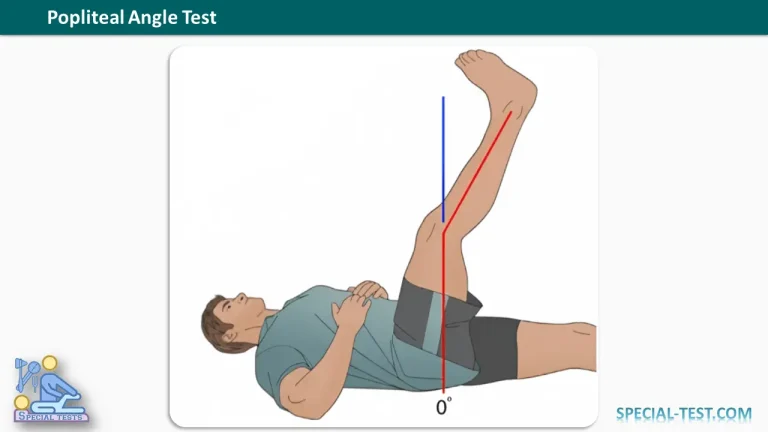
- Flex the hip. The examiner flexes the hip to 90°. The opposite (contralateral) hip stays in neutral position.
- Extend the knee. With the hip held at 90°, the examiner gradually extends the knee.
- Identify the endpoint. When the examiner feels substantial resistance to knee extension, the movement is stopped.
- Measure the angle. The acute angle between the long axis of the femur and the long axis of the tibia is measured, usually with a goniometer.
Keeping the contralateral hip in neutral and the hip fixed at 90° helps isolate hamstring length. Consistent positioning and a consistent definition of “substantial resistance” matter for reproducible results.
Normal Values of the Popliteal Angle
Normal values change with age, so interpretation should always take the child’s age into account:
| Age | Mean popliteal angle | Range |
|---|---|---|
| 1 to 3 years | 6° | 0–15° |
| 4 years | 17° in girls, 27° in boys | 5–45° |
| 5 years and older | 26° (little change with age) | 0–50° |
Positive Result: When Is the Popliteal Angle Abnormal?
A popliteal angle greater than 50° in the age groups above indicates abnormal hamstring tightness. The higher the angle, the less the knee can extend with the hip flexed, and the more severe the hamstring contracture.
How Accurate Is the Popliteal Angle Test?
The popliteal angle is widely used, but it has limitations. A study by Ten Berge and colleagues published in the Journal of Pediatric Orthopaedics examined the reliability of popliteal angle measurement in children with cerebral palsy and healthy controls (PubMed ID: 17717465). Because of the poor interobserver reliability of the measurement, the popliteal angle should not be the only variable used in clinical decision making in patients with CP.
In practice, it should be combined with the clinical history, gait analysis, other physical examination findings, and the judgment of the treating team. Using the same examiner and the same technique at each visit also improves reliability.
Key Takeaways
- The popliteal angle test assesses hamstring contracture, mainly in children with cerebral palsy.
- The hip is flexed to 90° and the knee is extended until firm resistance is felt.
- Normal values vary with age, and an angle over 50° suggests abnormal tightness.
- Interobserver reliability is limited, so the test should never be used alone for decisions.
Frequently Asked Questions (FAQ)
1. What does the popliteal angle test measure?
It measures hamstring length by determining how far the knee can be extended when the hip is flexed to 90°. A larger angle means tighter hamstrings.
2. Who should have a popliteal angle test?
It is used most often in children with cerebral palsy, where hamstring contracture is common. It can also be used to assess hamstring tightness in other patients.
3. What is a normal popliteal angle in children?
Between 1 and 3 years the mean is about 6° (range 0–15°). At 4 years it is about 17° in girls and 27° in boys. From 5 years on, the mean is about 26° (range 0–50°).
4. What popliteal angle is considered abnormal?
An angle greater than 50° in the age groups above indicates abnormal hamstring tightness.
5. Is the popliteal angle test reliable?
Interobserver reliability is poor, so results can differ between examiners. For this reason, it should not be the only measure used for clinical decisions in children with cerebral palsy.
6. Why is the opposite hip kept in neutral position?
Keeping the contralateral hip neutral and the tested hip at 90° standardizes the position and isolates hamstring length, which improves consistency.
7. How can I improve the consistency of my measurements?
Use the same examiner, patient position, and endpoint criteria at every visit, and record the measurement with a goniometer.
References
- Popliteal Angle Test – Orthofixar
- Ten Berge SR, Halbertsma JP, Maathuis PG, Verheij NP, Dijkstra PU, Maathuis KG. Reliability of popliteal angle measurement: a study in cerebral palsy patients and healthy controls. J Pediatr Orthop. 2007 Sep;27(6):648-52. doi: 10.1097/BPO.0b013e3180dca15d. PMID: 17717465.