Patellofemoral Grind Test: How to Perform & Interpret Results
What Is the Patellofemoral Grind Test Used For?
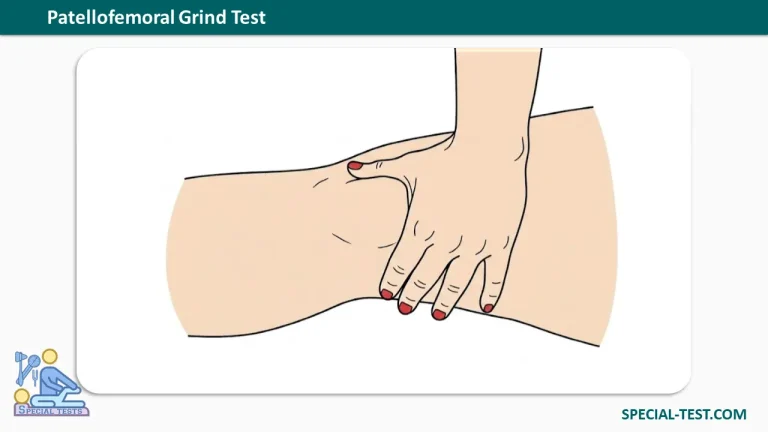
The patellofemoral grind test, also called the patellar grind test, Clarke’s sign, or the Osmond-Clarke test, is a physical examination maneuver. Clinicians use it to evaluate people with pain at the front of the knee. It is mainly used to screen for patellofemoral pain syndrome (PFPS), often described under the older label chondromalacia patellae. The test may also be used when patellofemoral arthritis is suspected.
The test works by pressing the kneecap (patella) against the thigh bone (femur) while the quadriceps contracts. If the cartilage under the kneecap is irritated, this compression can reproduce the patient’s familiar pain.
How to Perform the Patellofemoral Grind Test
The test is quick and needs no equipment. Here is the standard technique:
- Position the patient. The patient lies supine (on their back) with both knees fully extended and the quadriceps relaxed.
- Compress the patella. The examiner presses the patella backward onto the femoral condyles, then moves it gently downward (distally) in the trochlear groove.
- Ask for a quadriceps contraction. While compression is maintained, the patient tightens the thigh muscle, as if pulling the kneecap upward (proximally).
- Observe and compare. The examiner notes pain, grinding, or hesitation, and compares the painful knee with the other side.
Apply pressure gradually. An abrupt or forceful push can cause discomfort even in a healthy knee.
What Is a Positive Result?
A positive test reproduces the patient’s symptoms. Findings include:
- Pain behind or around the kneecap
- Crepitus, a grinding or crunching sensation
- Apprehension, meaning the patient guards or resists as the irritated surfaces of the patella rub over the femur
A negative test produces no pain or grinding beyond mild pressure.
How Accurate Is the Test?
Clinicians should know the limits of this test. A study in the Journal of Athletic Training (Doberstein et al., 2008) compared Clarke’s sign against arthroscopic findings. It reported sensitivity of about 0.39 and specificity of about 0.67, and the authors concluded the diagnostic value was poor. Research on clinical tests for patellofemoral pain (Nijs et al., 2006, Manual Therapy) has likewise questioned how well individual tests perform on their own.
In practice, the test can produce discomfort even in people without knee problems. A positive result is therefore best read as one piece of evidence rather than a diagnosis.
Using the Test in a Full Knee Assessment
Clinicians usually pair the grind test with other findings:
- Patient history, such as pain on stairs, squatting, or prolonged sitting
- Palpation around the patella
- Patellar tilt, glide, and apprehension tests
- Functional tests such as a single-leg squat or step-down
- Imaging when the presentation is unclear or symptoms are persistent
If you have knee pain, see a qualified healthcare professional. This article is for education and does not replace a clinical evaluation.
Frequently Asked Questions (FAQ)
What is the patellofemoral grind test used for?
It helps screen for patellofemoral pain syndrome (chondromalacia patellae) by testing whether compressing the kneecap against the femur reproduces pain.
Is the patellar grind test the same as Clarke’s sign?
Yes. Patellar grind test, Clarke’s sign, Clarke’s test, and Osmond-Clarke test all refer to the same maneuver.
Does a positive test confirm chondromalacia patellae?
No. A positive result suggests patellofemoral involvement, but diagnostic accuracy is limited. Diagnosis needs history, a wider exam, and sometimes imaging.
Can the test be painful in healthy people?
Yes. Gentle patellar compression can cause mild discomfort even in healthy knees, so findings should be interpreted in context.
Does the test hurt?
It may reproduce your familiar knee pain, but it should be done gradually. Tell your clinician if the pain becomes sharp or severe.
What tests are used with it?
Common companions are the patellar tilt, patellar glide, and patellar apprehension tests, plus functional movement testing.
Can I do it on myself at home?
Self-testing is not reliable. Persistent front-of-knee pain, swelling, locking, or giving way should be assessed by a physician or physiotherapist.
References
- Doberstein ST, Romeyn RL, Reineke DM. The diagnostic value of the Clarke sign in assessing chondromalacia patella. J Athl Train. 2008;43(2):190–196. PubMed 18345345
- Nijs J, Van Geel C, Van der Auwera C, Van de Velde B. Diagnostic value of five clinical tests in patellofemoral pain syndrome. Man Ther. 2006;11(1):69–77. PubMed 15950517
- OrthoFixar. Patellar Grind Test (Clarke Sign). orthofixar.com
- Dutton M. Dutton’s Orthopaedic Examination, Evaluation, and Intervention. 3rd ed.