Lemaire Jolt Test: Purpose, Technique, and Interpretation
What Is the Lemaire Jolt Test Used For?
The Lemaire jolt test is a physical examination maneuver that assesses anterolateral rotatory instability (ALRI) of the knee. Clinicians most often use it when they suspect an anterior cruciate ligament (ACL) deficiency or an injury to the anterolateral complex of the knee. It is closely related to the pivot shift test and is one of several dynamic tests used to check rotational stability, which a simple Lachman or anterior drawer test may not fully show.
Rotational instability matters because an athlete may report the knee “giving way” during pivoting, cutting, or sudden deceleration. The Lemaire jolt test helps reproduce that sensation under controlled conditions so the examiner can recognize it.
Why Anterolateral Rotatory Instability Matters
The knee depends on the ACL and on the structures of its anterolateral side to control tibial rotation and forward translation. When these structures are injured, the tibia can subluxate forward relative to the femur during movement. Over time, repeated episodes of instability can stress the menisci and cartilage. Identifying rotatory instability early gives surgeons and sports medicine physicians a more complete picture of the injury than a straight-plane exam alone.
How to Perform the Lemaire Jolt Test
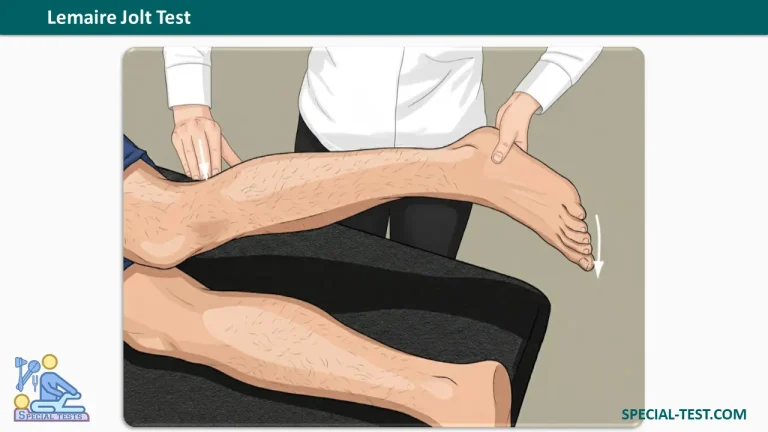
Technique and patient relaxation both affect how reliable the test is. The standard steps are:
- Position the patient. The patient lies on their side with the knee being tested on top.
- Make sure the patient is relaxed. Muscle guarding can hide the instability, so the test works only when the patient is relaxed.
- Rotate the tibia. With one hand, the examiner grasps the foot and medially (internally) rotates the tibia while the knee is in extension.
- Apply lateral pressure. The back of the other hand pushes lightly against the biceps femoris tendon and the head of the fibula.
- Move the knee. While maintaining this pressure and rotation, the hand on the foot flexes and extends the knee.
The examiner watches and feels for a sudden shift as the knee moves through the early range of flexion.
What Is a Positive Result?
A test is positive when, at approximately 15° to 20° of knee flexion, a distinct “jolt” occurs as the tibia displaces. This sudden shift indicates anterolateral instability. The jolt reflects the tibial plateau subluxating and then reducing as the knee moves, which is the same abnormal motion patients feel during giving-way episodes.
A negative test does not completely exclude injury, since pain, guarding, or a stiff knee can mask the finding. Results should always be interpreted alongside the patient’s history, other stability tests such as the Lachman test, and imaging when needed.
Clinical Takeaways
- The Lemaire jolt test targets rotatory instability, not just straight anterior laxity.
- A relaxed patient and a consistent technique are essential.
- The characteristic finding is a jolt at roughly 15° to 20° of flexion.
- It supports, but does not replace, a full knee examination and appropriate imaging.
Sources and further reading: Orthofixar.com (clinical orthopedic test resources) and PubMed-indexed literature on ACL injury, the pivot shift phenomenon, and the anterolateral complex of the knee. Before publishing, please check the exact article links and add them as citations. I haven’t pulled live URLs for this rewrite.
Frequently Asked Questions (FAQ)
What is the Lemaire jolt test?
It is a clinical knee examination used to detect anterolateral rotatory instability, most commonly linked to ACL deficiency and anterolateral complex injury.
What does a positive Lemaire jolt test mean?
A positive result is a “jolt” with tibial displacement at about 15° to 20° of flexion. It indicates anterolateral instability of the knee.
How is the Lemaire jolt test different from the pivot shift test?
Both assess rotatory instability of the ACL-deficient knee. The Lemaire jolt test is performed with the patient side-lying, with the examiner internally rotating the tibia and applying pressure near the fibular head while moving the knee between flexion and extension.
Why must the patient be relaxed during the test?
Muscle tension can prevent the tibia from shifting, which may hide a true instability and cause a false negative.
Can a negative Lemaire jolt test rule out an ACL injury?
Not by itself. Pain, guarding, or technique can affect the result, so clinicians combine it with history, other exam tests, and imaging such as MRI.
Who should perform the Lemaire jolt test?
It should be performed by a trained clinician such as an orthopedic surgeon, sports medicine physician, or physiotherapist.
Does a positive test always mean surgery is needed?
No. Treatment decisions depend on symptoms, activity level, associated injuries, and overall clinical findings, and they are made by the treating clinician.