Knee Varus Test: Purpose, Steps, Positive Findings & Grading
What Is the Knee Varus Test Used For?
The knee varus test, also called the varus stress test, is a clinical orthopedic examination used to assess the integrity of the lateral collateral ligament (LCL). The LCL runs along the outer side of the knee and resists forces that push the knee outward (varus stress). When the ligament is sprained or torn, the lateral joint line can open abnormally under stress.
Clinicians use the test in acute knee injury assessments, sports medicine evaluations, and post-traumatic follow-ups. It is usually paired with the valgus stress test, which assesses the medial collateral ligament (MCL), so that both sides of the knee are compared systematically. A thorough history and physical examination remain the foundation of acute knee injury diagnosis (Smith & Green, American Family Physician, 1995).
How to Perform the Knee Varus Test
Perform the test on both knees and compare the injured side with the uninjured side.
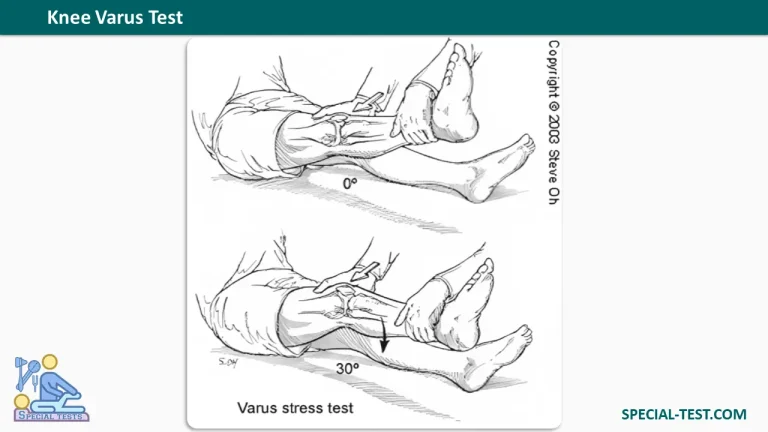
- Position the patient. The patient lies supine and relaxed, with the affected knee in full extension.
- Stabilize the leg. Hold the affected leg in slight external rotation, with one hand on the lateral malleolus (outer ankle).
- Place the stress hand. Place your other hand on the medial (inner) aspect of the knee.
- Apply varus stress. Apply a laterally directed force, a varus stress, through the medial knee while the ankle is held steady.
- Repeat at 30 degrees of flexion. Flex the knee to about 30 degrees and apply the same stress. Flexion relaxes the posterior capsule and other secondary stabilizers, which isolates the LCL.
Testing in both full extension and 30 degrees of flexion is important. Laxity that appears only at 30 degrees points toward an isolated LCL injury. Laxity that also appears in full extension suggests damage to additional structures, such as the posterolateral corner or a cruciate ligament, and warrants further workup.
What Is a Positive Result?
A positive test is the presence of pain and hypermobility (increased joint opening) at the lateral aspect of the knee compared with the opposite knee. Pain without increased opening can still suggest a lower-grade sprain, so always interpret findings alongside the mechanism of injury, swelling, and other special tests.
Grading Varus and Valgus Laxity
Collateral ligament laxity is commonly graded by how much the joint space opens compared with the contralateral knee:
- Grade I: Joint space opening is within 2 mm of the opposite side.
- Grade II: The joint opens 3–5 mm more than the opposite side at 20 degrees of flexion, and less than 2 mm more than the normal knee in full extension.
- Grade III: The joint opens 5–10 mm more than the normal knee at 20 degrees of flexion and in full extension.
Grading thresholds vary slightly between textbooks and classification systems, so confirm the system your clinic or institution uses. A firm versus soft endpoint during the test also adds useful information about ligament continuity.
Clinical Tips for Accuracy
- Test the uninjured knee first so the patient knows what to expect and you have a baseline.
- Keep the patient relaxed. Hamstring or quadriceps guarding can mask laxity.
- Use consistent hand placement and gradual force.
- Combine the varus test with other tests and imaging (such as MRI or stress radiographs) when a multi-ligament injury is suspected.
FAQ: Knee Varus Test
What does the knee varus test check?
It checks the integrity of the lateral collateral ligament (LCL) on the outer side of the knee.
What is a positive knee varus test?
A positive test shows pain and increased opening (hypermobility) at the lateral knee compared with the other side.
Why is the knee tested at 30 degrees of flexion?
At about 30 degrees, the secondary stabilizers are relaxed, so the LCL bears most of the stress. This isolates the ligament.
What does laxity in full extension mean?
Laxity in full extension suggests injury beyond the LCL, such as the posterolateral corner or a cruciate ligament, and needs further evaluation.
How is LCL laxity graded?
Grading compares joint opening with the opposite knee. Grade I is mild opening, Grade II is moderate, and Grade III is the largest opening, indicating a complete tear.
What is the difference between the varus and valgus stress tests?
The varus test stresses the LCL on the outer knee, while the valgus test stresses the MCL on the inner knee.
Can the test be done on its own?
It is best used with a full history, other knee special tests, and imaging when needed, since multi-ligament injuries are common.
Should I see a doctor for lateral knee pain or instability?
Yes. Persistent pain, swelling, or giving way after an injury should be evaluated by a qualified healthcare professional.
References
- Varus Test of the Knee | Orthofixar
- Smith BW, Green GA. Acute knee injuries: part I. History and physical examination. Am Fam Physician. 1995;51:617.
- Clinical Tests for the Musculoskeletal System, Third Edition.