Knee Pivot Shift Test: Technique, Positive Result & Accuracy
What Is the Knee Pivot Shift Test?
The knee pivot shift test is a special orthopedic test that helps clinicians assess rotatory instability of the knee, most often caused by a torn anterior cruciate ligament (ACL). The ACL keeps the tibia (shinbone) from sliding too far forward and controls rotation of the knee during cutting, pivoting, and landing. When the ligament is torn, the knee can shift or “give way” during these movements.
Unlike tests that check only forward translation of the tibia, the pivot shift reproduces the combined rotation and translation that patients feel as giving way. That is why it is considered one of the most functionally relevant tests for ACL deficiency.
What Is the Pivot Shift Test Used For?
Clinicians use the pivot shift test to:
- Diagnose rotatory instability associated with an ACL tear
- Reproduce the giving-way event athletes describe after an ACL injury
- Support the overall physical examination alongside other ACL tests
How Is the Knee Pivot Shift Test Performed?
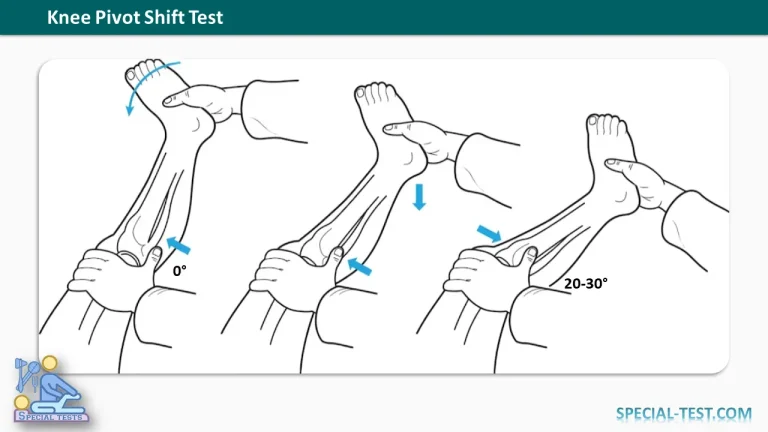
The patient lies on their back with the leg relaxed. The examiner then:
- Holds the leg and starts with the knee in full extension (0°).
- Applies an internal rotation stress to the tibia.
- Applies a valgus stress (an inward force) to the knee.
- Slowly flexes the knee from 0° to about 90° while maintaining both stresses.
Muscle relaxation matters. If the patient tenses their hamstrings or quadriceps, the movement can be masked and the test becomes harder to interpret.
What Is a Positive Pivot Shift Result?
A positive test shows a sudden shift or “clunk” at roughly 20°–30° of knee flexion. At this point the tibia, which sits subluxated (partly displaced) forward in an ACL-deficient knee, reduces rapidly under the femoral condyles.
This sensation mirrors what happens when the knee gives way in daily life or sport, so a positive result strongly suggests ACL rupture with rotatory instability.
How Accurate Is the Pivot Shift Test?
According to the data summarized in a PubMed-indexed analysis:
| Measure | Value |
|---|---|
| Sensitivity | 24% |
| Specificity | 98% |
What this means in practice:
- High specificity (98%): If the pivot shift is positive, an ACL tear is very likely. Few people without an ACL injury will test positive.
- Low sensitivity (24%): A negative test does not rule out an ACL tear. Many patients with a torn ACL will still test negative, often because pain, swelling, or muscle guarding prevents the shift from occurring when the patient is awake.
For this reason, the pivot shift is best used together with other tests (such as the Lachman test and anterior drawer test), the patient’s history, and imaging such as MRI when needed. A diagnosis should always come from a qualified healthcare professional.
Key Takeaways
- The pivot shift test evaluates rotatory instability linked to ACL injury.
- It combines internal tibial rotation, valgus stress, and knee flexion from 0° to 90°.
- A positive result is a sudden shift at 20°–30° of flexion.
- It is highly specific (98%) but not very sensitive (24%), so a negative result does not exclude an ACL tear.
Frequently Asked Questions (FAQ)
1. What does the pivot shift test diagnose?
It helps diagnose rotatory instability of the knee caused by an ACL tear.
2. Is the pivot shift test painful?
It can be uncomfortable, especially after a recent injury when the knee is swollen or tender. Pain and guarding can also make the test less reliable.
3. What does a positive pivot shift test feel like?
The examiner feels, and the patient may sense, a sudden shift or clunk around 20°–30° of flexion as the tibia reduces. Patients often describe it as similar to their knee “giving way.”
4. Why is the sensitivity of the pivot shift test so low?
In awake patients, pain, swelling, and muscle tension can stop the knee from shifting during the exam, so some ACL tears go undetected. The reported sensitivity is 24%.
5. If my pivot shift test is negative, can I still have an ACL tear?
Yes. Because sensitivity is low, a negative result does not rule out an ACL injury. Other tests and MRI are commonly used for confirmation.
6. Is the pivot shift test enough to diagnose an ACL tear?
Its high specificity (98%) makes a positive result very meaningful, but diagnosis normally relies on the full clinical picture, including history, other physical tests, and often imaging.
7. Can I perform the pivot shift test on myself?
No. It requires proper technique and a relaxed patient, and it should be performed by a trained clinician.
References